


Due to its position in the central west of Crete, there are some amazing day trips from Rethymno. We stayed in the city for two months and found that we could cover a huge amount of ground from there, from the famous beaches of the Crete west coast to capital Heraklion, and even further east.
In this guide, I’ll show you my pick of the best Rethymno day trips. I’ll advise you on what to see at each destination, and cover the practicalities of getting to each, whether by bus, car or on a tour.
I hope you find it helpful.
Where To Stay In Rethymno
***** – Kyma Suites Beach Hotel – luxury 5-star overlooking Rethymno Harbour, and very close to the Old Town
**** – Palazzino di Corina – beautiful boutique hotel in small Venetian palace in the Old Town
**** – Avli Lounge Apartments – stunning restored Venetian nobleman’s house with renowned in-house restaurant
*** – Steris Elegant Beach Hotel – modern beachfront hotel a 10-minute walk from the Old Town
Day Trips From Rethymno – East of Rethymno
Arkadi Monastery

Arkadi Monastery is one of the most popular day trips from Rethymno, one of the most fascinating churches in Crete and scene of a terrible tragedy just after the outbreak of the 1866 Cretan Revolt against Ottoman Turkish rule.
The date of the foundation of the Monastery is unknown, but we do know that the present honey-coloured church was built during Venetian rule in the late 16th century. It replaced an earlier church, and guesswork suggests the Monastery may be centuries older.


Soon after the beginning of the Revolt, a force of 259 Cretan rebels took refuge in the fortified monastery along with hundreds of women and children. They held out heroically against overwhelming force, an Ottoman army of 15,000 men and 30 cannons, with reinforcements.
Eventually the Ottoman force overpowered the rebels, and one of the rebel leaders barricaded himself and the surviving women and children in the gunpowder store, blowing it up and killing everyone inside. They decided on this fate rather than face capture by the Turkish army.
News of this spread quickly around the world thanks to the recently invented telegraph, and worldwide public opinion was largely on the Cretans’ side. Not that this made any difference – the Revolt was eventually defeated, and the Turks continued to occupy Crete until withdrawal under the terms of the Treaty of Constantinople in 1898.
Getting there: Regular minibuses run from Rethymno bus station to Arkadi, taking 40 minutes. Otherwise it’s around a 30-minute drive.
Tours: Regular day tours also run to Arkadi Monastery from Rethymno. This Arkadi tour from Rethymno follows a typical itinerary, also visiting picturesque Margarites village and nearby Melidoni Cave.
Margarites Village

Margarites is one of the most popular Rethymno tour stops, a beautiful little village six miles inland (as the crow flies from the coast at Geropotamos.
It has survived the passage of time better than many villages around the island, its church (with superb 14th-century frescoes) worth the visit alone. Many older houses have survived, as have details including doorways from the Venetian period.
Margarites is best-known as the ‘pottery village’, with a long tradition of ceramic production in the village. There are numerous studios and ateliers with attached shops, and I’ve not seen anywhere better for beautiful Cretan plates or bowls for your dining or living room.
Melidoni Cave

Melidoni Cave is a 10 km (6 mile) drive along winding hilly roads from Margarites, or a short drive south off the E90 main road between Panormos and Bali.
The caves are spectacular, a series of chambers with amazing stalagmite and stalactite formations. Some of the caves were used for religious purposes as far back as the Minoan period.
Like Arkadi, the Melidoni Cave is of great significance in Cretan and Greek history because of a rebellion there. In October 1823, towards the end of the Greek War of Independence, 30 soldiers and 370 women and children hid in the cave complex from the local Ottoman military commander. Three months later, they filled the cave entrance with combustible items and set it on fire, killing everyone inside. Their bones are kept in an ossuary ion the central chamber of the cave.
Spilies and Geropotamos Beaches


These two very different beaches are less than a mile apart, and linked by a not very obvious but very scenic coastal walk. They are 10 miles (17 km) east of Rethymno, just off the main E90 road across northern Crete, and both well worth the stop.
If you’re travelling from Rethymno, the first beach you’ll reach is Spilies Beach, which isn’t at all well signposted. There’s a turn on the left side of the road next to the Eko garage, and this road runs through an olive grove for around 400 metres before reaching the car park.
It’s an idyllic pebble beach with outstanding clear water to swim in, and it’s framed by stratified cliffs either side. The beach is fully ‘organised’, with the taverna (very good food) running the sunbed and umbrella concession.


Geropotamos Beach is around a mile further along the coast to the east, with a much larger spread of sand next to the cool waters of a river and lagoon. Between the two beaches lies the dramatic Kamara Sea Arch, one of the most beautiful natural landmarks in Crete. You can reach the viewpoint above it via a footpath that isn’t signposted, and boat trips from the beach also take you for a much closer view.
Geropotamos’ setting is stunning, but it’s not a great beach for kids wanting a swim. There’s a very steep incline in the sand just offshore, meaning that they don’t need to venture far to be up to their necks in the water. So if they want a swim, take them to Spilies or elsewhere.
Getting there: Bus 20 from Rethymno to Panormos and the Rethymno to Heraklion bus stop at the Eko bus stop for Spilies and the Geropotamos bridge stop for the second beach.
Panormos

Panormos is one of the most pleasant villages along the Rethymno north coast. It’s a former fishing village which even in season manages to escape the crowds you get in Rethymno.
It’s a small, quiet village with a few streets, three small beaches and a few tavernas around the harbour. The local old timers sit at tables outside in the shade, enjoying a drink and a smoke outside the kafeneio. You can hear boat trips leaving the harbour from time to time. But life drifts slowly along in this village, and it’s the sort of place you’d come to wind down for a while. Or a quiet lunch overlooking an idyllic harbour.
You may encounter many Panormos hotels and resorts online – most of these are outside the village and along the highway in the direction of Rethymno.
Getting there: The number 20 bus from Rethymno takes you to the centre of the village.
Mili Gorge


The abandoned, atmospheric Mili Gorge is one of the closest day trips to Rethymno, a short bus ride away on the hop-on-hop-off Rethymno City Explorer.
The near-deserted valley was once home to several mills, now long since closed, and the path down the gorge passes their ruins and several whitewashed churches along the way. It’s as if the 20th century, never mind the 21st, ever touched this place, with supplies even hauled across the valley to the café at the top on a winch line.
Don’t attempt the hike (2-3 hours maximum) after rain – give it a few dry days first, as you need to cross back and forth over the river bed a few times.
The hike eventually ends at Cantina Banana, from where you can call a taxi back to Rethymno.
Alternatively, you could visit the Military Museum at Chromonastiri, the next village up the mountain, before backtracking to the start of the Gorge hike.
See Also: Mili Gorge Crete – A Wonderful Hike Near Rethymno
Day Trips from Rethymno – Heraklion Region
Bali


Bali is one of the most pleasant resorts on the north Crete coast, a pretty town with five beautiful beaches well worth a day’s visit, especially towards the shoulder season when you might find a bit more space on the beach.
Like many other places along the north Crete coast, Bali has been ‘discovered’, hence every square millimetre of sand is taken up with sunbeds and umbrellas. I’m more of a coastal wanderer than someone who lies on the beach for an hour, but if I do indulge in an hour’s snooze under the sunshade, I prefer to do so not feeling wedged in like a sardine so someone can make a few extra euros!
That said, I really did enjoy my visit to Bali. It’s picturesque, bright and colourful, and the beaches are generally quite sheltered from the meltemi wind that blows in from the north during the Cretan summer.
The best of the beaches is the furthest from the main road. Karavostasi beach is a glorious sight from either side, particularly from the north with all the mountains in the background. There’s also a great little taverna that does excellent food and ice -cold beer, just what you need on a scorching hot day.
Getting there: The Bethymno to Heraklion bus stops on the edge of Bali village. Cross the road from there to the entrance to the village, where you can also catch the Bali tourist train if you so desire.
Fodele


Fodele, further along the Rethymno to Heraklion main road, is another popular beach resort on the north Crete coast. If you crave some space on the beach, there’s far more of it here than at Bali. There are two beaches at Fodele, separated by a small rocky headland. The western side is partly ‘organised’ by the Fodele Water Park and Resort, with the standard €10 per umbrella and two sunbed package. But there’s plenty of space on the other part of the beach, and on the eastern beach beyond the headland.
Just outside Fodele, there are two sights that draw visitors far and wide. The first is the El Greco Museum, housed in what many believe to be the painter’s birthplace. There’s some dispute as to whether he was born there or in Heraklion, but we do know from his detailed description that it was his childhood home. The small Museum doesn’t hold any of his original artworks but offers a great introduction to his work and life. One of the most intriguing museums in Crete.
Across the road from the Museum is the Byzantine church that El Greco described in detail. It’s around 900 years old and one of the finest surviving Byzantine churches in Crete, well worth a visit. The taverna next to the Museum is also a great place to stop for lunch.
Tour: This El Greco Crete tour visits the Museum and church in Fodele and the nearby Agios Pantelemonias monastery.
Knossos and Heraklion


Heraklion is well within reach of Rethymno as a day trip, a little over 50 miles to the east, and only an hour and a half by bus. You might not get to see everything in one day in Heraklion, but you can cover a lot of ground, including visiting Knossos Palace, the largest of the Minoan civilisation sites in Crete.
Knossos is a 3-mile (5 km) bus ride to the south of Heraklion city centre, and much of the site consists of foundations, along with a few partially reconstructed areas. Some replicas of artworks uncovered there are also on display at the site. If you’re visiting Knossos, it’s worth your while heading there first, as there’s little shade there and it gets extremely hot there by late morning.

Knossos makes a lot more sense if you visit Heraklion Archaeological Museum, in the city centre. This is by far the best museum covering the Minoan civilisation that dominated life on Crete for at least 500 years, from around 2000 BC to 1400 BC. There’s much that we don’t know about them, but their culture was immensely rich and this is the best place in the world to appreciate it.


Heraklion isn’t the prettiest city in Crete, but it has some fascinating sights, from Agios Titos Church – formerly a mosque under Turkish rule – to some excellent museums, including the Historical Museum of Crete and the Natural History Museum of Crete, both close to the waterfront.
Its street market – on Odos 1866 – is also one of the biggest in Crete, and the shops on the lower part of 25 Avgostou are among the best places to find high quality souvenirs of Crete.
See Also: Things to Do In Heraklion
Tours: This Knossos and Heraklion guided tour from Rethymno allows time to explore the Archaeological Museum and the historic centre of Heraklion
Zominthos

Zominthos is one of the six World Heritage-listed Minoan sites in Crete, along with the likes of Knossos and Malia. It’s one of the most remote and least accessible Minoan palace sites, but with a car, you’ll be able to reach this hidden ancient site from Rethymno.
The Zominthos site is unusual in that it is the only mountain palace site on anything like its scale. It’s in an upland area of the Psiloritis massif, the second highest mountain on Crete, and it’s likely that it would only have been used seasonally. During the winter months – November to March – it’s possible that it would have been under snow for much of the time, so the occupants probably would have had to leave it for a few months, returning in springtime in April.
Getting there: The nearest a bus will get you is Anogia, 7 km to the north, but this bus only runs three times daily from Heraklion, not Rethymno. My advice is to drive yourself.
Tours: This Psiloritis 4 x 4 adventure makes a brief 10-minute stop at Zominthos, as well as visiting the villages of Anogia and Kroussonas and Sfendoni Cave. My advice with tour operators is to contact them and ask / persuade them to stop for longer – 30 minutes would be more than enough time there.
Day Trips from Rethymno Further East – Lassithi
Agios Nikolaos


The area around Agios Nikolaos – capital of the island’s eastern Lassithi region – is about as far as you can reasonably reach on a day trip from Rethymno. It’s over an hour’s drive beyond Heraklion, and you’d normally visit Agios Nikolaos in conjunction with one of the other local attractions – usually Elounda or Spinalonga.
Agios Nikolaos has a beautiful setting on the western shore of Mirabello Bay, with wondrous views across to the mountains of the far east of Crete. There are some beautiful Agios Nikolaos beaches in and around the town, and also the gorgeous freshwater Lake Voulismeni just behind the harbour.
Spinalonga


Spinalonga is one of the most popular places to visit in Crete. The Venetians built one of the most formidable castles in Crete on this small island at the entrance to the Gulf of Elounda in the late 16th century. It was constructed to defend their lucrative salt pans near Elounda, and was also one of a trio of fortresses (along with Heraklion and Gramvousa) built to defend the north coast of the island from Ottoman Turkish incursions.
The fortress was never captured, and after falling into disuse the island was used as Greece’s last leper colony until the discovery of an antibiotic cure in the 1950s. Victoria Hislop’s 2005 novel The Island raised awareness of the inhabitants’ plight on the island in appalling conditions, and boat trips now run there from Agios Nikolaos, Elounda and Plaka.
The easiest way to reach Spinalonga from Rethymno is on a guided tour. This Rethymno to Spinalonga tour also includes stops at the Selinari Monastery, Agios Nikolaos and Elounda village, which also has an outstanding beach.
Day Trips From Rethymno – West of Rethymno
Chania


Chania is the most beautiful city in Crete, indeed one of the most beautiful cities in Greece. Crete’s westernmost city is only an hour west of Rethymno, and an easy day trip, with frequent buses making the scenic journey west along the coast.
Like Rethymno, Chania has a lovely Venetian harbour and lighthouse, and a spectacular setting, with views of the White Mountains (Lefka Ora) to the south. Chania Old Town is gorgeous, with Venetian and Ottoman houses side by side with Bronze Age Minoan ruins and Byzantine city walls. I particularly recommend the alleyways around the Splantzia square, where we stayed for our first week in the city, and the hilly district just to the west of the harbour.
There are also several beaches in Chania, mostly to the west of the city centre and harbour, the busiest of which is the closest to the old city walls, Nea Chora. The city is also home to some of the best museums in Crete, including the Archaeological Museum, the Maritime Museum of Crete and the Museum of the Greek National Football Team. Add in one of the best fresh food markets in Crete and here’s somewhere you may well find yourself returning for a longer stay.
See Also: Things To Do In Chania
Tours: Chania is an easy day trip to do by yourself, but if you prefer the comforts of a tour, this Chania day tour from Rethymno is just the ticket.
Balos Beach


Remote Balos Beach is one of the best beaches in Crete, and some might say the Mediterranean. It’s an astounding place, a strip of golden sands with a lagoon on one side, a rocky cape on another and a soaring mountain peak on another. Unless you’re driving a 4WD vehicle the only way to reach Balos is by ferry from the nearest port, Kissamos, half an hour’s drive to the west of Chania.
Balos is one of the longer day trips from Rethymno, but definitely worth it. The port, Kissamos, is a 95 km, 90-minute drive west from Rethymno, and the ferry takes an hour to reach the unpopulated island of Gramvousa, with one of the most beautiful beaches (and turquoise seawater) that you’re likely to see in your lifetime. The deserted Venetian fortress at Gramvousa Castle is worth the climb for the wondrous view over the beach below.
After roughly two hours, the boat proceeds the short distance to Balos Beach, a few minutes’ walk away from the wharf. The shallow lagoon waters are ideal for kids to paddle in, while the seaward (north) side of the beach is prone to more waves. There aren’t many facilities in this remote spot, and when we visited a shortage of sunbeds and umbrellas (you can rent these on board the ferry). You get three to four hours at Balos to savour it.
Kissamos is a fairly easy drive along the main road from Rethymno and Chania, but the public transport option is problematic because you’d need to change buses each way at Chania – which could mess your schedule up completely. For this reason we booked ourselves on a tour to Balos, and this Balos tour to Rethymno includes transfers and your return boat tickets.
Elafonissi Beach
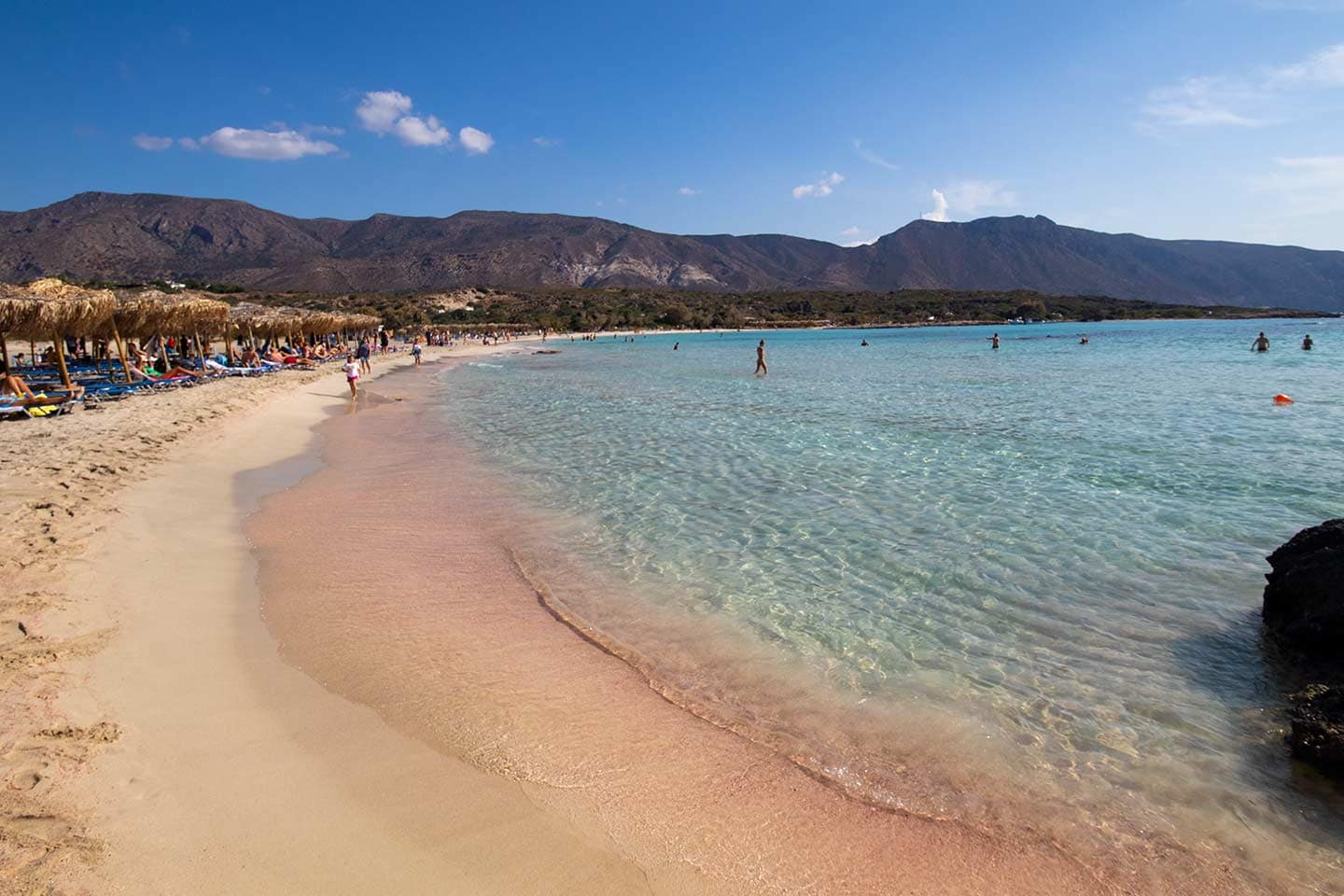


Elafonissi is the second main draw on the far west coast of Crete, a tantalising series of beaches fringed with rare pink sand from millions of crushed shells.
Elafonissi Beach is in the southwestern corner of Crete, with a mainland beach facing both sea an lagoon, and further beaches a short walk away along Elafonissi Island. If you’re prepared to walk towards the end of it, you may well find a spot of pink sand paradise to yourself. Otherwise, in the height of summer it’s very overcrowded, and there aren’t enough facilities to cater for so many visitors.
A few pieces of advice if you’re visiting Elafonissi from Rethymno. Firstly, try to visit in the October shoulder season if possible, when it’s nowhere near as crowded. Secondly, it’s a long drive, the latter part along narrow winding roads. And thirdly, it doesn’t work with public transport from Rethymno.
I visited Elafonissi twice on a tour, which worked really well for me. It’s over three hours’ drive from Rethymno, so this Elafonissi tour from Rethymno is the easiest way to see it.
Falassarna Beach


Falassarna Beach is the least-known and least-visited of the three great beaches on the west coast of Crete, but I’ll stick my neck out and say it’s the best of the lot.
Falassarna is a series of five distinct beaches, from the wide open golden (and occasionally pink) sands of its main beach to secluded shores hidden by boulders to a wondrous child-friendly beach at the northern end, with natural shallow sheltered rock pools perfect for paddling and first swimming strokes. It’s the only place I’ve stayed at in my life just for the beach, and I cannot sing its praises enough.
Falassarna is a two-hour drive from Rethymno, along the E90 road as far as Kissamos then down a narrow winding road from a mountain to Falassarna itself. As with Balos and Elafonissi, public transport won’t get you there and back in a day. This Falassarna tour from Rethymno gives you four hours at this exquisite beach – don’t be surprised if you’re left wanting a whole lot more.
Samaria Gorge

Most hikers visiting Crete make a beeline for the famous Samaria Gorge hike through the White Mountains to the sunny shore of the Libyan Sea. It’s a 1,200-metre descent from the starting point down to sea level, with a flat section at the end, a 16-km (10 mile) hike in total.
Doing the hike is a bit of a logistical challenge from Chania, but from Rethymno, it’s martyrdom by public transport. Do not attempt it.
Here’s how it works: you start off early in the morning (6.30-7.00) at Omalos, descending through pine forests towards the Gorge proper and eventually the coast. The hike takes most people 6 hours, sometimes more. You usually have around ten hours to make the hike from drop-off at Omalos to the departure of your ferry from Agia Roumeli.
At Agia Roumeli you usually catch the ferry to Chora Sfakion (though I’ve seen groups go via Paleochora as well). A direct bus to Chania runs from there, meeting passengers off the boat.
Many people I’ve met opted for the Samaria Gorge tour from Rethymno for the convenience of having transport to Omalos and back to Rethymno at the end of a very long day, one that will stay in your memory for ever.
Georgioupolis and Kournas Lake


The resort village of Georgioupolis, a short drive or bus ride west of Rethymno, has become something of a gateway to inland Crete in recent years, the starting point for $WD and jeep tours into the interior of the island.
It also has a spectacular long sandy beach with a delightful whitewashed fishermen’s chapel built on an islet at the end of a rocky causeway. From a distance it looks like it’s floating on the sea, but you can walk along the causeway to it – just beware of potentially slippery rocks along the way.
Crete’s only natural freshwater lake, Kournas, is 3 km (2 miles inland), a wildlife haven beneath the rugged mountains. It’s home to a variety of birdlife and some rare turtles, which you’ll sometimes see if you’re swim ming in the cool water of the lake.
The Georgioupolis tourist train makes the short run inland to Lake Kournas twice a day.
Argyroupoli

Argyroupoli is one of the most fascinating villages in Crete, built over and around the ruins of ancient Lappa, a city that was prominent during the Archaic, Classical and Roman periods.
It’s also next to the springs which flow into the Mouselas river via a series of waterfalls. It’s a wonderful place to stop by for a few hours, with some tavernas serving excellent food. The Georgioupolis tourist train also runs to the village once a day, leaving you there for 4 hours.
Tours: This scenic Crete tour from Rethymno and nearby resorts visits Georgioupolis, Lake Kornas and Argyroupolis.
South of Rethymno – The Coast
Plakias, Damnoni and Kalypso Beaches


There are some outstanding beaches on the south coast of the Rethymno, and several of these can be found around the seaside village of Plakias. It’s an hour’s bus ride and a world away from the crowds of Rethymno, with everything and everyone drifting along at a much slower pace than the hectic regional capital. Even at the height of the summer season, the village’s main beach was largely empty. There are several great tavernas and cafes along the beachfront, and it’s the sort of place I could easily see us spending a week or two next time we return to Crete.
Although the bus gets you to Plakias, your own set of wheels comes in handy if you intend to explore the beaches near Plakias. Damnoni Beach is a ten-minute drive away, and it’s the first of a string of three fabulous beaches in barely a mile. Mikro Ammoudi and Skinaria beach are both wondrous, and you can appreciate them more with relatively few people around.
Damnoni is also the departure point for the ferry to the nearby Palm Beach at Preveli, and it’s possible to combine the two on a day trip from Rethymno.


It’s also possible to combine Damoni with one of the most unusual beaches in Crete, Kalypso Beach. It’s hidden away behind a headland a 15-minute walk around the coast from Damnoni, and as you descend the cliff path it’ll dawn on you that there isn’t a single grain of sand in sight.
Kalypso Beach is also known as the Pirate’s Fjord, and it is just that – a narrow inlet with a steep cliff on one side and a narrow headland on the other. People come to Kalypso to swim, snorkel and scuba dive, and family fish Faye says that’s that it’s the clearest, cleanest water she has ever swum in. And coming from someone who grew up around the stunning coastline of New South Wales in Australia, that’s a huge recommendation indeed.
Preveli Beach, Kourtaliotiko Gorge and Monasteries


Preveli, on the south coast, is two destinations in one, because of the topography of the place. Its famous Palm Beach and the grove which extends along the lower reaches of the Kourtaliotiko Gorge are by far the more popular place to visit of the two, with its two monasteries – one intact, the other a ruin – high above the beach via a very steep and difficult cliff path.
You can visit the two places in a day, but need to be in good physical condition to tackle the steep uphill climb to the car park or bus stop from the beach. The heat is a big factor – there’s no shade on the climb or the beach, only in the Gorge.
Three buses a day run from Rethymno bus station to Preveli. The final stop is on the middle of three levels, with the Rear (Piso) monastery on the upper level and the beach on the lower level. The car park is just down the hill from the bus stop.
The other way to get to Preveli is by ferry boat from Plakias or Damnoni beach, a short distance away to the west. Return tickets cost €20 for adults, and €10 for children from the LB Ferries website.
Tours: This classic Preveli tour from Rethymno gives you nearly 3 hours at Preveli, 90 minutes at Damnoni and a driving tour of the Kourtaliotiko Gorge.
Spili Village


Spili is one of the most beautiful traditional villages in Crete, and a popular stop on day trips from Rethymno and tours of the area.
It’s best-known for its Venetian-era fountain in the village square with water trickling from 25 sculpted lions’ heads. The village was sadly destroyed by Nazi forces in 1941, so the rest of the village looks relatively new, but this is a tiny quibble. It’s a glorious spot at the foot of a mountain, and at 430 metres above sea level it’s a little cooler than down on the coast – of which there are tremendous views.
There are also a few traditional tavernas in the village, which is a wonderful place to break for lunch, even perhaps the whole afternoon.
Getting there: Buses from Rethymno only run once or twice a day, so driving gives you much more flexibility.
Matala Beach

Matala – which is in Heraklion province – is one of the most popular places to visit on. The south Crete coast. The fine sandy beach is great, but it’s best-known for the numerous caves in its stratified cliffs, some of which were lived in by hippies for a while during the late 1960s.
They have long gone but the caves still attract many curious visitors, and you can follow paths to s few of them and enjoy the superb view.
Matala is the busiest, most developed village in the Rethymno part of the southern Crete coast, with plenty of accommodation options as well as tavernas and cafes. Other than the beach and caves, there’s not a great deal else to do, so you could easily combine with nearby Spili or Agia Galini.
Getting there: No direct buses run from Rethymno to Matala – they only run there from Heraklion. So you’ll either need to drive or join a tour.
Tours: This Spili, Agia Galini and Matala tour from Rethymno is the best bet, giving you three hours at Matala beach and caves.
Triopetra Beach

Triopetra is one of the most beautiful Rethymno beaches, and one of the hidden gems of south Crete. This magnificent beach, named after the captivating three rocks at the southern end of the beach, receives but a fraction of the visitors that Matala does, and the beach makes a wonderful escape for the day.
The reason that Triopetra is relatively quiet is that no buses run there. You either have to drive there (parking is close to the beach, with a taverna and umbrellas nearby) or book a tour there. This tour from Rethymno has a great itinerary, visiting Spili, Kalypso Beach, Agia Fotia beach and the Kourtaliotiko Gorge in a 9-hour day.
To Other Islands – Santorini


A Santorini day trip from Crete makes for a very long day, but if this is going to be your one chance of seeing the remarkable volcanic island and its clifftop villages, it’s doable from Rethymno.
It is considerably easier to do a day trip to Santorini from Heraklion as the ferry journey is considerably shorter, and more regular, running a few times daily during the season. From Rethymno, you can normally only do the day trip to Santorini four days a week – Tuesdays, Wednesdays and weekends – and that’s with a limited season from late May to September.
Tours tend to cost in the region of €200 per person including all transfers. This Santorini day tour from Rethymno offers the classic itinerary, with six hours on the island including a guided tour from the port taking in the stunning village of Oia and the island’s capital, Fira, which also overlooks the caldera.
Day Trips From Rethymno – Final Thoughts

I hope that you’ve found this article and that it has helped you plan some trips around the Rethymno region – or indeed beyond.
I’ve spent eight months travelling around Crete and written many articles about the island. Feel free to browse through some of them here:
Explore more of Crete in our guides below:
Overall Crete Articles
Regions of Crete – what to see where, and how to choose your ideal base for your Crete holiday
Pink Beaches In Crete – the 3 stunning pink sand beaches to visit on Crete
Famous Landmarks In Crete To Visit – from Knossos to its most famous beaches, gorges and more
Castles in Crete – Heraklion, Rethymno, Frangokastello and more
Minoan Sites in Crete – the six World Heritage-listed Minoan palace sites on the island
Heraklion and Central Crete
Things To Do In Heraklion – discover the greatly underrated capital of Crete
Visiting Knossos Palace Crete – the foremost ancient Minoan site in the world
Visiting Heraklion Archaeological Museum – the foremost museum on Minoan history
Things To Do In Malia – away from the foam parties – terrific beaches, lovely Old Town and a Bronze Age World Heritage Site
Things To Do In Hersonissos – Crete’s other main party town
Hersonissos or Malia – which is better for you?
Bali Crete Beaches – guide to all 5 beaches in this beautiful north coast village
Kalypso Beach Crete – a fjord, of all things, in Crete – and one of the best places to swim and snorkel in Greece
Visiting Spinalonga Island Crete – the impregnable Venetian fortress that became home to Greece’s last leper colony
Voulisma Beach – glorious golden sands in eastern Crete
Western Crete
Things To Do In Chania – discover the most beautiful city in Crete, indeed, perhaps, Greece
Balos Beach Crete – one of the most beautiful beaches in the Mediterranean
Elafonissi Beach – the most famous pink sand beach in Crete
Falassarna Beach – one of the most beautiful beaches in the world
Kedrodasos Beach– glorious pristine beach and coves in a grove of rare juniper trees
Things To Do In Rethymno – discovering Crete’s enchanting third city
Rethymno Beaches – 20 of the best beaches in Rethymno province in central and western Crete