

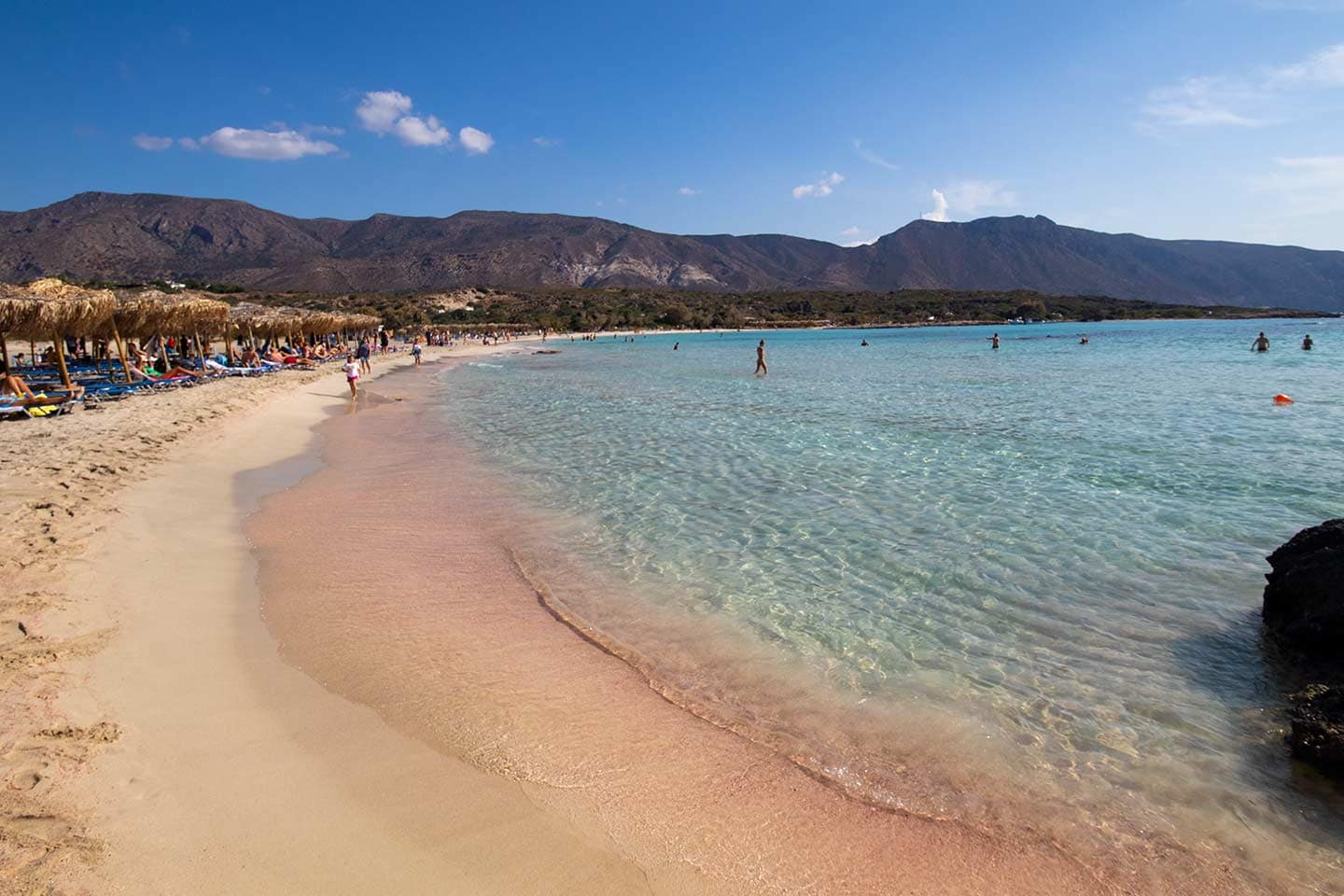
Elafonissi beach is one of the most beautiful beaches in Europe. It’s the most famous of the pink beaches in Crete, a once-remote idyll but now a major stop on the Crete travel trail.
In our guide to Elafonissi beach, we tell you everything you need to know to make the most of your visit to one of the best beaches in Crete.
Elafonissi is one of the most popular Crete destinations, along with Balos, Gramvousa and Falassarna beaches which are also on the west Crete coast.
In this Elafonissi beach guide we advise you on how to get there, whether driving or on Elafonissi tours from Chania, Rethymno and the north coast resorts.
We visited this beach as a family, and I also revisited it soon afterwards to explore it further, along with the nearby Kedrodasos beach.
We also point you in the direction where the famous Elafonissi pink sand, composed of millions of crushed sea shells, is most likely to accumulate, and offer suggestions on when to visit Elafonissi.
Tours To Elafonissi Beach
From Chania: Full day Elafonissi Beach tour and Elos village
From Rethymno: Elafonissi Beach tour and Topolia Gorge drive
From Heraklion: Elafonissi beach tour, with pickup from north coast resorts near Heraklion
From Paleochora: Catamaran cruise to Elafonissi Beach and Kedrodasos
Why Visit Elafonissi Beach

Elafonissi is an astonishingly beautiful beach – or rather series of beaches – in the south-west corner of Crete, most of which have a fringe of pink sand on the shoreline.
The pink sand is a rare phenomenon, made up of millions of crushed sea shells, washed up in the shallow waters of the sea and lagoon.

The most striking aspect of Elafonisi beach, for us, is the contrast between the pink sand and the gorgeous clear turquoise water.
It’s a small corner of tropical paradise, a protected area with a triangle of sand with the turquoise sea on one side and the shallow, child-friendly Elafonissi lagoon waters on the other.
Elafonissi island is a small island just beyond the shallow lagoon, and has several more glorious pink sand beaches, and a small chapel at the far end.


You can visit Elafonissi between May and the end of October – you can get there over the winter, but only if you drive there yourself, and no facilities will be open.
The water is normally warm enough to swim at Elafonissi between late May and late October Overcrowded in the peak summer months, the best time to visit early or late in the season (late May through June, or late September through late October).
It’s not the only pink beach in Crete – Balos and Falassarna also have some – but Elafonissi usually has by far the most.
It’s also a 30-45 minute walk from the stunning secluded beach at Kedrodasos, a series of bays and sand dunes with a grove of juniper trees.
What To See At Elafonissi Beach


You come to Elafonissi for the paradise beach with its fringe of pink sand and astonishingly clear turquoise water.
There are three sections of beach at Elafonissi. Two of these – the sea-facing side and lagoon side – share the same triangular patch of sand on ‘mainland’ Crete. The third section is on the small islet which is usually called Elafonissi Island, where you’ll find more secluded areas away from the crowds.
The shallow crystal clear water on the lagoon side of the beach is ideal for small children. The sand on the seaward side gently slopes away from the shore, so you usually have to go several metres away before you can swim.


As for the Elafonisi pink sand, I found that the best concentrations of it tend to be around rocks. There is one particular rocky outcrop about halfway along the beach (pictured) where I found the most pink coral sand.
The pink sand you see on many photos of Elafonissi online is significantly altered in Photoshop or Lightroom. The Elafonissi pink sand can vary in shade, but when I visited twice it is somewhere between coral pink and salmon pink, not the lighter, a false, almost fuchsia tone in some widely visible photographs.
Part of Elafonissi beach and the entire island comprise a protected Natura 2000 Reserve. It’s a very rare habitat, home to sea daffodils and other protected species of plant.
Elafonissi Beach Visitor Tips


The standard beach bed and umbrella package usually works out at 10 to 12 euros, and the you can get these along the ‘mainland’ part of the beach. At the pink sand beaches on Elafonissi Island, it’s just you, the sand, the sun and the sea.
If you’re looking for a quiet place on Elafonissi, the Island is where you should head – especially towards the far end, around the chapel, where you may well have a small sandy cove all to yourself.
There is no shade anywhere on Elafonissi beach, so if you don’t arrive in time to get an umbrella (in high season forget it) a sun hat and supply of sun cream is absolutely mandatory.
If you have one, it’s worth bringing a cool bag with food and drink rather than shell out at the expensive snack and beach bars.


Bear in mind that Elafonissi tides vary significantly. The first time I visited Elafonissi the water between the mainland beach and island was only ankle deep, and the second time it was above my knees. So you may need to carry your things on your shoulders or even your head.
The toilet facilities at Elafonissi beach are poor. I counted just six cubicles when I visited – not so bad when there are only 300-400 on the beach, but with ten times that number in the peak tourist season, it’s disastrous. The second time I visited, very near the end of the season, the toilets had broken down entirely. This isn’t ideal anywhere, never mind a conservation area with rare plant species and the endangered loggerhead sea turtle residing or visiting frequently.
Do not take any pink sand away from Elafonissi. There is a large sign asking you not to do this, warning of heavy fines if you degrade the pristine environment in this way. As the old photographers’ motto goes, take only photographs and leave only footprints.
Where Is Elafonissi Beach In Crete

Elafonissi Crete is at the southwestern tip of Crete. It’s part of Chania province, the westernmost of the four Crete provinces. It’s one of the best Chania beaches, and is an hour and a half to two hours’ drive from the town of Chania.
The closest town of any size is Paleochora, 20 km to the east. Paleochora is a great base for holidays in Crete, as it’s within relatively easy reach of Elafonissi and is also on the stunning Agia Roumeli ferry route.
The distances from other main towns on the island of Crete to Elafonissi Beach are as follows:
- Chania to Elafonissi – 83 km (52 miles)
- Rethymno to Elafonissi – 132 km (82 miles)
- Heraklion to Elafonissi – 211 km (131 miles)
- Kissamos to Elafonissi – 41 km
See Also: 30 of the Most Famous Landmarks In Greece
How To Get To Elafonissi Beach


During the spring and summer several buses a day run from Chania to Elafonissi. The daily bus service from Chania to Elafonissi bus runs through the resorts to the west of the city, then through Kolymvari and Kissamos before heading south down the western end of the island. It’s 11 euros each way, and takes around two hours.
The buses drop you off at the top of the hill above the car park, less than ten minutes walk to the beach. Elafonissi tours drop you further down, closer to the beach.
Otherwise you can drive from Chania, Rethymno or Paleochora, and other places in between.
The road down from Kissamos, through the Topolia Gorge, has some difficult winding stretches, but there are far worse mountain roads in other areas of Crete.
You can also reach Elafonissi beach by boat. The Paleochora Elafonisi boat runs during the summer months, usually into October. If you’re around later than that you can do what we did and take a speedboat ride to Elafonissi beach.
They usually need a minimum of four customers to run the trip, which gives you three to four hours at the beach.
Best Time To Visit Elafonissi Beach Crete ?


You can rely on warm, sunny Elafonissi weather most days between late May and October. There will obviously be the occasional inclement day.
It’s also worth keeping an eye out for the wind forecast – the Greek Meteo site is usually pretty reliable with its local forecasts. Elafonissi can be exposed to some strong winds, so if you can plan around a good forecast and avoid gusty windy days, it’s worth your while.
When you visit Crete Elafonissi beach amazes not just with its pink sand but also its pristine, beautiful clear turquoise water. If you come all that way, you’d want to swim in it, surely?
The high season in the Greek islands is usually June to the end of August, with a gradual tailing-off through September. October is very much shoulder season in Greece.

The water in the Mediterranean is warm enough to swim in from late May or early June through until late October. Sometimes it might be warm enough in late May, possibly early June but year to year you can’t guarantee exactly when.
You can visit Elafonissi between May and the end of October – you can get there over the winter, but only if you drive there yourself, and no facilities will be open.

In July and August Elafonissi is jammed with people. Our boat driver said you could expect 3,000 to 4,000 day trippers every day. It’s still pretty busy through most of September, with the Crete weather still close to 30 Centigrade most days.
We went during October,in early autumn when it’s still very warm, and the warm waters are still fine to swim in. There were probably 500 or 600 people on the beach and Elafonisi island, so there was plenty of space to wander, and no feeling of overcrowding. October is a great time to visit Crete, just be aware that some transport services and tours wind down around the middle of the month – and in some cases they stop altogether.
Elafonissi Beach Facilities


It’s one of the most beautiful beaches in Crete, and has all the facilities you’d need – just not enough of some of them.
There are plenty of umbrellas and sunbeds available for rental. There are also some beach bars, snack bars and cafes, selling drinks and food. Many will be relieved to know there are toilets on Elafonissi beach. There are just six cubicles, so the line for these in the height of summer can be ridiculously long.

There is also a shop selling inflatable swans, flamingoes and other beach toys and gear.
Crete Beaches to visit near Elafonissi Beach


Elafonissi is on the E4 trail that traverses some of the stunning south Crete coast.
By serendipitous good fortune, it just so happens that one of the best beaches in Chania province, Kedrodasos beach, is only a half-hour, 2 km walk away.
The E4 trail continues past several other beaches after Kedrodasos, eventually reaching Krios beach two hours, 7 km (4 miles) away.
Some of the Elafonissi tours also stop at Chrysoskalitisa Monastery, 5km north of Elafonissi.

We stayed 20 km to the east of Elafonissi at Paleochora, the main town in the remote south-west corner of Crete. While staying there we visited all of the Paleochora beaches, including Pachia Ammos in the town, Gialiskari beach a few miles to the east, and the wondrous Grammeno Wild Beach to the west. Paleochora is the ideal place to really get away from it all, and also to explore the breathtaking south Crete coast.
Elafonissi Beach – Final Words

We had a great day out at Elafonissi, with a fantastic boat trip there and back. And I made a return trip there when I found another boat was running on the very last day of the season.
There’s no question that visiting Elafonissi is one of the best things to do in Crete. The fringe of pink sand on the beaches is very striking and incredibly photogenic. It is a small slice of paradise, and if you can get there at a time it’s not overrun, it’s a very special place.
For more inspiration, feel free to browse though some of the following articles on Crete:
20 Best Rethymno Beaches To Visit
20 Best Things To Do In Chania
15 Best Things To Do In Heraklion
Visiting Heraklion Archaeological Museum
12 Best Things To Do In Agios Nikolaos
Visiting Spinalonga Island Crete
Visiting Kritsa, Crete – one of the island’s most beautiful villages
You may also like: