


Best Day Trips From Heraklion
It’s the main arrival point on Crete, and its central location means that there are so many day trips from Heraklion that you can see a lot of the island from there.
We recently stayed in the Heraklion area for three months, over most of a full summer season, and were able to sample many day trips from the island’s capital. Even if you don’t actually stay in Heraklion, most tours from the city also pick up from the resorts along the coast to the east and west. So staying in the area gives you plenty of scope for exploration.
In this guide I show you the best day trips possible from Heraklion and the surrounding area, covering the other three cities on Crete, trips into the mountains, the stunning beaches of the west coast of Crete and even a one-day island-hop to Santorini, to the north. I also advise on the logistics and practicalities of each day trip, and suggest possible day tours where they are available.
I hope you find it helpful.
Where To Stay In Heraklion
**** – Lato Boutique Hotel – superb location overlooking the historic Venetian harbour, and a short walk from Heraklion bus station and the port
**** – Porta Medina Boutique Hotel – another superb central Heraklion location, in a centuries-old house close to Agios Titos Church
*** – Kastro Hotel – superb 3-star in the historic centre, close to all the main sights, Venetian harbour, bus station and port
Best Day Tours from Heraklion – My Top 4

Santorini – includes return ferries and guided tour of Oia And Fira villages
Chania – also includes stops at Rethymno and Lake Kournas en route
Spinalonga and Agios Nikolaos – the former leper colony and one of Greece’s most scenic cities
Lassithi Plateau 4×4 Safari – the mountainous fertile heart of Crete – and the legendary birthplace of Zeus
Day Trips from Heraklion To The West
Chania


Chania is the most beautiful city in Crete, and one of the most beautiful cities in Greece. It has escaped the ravages of war that so damaged Heraklion, leaving us with a small coastal city with Minoan, Byzantine, Venetian and Ottoman buildings around an exquisite historic harbour with an Egyptian-built 19th-century lighthouse.
What we love most about Chania is the warren of narrow lanes in the Old Town, just inland from the harbour. Here you’ll find many great tavernas and restaurants hidden down the side streets and alleyways, intimate squares like Splantzia buzzing with life into the early hours in summer, and sublime sunsets behind the lighthouse and mountains beyond. And then there are the views from the harbour wall of the city below the peaks of the White Mountains.
We spent almost a month in Chania and fell head over heels with the place. There are also town walls from the Byzantine period, several town beaches (just to the west of the centre) and three excellent museums – the new Archaeological Museum, the Maritime Museum of Crete and the Museum of the Greek National Football Team. All of them are wonderful in their different ways.
Chania is 2 ½ hours from Heraklion by road and bus, but worth the effort as it’s one of the most beautiful cities in Greece. Ideally it works as a base rather than a day trip destination, but if a day is all you have available, I can’t think of a better use of your time than a day trip to Chania.
Tour – this Chania tour from Heraklion gives you much of the day in and around d Chania, visiting the Old Town and one or two sights nearby
See Also: 22 Best Things to Do In Chania
Rethymno


Rethymno is Crete’s third city, and while not exactly a secret, it’s less widely known than Heraklion or Chania, both of which have airports. It’s an hour and a half from Heraklion along the main north coast road, and somewhere well worth considering as a base on a future Crete holiday.
Rethymno has a bit of everything – a fantastic sandy beach (which extends around ten miles to the east), a gorgeous Old Town full of reminders of its Venetian and Ottoman Turkish past, not to mention a hilltop Venetian fortress (the Fortezza), an evocative location with amazing views over the town and beach towards Psiloritis, the mountain that dominates the landscape of central-west Crete.
Rethymno is a 90-minute bus ride from Heraklion, and the Old Town and city beach are a 10 to 15-minute walk from Rethymno bus station.
Oddly, no tours from Heraklion focus on Rethymno only – strange as it’s somewhere many people would love to explore. The only tours from Heraklion have similar packages, like this one visiting Rethymno, Kournas Lake and Chania in one day.
Balos Beach


Balos Beach is one of the longest day trips from Heraklion, like Elafonissi and Santorini a possible 15-hour itinerary, over half of which is on the road and water. But people are prepared to travel all this way if it’s their one shot at visiting not just one but two of the best beaches in Crete.
Balos Beach is on the northwest corner of the Crete mainland, a stunning sandy beach with the sea on one side and a shallow lagoon on the other. A steep mountain peak on the mainland overlooks the scene, while a rocky cape completes the breathtaking scene.

Most visitors to Balos arrive on the regular ferry from Kissamos, a journey that takes around an hour. Before reaching Balos, the ferry stops at Gramvousa Beach, a sublime spot on an uninhabited island overlooked by the ruin of a fine Venetian castle. After up to two hours at Gramvousa, the ferry makes the 15-minute onward journey to Balos, where you usually get to spend 4 hours before the return trip to Kissamos.
4WDs can make the trip from Kissamos to Balos along a dirt road, which then entails a downhill hike (and a steep uphill slog back up). Much as I love uphill hikes, the ferry is a much more comfortable option in the summer heat of Crete.
Getting there: I recommend this tour from Heraklion to Balos, with transfers and ferry tickets included in the package.
Elafonissi Beach
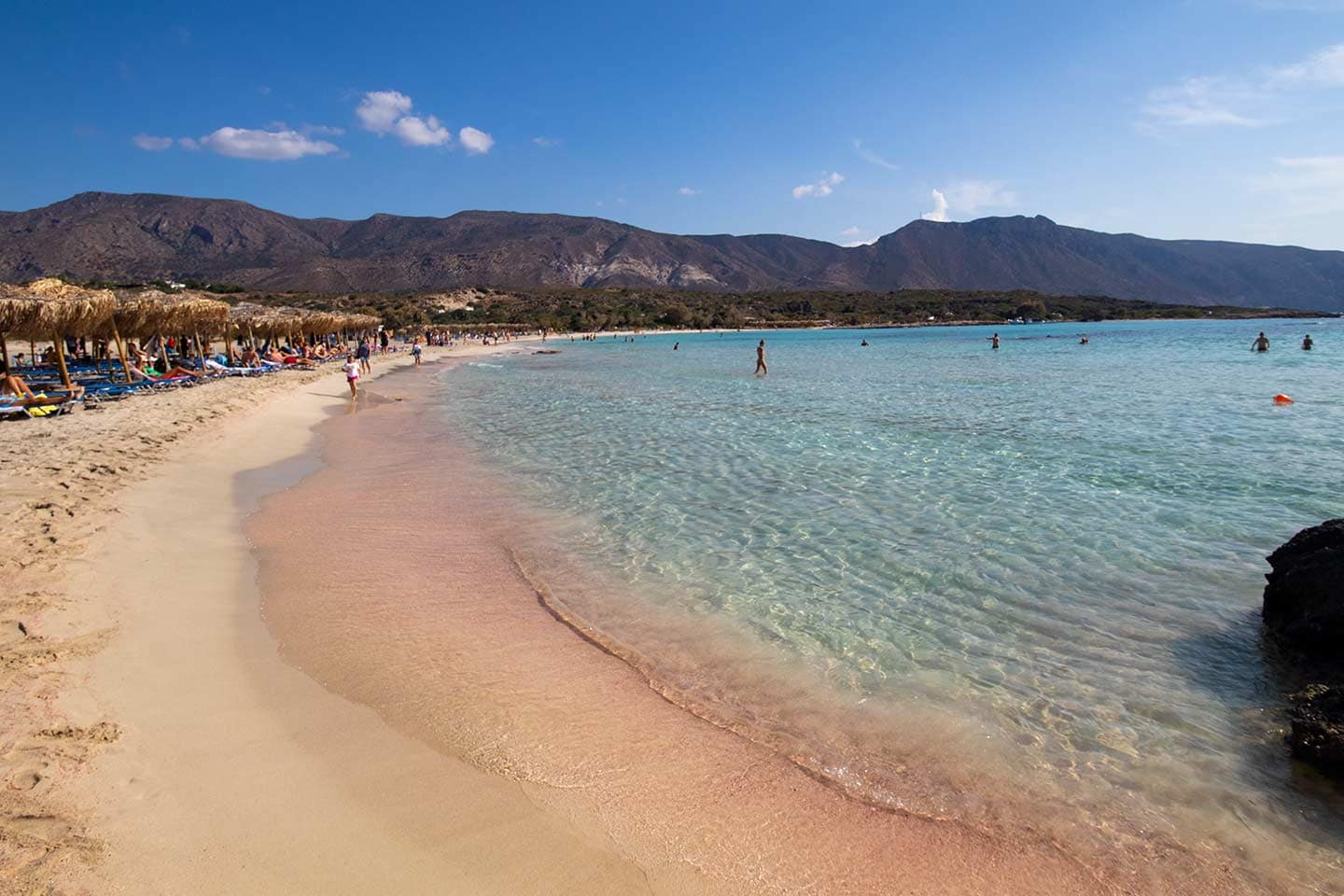


The famous pink sand Elafonissi Beach is as far as you can travel on land from Heraklion, and makes for a very long day trip from the capital. It’s a four-hour bus drive each way to this series of beaches on the southwest corner of Crete, but people do make the trip, such is its lure.
Elafonissi Beach is wonderful. The main beach has a seaward shore and a lagoon shore, and the pink sand – the accumulations of hundreds of millions of fragments of pink shells – is an amazing sight. You can walk across shallow water to Elafonissi Island where there are more beaches, also with pink sand. The further you walk along the island, the less fellow visitors you will see.
Apart from its isolation and the long journey there and back, the drawback with visiting Elafonissi is that it gets overcrowded in the summer months. This means long queues for the small number of toilets – not exactly the pink sand paradise you had in mind. My tip is that if you venture this far from Heraklion, do so in October when there are far few people there.
Getting there: No direct buses run from Heraklion to Elafonissi, ruling out that option. The drive to Elafonissi is around four hours.
Tours: This Elafonissi tour from Heraklion is a great bet – and saves you all that driving time!
Arkadi Monastery


Arkadi Monastery is one of the most compelling places to visit in Crete, an ancient monastery where a terrible tragedy unfolded in 1866 at the start of the Cretan Revolt against Ottoman Turkish rule.
The Monastery, in upland country to the east of Rethymno, was probably founded at some point in the Middle Ages, and the honey-coloured Venetian style church isn’t the original.
Arkadi became a refuge for a small band of soldiers and around 300 women and children who fled Turkish forces in November 1866. The Turkish troops soon tracked them =down and had an overwhelming advantage in numbers and firepower. They eventually broke Cretan resistance, and one of the rebels’ leaders decided that it was better to die than be captured, so all but four of the survivors were killed when the gunpowder store was blown up.
Arkadi is easy to reach by car from Heraklion, but if you’re planning to make your way there by public transport, you’ll have to catch a bus to Rethymno, then another from there to Arkadi. Alternatively you can get an early bus to Rethymno, and join an Arkadi Monastery tour from Rethymno, which also includes visits to Margarites village and Melidoni Cave.
Fodele


Fodele is a small village just off the highway that runs across northern Crete. On one side of the road is the excellent sandy beach, but two my reasons for bringing Fodele to your attention are a mile or two inland, a short distance from the centre of the village. Indeed, they are right across the road from each other.
The first is the beautiful old Byzantine church, one of the loveliest churches in Crete from this period. It’s believed to be between 900 and 1,000 years old, and it has well-preserved frescoes from as far back as the 11th and 14th centuries.
The second is the small El Greco Museum. The 17th-century painter was born on Crete, possibly in this house, if not in nearby Heraklion. We do know from his own accounts that young Domenikos Theotokopoulos lived in this house during his childhood, as its location exactly matches his description.
This small Museum includes a re-creation of part of his home, and replicas of some of his best-known works. No original works of his are held at the Museum, but two can be seen in the Historical Museum of Crete in Heraklion.
Tour: This El Greco tour from Heraklion focuses on Fodele, with a drive through the stunning Cretan countryside also included.
Bali


Bali is a gorgeous beach village less than an hour to the west of Heraklion, and on the main road and bus route from Heraklion to the two major cities further west.
There are five Bali Crete beaches along the peninsula, four of which are well sheltered from the meltemi winds from the north. Two of them – Bali and Mythos beaches – are close to the picturesque harbour, and the best of them, Karavostasi Beach, is a 20-minute walk north of the village. It’s a stunning spot, with amazing views back along the coast to the mountains inland.
The only drawback with Bali is that, unless you don’t mind being in pretty close proximity to other visitors, there isn’t much space on the five beaches. The beach concession operators have gone with the sardine principle, cramming as many sunbeds and umbrellas as possible into a small space to maximise their income.
Having some of the sunbeds and brollies is perfectly fine – after all, they provide protection from the fierce sun – but cramming so many into a confined space does not appeal to many, myself included.
Getting there: regular buses run from Heraklion to Bali, including the frequent Rethymno and Chania services.
Agia Pelagia


Agia Pelagia, fifteen miles northwest of the capital, is one of the best beach villages near Heraklion. Until the tourist explosion in the 1960s and 1970s it was a small fishing village, but now, like Panormos to the west, it is full of hotels and resorts, but still kept much of its charm.
There are three beaches in and around the village, the best of which is the main village beach, with a long stretch of sand and clear turquoise water. Just north of the headland, Psaromoura Beach is much smaller, an intimate cove at the end of a track with a sea arch in the corner of the bay. And Mononaftis is a golden sand beach between two resort complexes just beyond the next headland.
Agia Pelagia is popular for watersports, with jetski rental and boat rental available.
Day Trips From Heraklion To The East
Agios Nikolaos


Agios Nikolaos is the least-known of the four regions of Crete, a mostly-new city with an ancient foundation in a sublime location on Mirabello Bay, facing the mountains of eastern Crete.
There are enough things to do in Agios Nikolaos to base yourself there for a few days, and it’s a useful and popular jumping-off point for Elounda, Spinalonga, Voulisma Beach and the far east of the island.
There are several great Agios Nikolaos beaches, the best of which is Almiros beach, a mile or so to the south of the city centre on the road to Istron and Voulisma. There are more around the town centre including Ammos and Kitroplatia Beach, both of which have plenty of tavernas serving good local food and providing welcome shade from the Cretan sun for a while.
The other place to visit in Agios Nikolaos is the freshwater Lake Voulismeni, a particularly scenic spot a short walk inland from the city harbour. The view from the lookout at the top, especially first thing in the morning or at dusk, is sublime.
Getting there: regular buses from Heraklion and towns along the bus route including Hersonissos and Malia
Spinalonga


The island of Spinalonga is one of the most popular day trips from Heraklion, drawing visitors from across central and eastern Crete.
It’s a small rocky island at the entrance to the Gulf of Elounda, occupied by a formidable Venetian fort that was never breached. After it was abandoned, an alternative use was found for it – as the last leper colony in Greece, a purpose it served from 1903 to 1957.
Leprosy is a much-misunderstood illness and sufferers had to endure enormous social stigma and were cast out of communities fearful of the spread of the disease which had no cure until the 1950s. The tragedy that the inhabitants of Spinalonga suffered is captured in Victoria Hislop’s 2005 novel The Island, in which the narrator learns her grandmother’s long-hidden secret.
You can visit Spinalonga by yourself, either driving to points of departure in Agios Nikolaos, Elounda or Plaka, then boarding the boat (from €12 return) for the trip to Spinalonga. You normally get 1½ to 2 hours on the island, ample to walk all around it and see the ruined village where people somehow scraped a living in awful conditions.
There are many variants on tours to Spinalonga. For me, the best is the Spinalonga, swimming and beach barbecue trip, stopping at remote Kolokitha Beach for a swim and barbecue lunch. I also recommend this trip from Heraklion and surrounding resorts to Spinalonga and Agios Nikolaos, which gives you a great introduction to Crete’s fourth city and the Lassithi regional capital.
See Also: Visiting Spinalonga Island Crete – the complete guide
Kritsa


Kritsa is one of the most beautiful villages in Crete, a few miles inland from Agios Nikolaos.
At the lower end of the village, you’ll find one of the finest churches in Crete, Panagia Kera, which has some of the best-preserved 14th-century frescoes on the island.
In the higher part of the village, there are a few streets packed with shops selling embroidery and clothing. Whole shop windows and fronts are covered with cloths and garments sold by local ladies, and there are also a few shops selling Cretan food products including the excellent local olive oil.
Within around 200 metres of the centre, the village is only accessible on foot or motorbike, as the streets are far too narrow for cars. This is the best part of Kritsa, with bougainvillea bushes lolling over whitewashed walls and doorways, and steep stepped side streets leading to places like the Kritsotopoula Museum, devoted to a local woman who bravely rebelled against a forced marriage to the local Turkish ruler in 1823.
Beyond Kritsa, there are two superb hikes – one of the Kritsa Gorge, the other to the mountain-top ancient city of Lato.
Tours from Heraklion: This combined Kritsa and Spinalonga tour gives you time in the village and includes a boat trip to Spinalonga Island
Getting there from Heraklion: Bus to Agios Nikolaos, then a second bus (15 minutes) to Kritsa.
See Also: Kritsa Crete – One Of The Most Beautiful Villages In Greece
Lassithi Plateau and Zeus’ Cave


The Lassithi Plateau is one of the best day trips from Heraklion and the north Crete coast. It’s a small, richly fertile plateau surrounded by peaks up to 2,000 metres above sea level, and the legendary Cave of Zeus – his birthplace, so the story goes – is the most popular place to visit there.
The Plateau is so fertile because it’s kept irrigated for much of the year by meltwater from the snows on the high peaks, which often lingers into the spring. The produce grown there is delicious, and includes the best potatoes I’ve tasted in my life. The restaurants around the edge of the Plateau serve it all up fresh, sometimes literally walked from field to fork.
Tours: This Lassithi Plateau, Zeus Cave and Olive Oil Mill tour is a great itinerary, not too rushed. This Lassithi 4×4 adventure takes you to the same places, also calling at the lovely mountain village of Krasi on the way back.
CretAquarium, Dinosaur Park and Water City


The north Crete coast east of Heraklion isn’t just about partying – it also attracts a great many families. And it’s got plenty of places to entertain the kids, with three big attractions all within the vicinity of Gournes and Kokkini Hani , around ten miles east of Heraklion.
Water City is immensely popular with families, and not surprisingly with the options of over 40 water slides, including some very long ones with big splash landings and the 385-metre long Lazy River, a relatively relaxing one that suits someone like me who can just about manage the revolving teacups at the funfair. There are also jacuzzi and whirlpool options if you want to take things even easier.
Tickets: This tour includes your ticket, pickup and dropoff at your accommodation


CretAquarium is a brilliant state-of-the-art exhibition of Crete’s astonishing marine life, from small sharks to jellyfish and crustaceans, with many colourful beauties darting through the water to the ever-present sound of some very well-chosen ambient music.
My son and I combined our visit to CretAquarium with a couple of hours at Dinosauria Park, which is a 15-minute walk away next to the main road and bus route. Dinosauria Park has around 50 dinos, some of which are animatronic. My son is a lifelong dinosaur connoisseur, and was impressed with the range of creatures, most of all the fearsome Spinosaurus, which could hunt both on land and in the water.
Tickets: you can book your CretAquarium tickets here.
Sissi


Sissi is one of the prettiest villages on the north coast of Crete. It’s a small harbour village four miles east of Malia, but very different in feel to the party town. Sissi is much quieter and more laid-back, and the main things to do there are eating at the seafood restaurants around the harbour, and swimming in the estuary, enjoying the stunning view inland to the nearby Dikti Mountains.
The harbour beach isn’t one of the best you’ll find in the area, but the views from the water are incomparable. There are sandier beaches to the east of town – the better of the two is Boufos Beach, while Avlaki Beach, a short walk further to the east, is very quiet, even in summer.
Getting there: Sissi is surprisingly hard to reach, even from Malia. Very few buses call there, and the nearest bus stop on the main Heraklion to Agios Nikolaos road is almost two miles away – a very long distance in the heat. When we stayed in Malia, we took a taxi there a couple of times. Why it’s so off the beaten path for public transport is a complete mystery!
Lychnostatis Museum


Lychnostatis Open Air Museum is one of the best museums in Crete, an outstanding skansen-type exhibition covering Cretan rural (and to a lesser extent, urban) life in the late19th and early 20th centuries.
The Museum is in the far east of Hersonissos, in a slightly awkward spot if you’re travelling by bus from Heraklion. It’s just up the hill from Stalis Beach, so is also very close to Malia.
Lychnostatis crams a huge amount into a tiny space compared with other open air museums in Europe that I’ve visited – it occupies one main building, a few small outbuildings and the gardens of the property.
There are several exhibits on plant life in Crete, and growing crops such as carob which feature in the super-healthy Cretan diet. There are also interiors of a weaver’s workshop, a rural farmhouse and a middle-class professional’s family home in the suburbs of Heraklion.
Some of the exhibits are beautifully designed, especially those on Cretan herbs – it’s phenomenal how well they’ve been put together. As I’ve said elsewhere on the site, someone deserves a major award for this superb work.
Tickets: You can book your Lychnostatis Museum ticket here.
Getting there: if travelling by bus, from Heraklion, ask for the ‘Mediterraneo’ stop, which is near the hotel of the same name. From there you need to backtrack slightly and cross the main road to join the side road to the Museum.
Hersonissos
Hersonissos is the first stop on Crete’s Strip, the most built-up and overtouristed area on the island. It’s basically one long, busy street running parallel to a series of narrow, often crowded beaches, ending at Lychnostatis Museum (see above).
The two best Hersonissos beaches are just north of the town. Gefyri Beach and Sarantari Beach are less crowded than those on the town centre. And they’re also more picturesque, with ochre cliffs and glorious crystal-clear turquoise water.
If you’re visiting Hersonissos with kids, as we did, I strongly recommend the Aqua World Aquarium in Hersonissos. It’s a beautiful place with a wonderful energy, run by a very kind gentleman called John. They have a beautiful aquarium at the front of the premises, and the kids can meet and hold the numerous rescued reptiles in the yard at the back. The three of us loved it.
Many boat trips run from Hersonissos harbour, including this 4-hour pirate cruise along the nearby coast, including Sarantari Beach, with swimming breaks and barbecue lunch. If you want the same sort of thing minus the pirates, this Hersonissos boat cruise might be just the ticket for you.
Malia


Malia is the second of the slightly infamous resorts on the built-up ‘Strip’ that runs around ten miles long the north Crete coast. It’s practically joined to Hersonissos, with hotels and holiday homes all the way along the coast road between the two towns. They are both very much party towns, but Malia has a little more to offer.
Most people visit the town for the Malia beaches, which are fine and sandy, but an inconvenient 20-minute walk down the hill from the town centre bus stop, not ideal in the summer heat.


Malia Old Town isn’t especially old – some of the churches and houses are from the 18th. century – but it’s a very pleasant area to while away an hour or three. There are a few lovely squares, with flower-decked restaurants serving (mostly) very good Cretan dishes.
East of the town, Potamos Beach is the best in the town, and its distance from the centre means that it’s seldom as crowded as those in town. Potamos is also close to the UNESCO World Heritage-listed Malia Minoan Palace, one of six palatial Minoan sites in Crete awarded this status in 2025.
Getting there: Most buses heading east from Heraklion stop at Malia – you’ll rarely have to wait long for one.
Day Trips From Heraklion To The South
Knossos


Many people wouldn’t count Knossos as a day trip from Heraklion, but as it’s a trip from the city centre to the furthest southern edge of the city, and it’s surrounded by countryside, I do.
Visiting Knossos Palace is a must for many visitors to Crete. It’s believed to have been a major palace site, possibly the most important in the Minoan world. This Bronze Age civilisation preceded what we call the Ancient Greeks by as much as 1,500 years, and despite a great many archaeological discoveries we don’t know what language they spoke, what they called themselves, and nor can we decipher their written script.
The ruins of Knossos are more substantial that those at other Minoan sites around the island, and this is partly because of some ‘restoration’ work by British archaeologist Sir Arthur Evans. He ‘rebuilt’ some parts of the Palace complex, including the iconic North Propylaeum (pictured. However, his constructions were largely guesswork.

We can be certain that his excavations at Knossos yielded many artistic treasures, and there are replicas of some of the frescoes around the Knossos site. I suggest that you need to visit Heraklion Archaeological Museum – where the original artworks are on display – to understand Knossos better. You’ll need up to two hours to see everything at Knossos, and anything between two and four hours, depending on your level of interest, at the Archaeological Museum.
Tickets – this Knossos Palace entry ticket comes with optional audio guide
Archanes

Archanes is one of the prettiest small towns in Crete, and is one of the easier day trips from Heraklion, a half-hour bus trip from the main bus station on a service which runs every two hours during the daytime in the summer months.
As you’ll see on your approach to the town, this is Cretan wine country, with vineyards covering the hills around a settlement dating back around 4,000 years to Minoan times. The area is also renowned for its olives and olive oil, and honey is also produced close to the town.
Archanes has also been beautifully restored over the last few decades, with many of the streets and houses given a marvellous makeover. If you’re looking for a beautiful traditional Greek town to photograph, Archanes is, along with Kritsa and Margarites (the latter is near Rethymno) right up there with the best on the island.
This Archanes tour from Heraklion and surrounding resorts includes visits to a Minoan farm (where you enjoy tasting the local honey), Archanes town, a local family-run winery and the ]nearby Monastery of St George Epanosifis.
Matala

Matala Beach is one of the most popular beaches in southern Crete, a small but superb sandy beach better-known for its pock-marked stratified cliff face full of caves. Some of these caves became temporary homes to visiting hippies during the late 1960s, and the story has been drawing visitors back ever since.
It’s a fantastic beach, and you can still walk to some of the caves on the lower section of the cliff. The small village has plenty of tavernas, bars and cafes to choose from, making it an easy day trip from Heraklion.
Getting there: three buses run direct from Heraklion bus station, taking two hours each way.
Tours: This Matala Beach and Caves tour from Heraklion only takes you to Matala, but gives plenty of time – around four hours – there.
Day Trips from Heraklion – Island Hopping
Santorini


The Santorini day trip from Crete is the only proper island-hop you can do from Heraklion, and one of the most expensive day trips from Crete. With a two-hour ferry journey from Heraklion to Santorini and back, plus transfers to the port, it can make for a long day.
You get six hours on the island, and the best way to make use of this time is to book on a package Santorini day tour from Heraklion. This avoids the hassle – and wasted time – of waiting for public buses or queuing for a hire car, and then finding places to park in the villages.

Most Santorini day tours run the same route, taking you to the famous village of Oia at the northern end of the island, with its stunning blue-domed churches overlooking the dramatic caldera. They then take you south to the island capital, Fira, where you’re treated to more extraordinary views of the caldera. Some also stop at the Three Bells of Fira, a well-known (but generally quiet) viewpoint over a blue-domed church, the caldera and volcanic islands beyond.
It’s a trip that I’d suggest you take if it’s going to be your one chance to see Santorini. You might not get to see a legendary Santorini sunset, but you will be able to look back and say to yourself, ”I saw that magical place – and I’ll never forget it.”
Day Trips from Heraklion – Final Thoughts
I hope that you’ve enjoyed this article and found it useful. There are so many places to visit from Heraklion on day trips, and my selection gives you plenty to choose from.
Overall Crete Articles
Regions of Crete – what to see where, and how to choose your ideal base for your Crete holiday
Pink Beaches In Crete – the 3 stunning pink sand beaches to visit on Crete
Famous Landmarks In Crete To Visit – from Knossos to its most famous beaches, gorges and more
Castles in Crete – Heraklion, Rethymno, Frangokastello and more
Minoan Sites in Crete – the six World Heritage-listed Minoan palace sites on the island
Heraklion and Central Crete
Things To Do In Heraklion – discover the greatly underrated capital of Crete
Visiting Knossos Palace Crete – the foremost ancient Minoan site in the world
Visiting Heraklion Archaeological Museum – the foremost museum on Minoan history
Things To Do In Malia – away from the foam parties – terrific beaches, lovely Old Town and a Bronze Age World Heritage Site
Things To Do In Hersonissos – Crete’s other main party town
Hersonissos or Malia – which is better for you?
Bali Crete Beaches – guide to all 5 beaches in this beautiful north coast village
Kalypso Beach Crete – a fjord, of all things, in Crete – and one of the best places to swim and snorkel in Greece
Visiting Spinalonga Island Crete – the impregnable Venetian fortress that became home to Greece’s last leper colony
Voulisma Beach – glorious golden sands in eastern Crete
Western Crete
Things To Do In Chania – discover the most beautiful city in Crete, indeed, perhaps, Greece
Balos Beach Crete – one of the most beautiful beaches in the Mediterranean
Elafonissi Beach – the most famous pink sand beach in Crete
Falassarna Beach – one of the most beautiful beaches in the world
Kedrodasos Beach– glorious pristine beach and coves in a grove of rare juniper trees
Things To Do In Rethymno – discovering Crete’s enchanting third city
Rethymno Beaches – 20 of the best beaches in Rethymno province in central and western Crete