

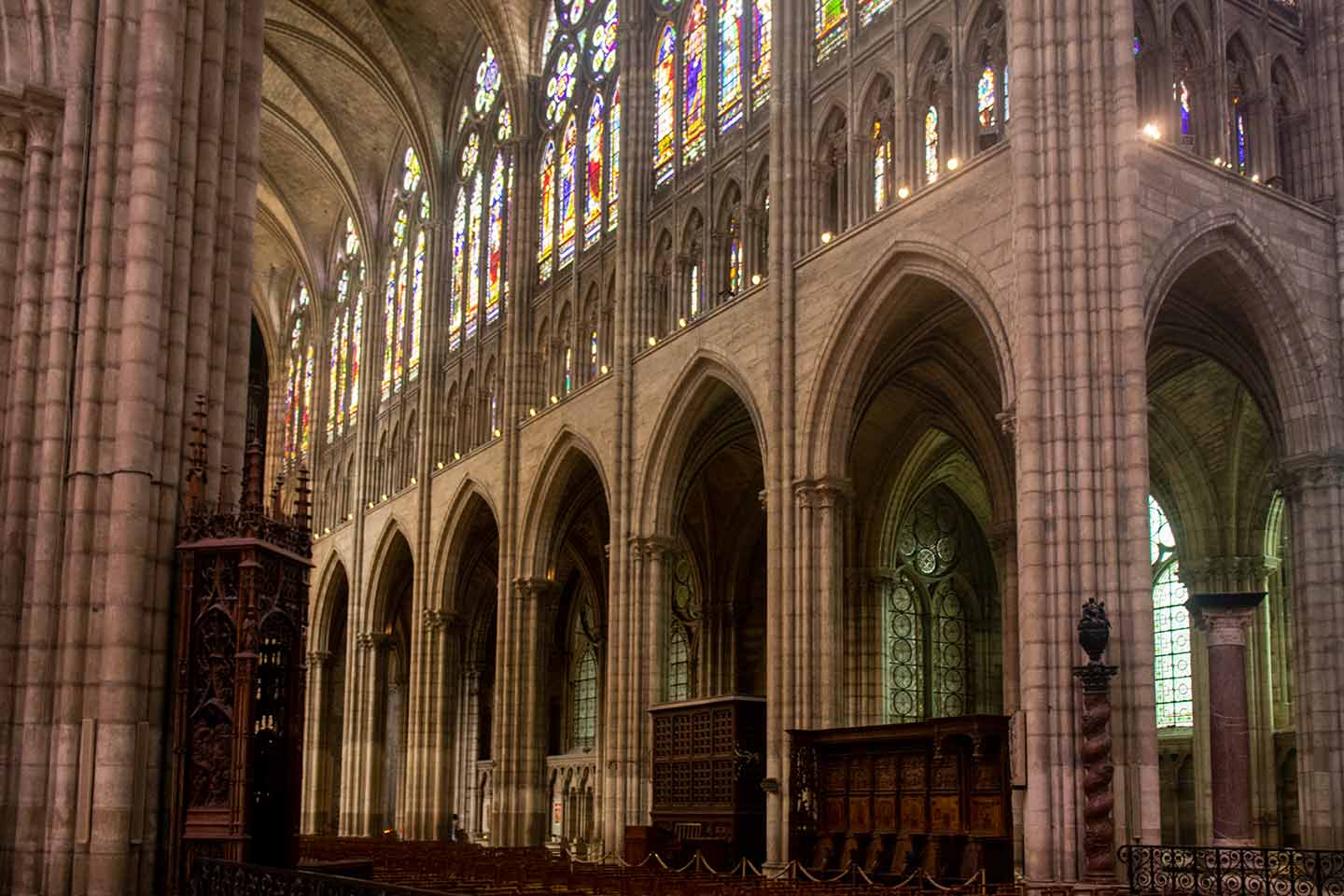
The Basilica of St Denis, just north of central Paris,is where Gothic architecture was first created, and over 70 French kings and queens are buried.
St Denis Basilica is one of the most famous churches in Paris but doesn’t attract the vast crowds of Notre Dame, Sainte-Chapelle or Sacré Coeur in the centre of Paris. But it belongs in the same bracket as any of the great cathedrals of France – Chartres, Reims, Amiens and more.
This is where the glories of Gothic architecture were first realised, and went on to have immeasurable influence over the next few hundred years.
In my guide to Saint-Denis Basilica I show you the architectural treasures and the best of the many royal tombs in the church and crypt. I also cover the practicalities of getting there – a short, easy Metro ride from the centre of Paris – as well as tickets, tours and what to see nearby. Enjoy!
Where To Stay In Paris – Great Hotels Near Parisian Churches
Les Rives de Notre Dame – superb riverside hotel with amazing views of newly-restored Notre Dame
Hôtel Artus – chic boutique 4* hotel very close to St Germain des Prés Church in the Latin Quarter
Hôtel Recamier – beautiful hotel on the same square as Paris’ second largest church, Saint-Sulpice
Hôtel Henri IV Rive Gauche – lovely hotel opposite the end of the east end of Gothic Saint-Severin Church
Basilica Of St Denis Tickets

Unlike at many other churches in Paris, you can only visit the Basilica of Saint Denis with a ticket, which you can book here. It currently costs €9.50 for an adult. I visited the Basilica using my Paris Museum Pass, which is a great way of saving money if you’re planning to visit a lot of Paris attractions. It comes in. 2-, 4- and 6-day versions.
There’s no need to reserve a time slot in advance, as the Basilica is not one of the busier places to visit in Paris.
Why Visit The Basilica Of St Denis


The Basilica of St Denis is one of the three greatest Gothic churches of Paris, along with the Cathedral of Notre Dame de Paris and La Sainte Chapelle.
It is architecturally one of the most important churches in Europe and the world, as it is the birthplace of the pointed arch and what became known as Gothic architecture – an enormous artistic revolution in early medieval terms.
The Basilica Church of Saint Denis is also one of the most beautiful Gothic churches in France and Europe, with gorgeous rose windows as well as the first pointed arches ever built in a European church.
St Denis Basilica Paris is also the necropolis of French kings and queens, with many princes and princesses and notable French nobles interred there.
The Basilica Cathedral Of Saint Denis History

The site of the present Basilica of St Denis was initially used as a cemetery during the latter years of the Roman Empire, with burials showing pagan and Christian elements.
St Denis was martyred in the 3rd century in Montmartre, and according to tradition picked up his severed head and walked around 4 miles (6 km) to the site of the Basilica, where he wished to be buried.
The relics of St Denis were reinterred at the basilica church on the present site in 636 AD, on the orders of Frankish King Dagobert I. St Denis is also one of the patron saints of France, and Dagobert himself chose to be buried in the same church as the saint when he died three years later. Other Frankish royal figures had already done the same, and more would follow.


Dagobert also founded a monastery at the site, so the Basilica also became known as the Abbey Church of Saint Denis. It was later rebuilt and reconsecrated in 775 AD with Charlemagne present. Some impressive remains of the Carolingian church survive, including a large section of the crypt.

The church continued to be a popular pilgrimage site, and in the first half of the 12th century Abbot Suger set about rebuilding a church fit to hold the relics of St Denis. The west front was completed first, followed by the choir between 1140-44. Suger died in 1151.
The nave and transepts were rebuilt in the late 13th century, the church interior transformed from the dark, sombre, bulky Romanesque to the airy, light new Rayonnant Gothic style also used in contemporary French Gothic cathedrals and churches.

The Basilica of St Denis also began to be re-purposed as a Royal Necropolis in the 13th century, with the bones of 16 monarchs – eight Carolingians and eight Capetians – moved to the church.
French monarchs and nobles continued to be buried in the Basilica for the following few centuries. The church was ransacked wince in the Middle Ages, and Revolutionaries wrought significant damage on the building in 1792, when the monastery was dissolved. The lead was removed from the roof to make ammunition, and many of the Basilica’s treasures were melted down.
Napoleon Bonaparte had the Basilica of St Denis reconsecrated in 1806, and at one point intended it as his own burial place (he was interred in the Dome des Invalides instead).
In 1966 the Basilica was raised to Cathedral status, so it has since then been the seat of a Bishop. It is often called the Basilica Cathedral of St Denis.
What To See In The Basilica Of St. Denis
The two main points of interest in St Denis Basilica are its early Gothic architecture and its vast collection of around 70 Frankish and French royal tombs and effigies.
Basilica Of St Denis Architecture

Abbot Suger set out to create something very different to the Romanesque. In his own words, ‘Bright is the noble edifice which is pervaded by the new light.’
The west front was built first, notable for its rose window and beautifully carved portals. However the real revolution came with the construction of the choir between 1140 and 1144. Here the pillars are at the lower levels are slender, the arches pointed, allowing more light to flood into the lower levels of the chancel and choir. This is the first instance of a fully realized Gothic building in the world.
As you look up, notice the stained glass windows on the upper two levels – the triforium (gallery or middle level) and the clerestory. As Suger intended, the building is flooded with light, which is even more impressive with sunlight streaming through the windows.


The choir was altered less than a century after completion by King Louis IX (Saint Louis), so it’s more in the Rayonnant style employed at Sainte-Chapelle. The large rose windows in the north and south transepts also date from this period, and are one of the most impressive features of the Basilica.
The nave was also completed long after the death of Abbot Suger, again in the 13th century. Again, the combination of slender pillars and windows on three levels gives it an airy, light feel.
Romanesque and Gothic Architecture – What’s The Difference?
To appreciate the difference between Romanesque and Gothic architecture, I’d recommend a brief walk in the Latin Quarter to see two churches no more than two minutes’ walk apart. The church of St Julien le Pauvre is one of the oldest churches in Paris, a humble Romanesque beauty with stout pillars, rounded arches and small clerestory (upper level) windows.
Contrast this with the church of Saint Severin Paris, just across the Rue du Petit Pont. In comparison it’s much lighter and airier, the Gothic interior bathed in light from the clerestory windows.
Basilica Of Saint Denis Burials – The Royal Tombs


The St Denis Basilica is to Paris what Westminster Abbey is to London – the mausoleum of many of its monarchs. Until the 11th century, some kings opted to be buried elsewhere, including at the church of Saint Germain des Pres, but the remains of all but three French monarchs (between the reign of Clovis and 1793) were held at Saint-Denis Basilica.
The remains of the earliest kings, the Merovingians, are located either side of the choir. These include the first King of the Franks, Clovis I, his successor Childebert I and Dagobert I, founder and patron of the Abbey of St Denis in the 7th century.


Many of the royal tombs are concentrated around the central crossing of the Basilica. The Merovingians’ successors, the Carolingians, are buried close to the steps down to the Crypt, and the Capetians, who reigned from the late 10th to the late 14th centuries, are buried in many tombs around the north aisle.
One of the most remarkable royal tombs in Saint-Denis is that of Isabella of Aragon, Queen Consort to Philip the Bold. She died tragically in 1271 at the age of 22 or 23, falling from a horse while crossing a river in Calabria (southern Italy) while pregnant. Her effigy is unusually realistic for its time, and was left intact by Revolutionaries in 1793 because of the rare inscription around her monument.


One of the most elaborate memorials in the Basilica is the Carrara marble monument to Louis XII and Anne de Bretagne (Anne of Brittany). Recumbent figures of the couple lie in the tomb, while their kneeling figures on the level above are a reminder of the afterlife they believed was to follow.
The tomb of Henri II (Henry II) and Catherine de Medici was initially built in the Valois Rotunda, a mausoleum just outside the Basilica but demolished in the 18th century. Catherine ruled as regent for thirty years following the death of Henri at a tournament in 1559. She rejected the original figure of her, preferring the second version in which she looks asleep, rather than dead!
Saint-Denis Basilica Crypt

The crypt of the Basilica of St Denis is fascinating. It’s the oldest part of the church to have survived, with Carolingian (most likely 9th century) arcades and carved capitals.

The Bourbon Cenotaph can also be found in the Crypt, with memorials including one to the Sun King, Louis XIV, the longest-reigning King of France. Louis XVI and Marie-Antoinette, who were executed by Revolutionaries in 1792, are buried beneath simple black slabs next to the Carolingian arcades in the centre of the Crypt.
Where Is The Basilica Of St Denis

The Basilica is located in Saint-Denis, a suburb of Paris 5 km (3 miles) north of the Boulevard Périphérique, the ring road surrounding central Paris.
The Basilica’s address is 1 rue de la Légion d’Honneur, 93200 Saint-Denis.
How to Get to Basilica Saint Denis

The Basilica of St Denis is a 5-minute walk from the Basilique de Saint-Denis Metro stop on the Saint-Denis Université branch of line 13.
Line 13 has two branches as you travel northbound. Assuming that you’re travelling from the centre of Paris, trains for both branches will depart from the same platform. Just make sure you board a train heading for Saint-Denis Université and NOT Asnières Gennevilliers Les Courtilles.
From the station, turn left, go under the bridge through the street market and turn left when you reach Place Victor Hugo. And there you are.
Basilica Of St Denis Paris Opening Times

Between April and September, the Basilica is open Mondays to Saturdays from 10.00 am to 6.15 pm, with last entry 30 minutes before closing time.
On Sundays during the same months, it is open from 12.00 pm to 6.15 pm, with last entry at 5.45 pm.
From October to March, the church is open 10.00 am to 5.15 pm Mondays to Saturdays, and from 12.00 pm to 5.15 pm on Sundays.
Things To See Near The Cathedral Basilica Of Saint Denis

There’s not much else to see in Saint Denis Paris. An old friend of mine hails from the suburb, and he confirms this. Apart from the Basilica, the only reason most people visit Saint-Denis is for a football or rugby match at the Stade de France, the national stadium of France. You can also join a behind the scenes tour at the Stade de France – there is usually a daily tour in English at 2pm.
It makes sense to tie in your visit to the Basilica of St Denis with a trip to see somewhere else in the north of Paris. This could be the hilltop village of Montmartre, the flea market at Porte de Clignancourt or the Parc de la Villette.
Basilica Of St Denis – Final Words

Anyone with an interest in medieval churches in Europe – or French history – should try to visit the Basilica of St Denis. It’s an astonishing building, the first Gothic church ever built, and as essential a place to visit as Notre Dame, Sainte-Chapelle, or any of the great Gothic cathedrals of France including Chartres, Rouen, Reims, Amiens and Beauvais.
I’ve written many more articles on Paris, and here’s a selection of them for you to browse:
General Paris Articles
Best Eiffel Tower Views – over 20 superb vantage points of the most famous landmark in Paris
Sunset in Paris – the best 15 places to see one
Icons of Paris – from the Arc de Triomphe to Art Nouveau Metro station signs, Sacré Coeur to the Seine and much more
Art Nouveau Paris – 12 magnificent sights not to be missed
Visiting the Arc de Triomphe Paris – all you need to know before you visit one of the great monuments of Paris
Visiting Place de la Concorde Paris – one of the most iconic squares in Paris
Things To do in The Latin Quarter Paris – the ever-fascinating Left Bank, the historic core of Paris
Visiting the Cluny Museum Paris – extraordinary museum of medieval art in the Latin Quarter
Paris Carousels – the best merry-go-rounds in Paris
Statue of Liberty in Paris – seek out the replicas of Lady Liberty across the French capital
Bridges in Paris
Famous Paris Bridges – 15 of the most beautiful bridges on the Seine
Pont Alexandre III Paris – the most flamboyant, ornate bridge in Paris
Bir-Hakeim Bridge Paris – stunning double-decker bridge near the Eiffel Tower
Pont des Arts Paris – elegant iron bridge connecting the Louvre and Institut de France
Pont Neuf Paris – the venerable oldest bridge in Paris, and sometime art installation subject
Churches In Paris
22 Famous Churches in Paris – 22 ecclesiastical wonders
La Sainte Chapelle Paris – one of the wonders of the Gothic Age
Basilica of St Denis Paris – the birthplace of Gothic architecture
Saint Germain des Pres – landmark ancient Left Bank church
Saint Etienne du Mont – stunning Latin Quarter church
Saint Sulpice Church Paris – vast Neoclassical church dominating the Latin Quarter skyline
Pantheon Paris – the resting place of many famous French luminaries
Saint-Séverin Church Paris – Left Bank Gothic wonder
St Julien Le Pauvre – humble ancient church within sight of Notre Dame
Montmartre
Abbesses Metro Station Paris – one of the most beautiful Metro stations in Paris
Rue de l’Abreuvoir – one of the most picturesque streets in Paris
Rue St Rustique Paris – ancient Parisian street in the heart of Montmartre
Sacré Coeur Basilica Paris – the white-domed symbol of Montmartre
Parks in Paris
Square du Vert Galant Paris – the most romantic garden in Paris
Jardin du Luxembourg – one of the most beautiful gardens in Paris
Tuileries Garden Paris – amazing garden near the Louvre
Parc Monceau Paris – gorgeous folly-filled park near the Arc de Triomphe
Discover more churches in Europe in our guides here:
- Frauenkirche Dresden – the crowning glory of Baroque Dresden, rebuilt following wartime destruction
- Churches In Venice Italy – 14 of the finest churches, basilicas and cathedrals in Venice
- Churches In London – 25 great churches for your London bucket list
- Three Bells Of Fira – landmark church above the Santorini caldera
- Churches In Santorini – the 15 best Santorini churches to visit
- Týn Church Prague – discover what’s beneath the fairytale Gothic spires of this famous Prague church
- Cathedral of St Barbara Kutná Hora – one of the Gothic wonders of Central Europe
- Kutná Hora Bone Church – the stunning skeleton art of the Sedlec Ossuary
- Churches in Prague – 20 Of The Best Churches In The Czech Capital
- Trier Cathedral – the oldest Cathedral in Germany – and one of the finest
- Churches in Nuremberg – 5 stunning churches in the Imperial City