

Day Trips From Nîmes
One of the finest Roman sites in France, three fascinating cities and the coastal landscape of the Camargue are among the best day trips from Nîmes.
The ‘French Rome’ is a compelling place to visit, and also makes a great base for exploring the surrounding area. Avignon has perhaps the most reach if you’re exploring the region by public transport, but the location of Nîmes means that different places open up as possibilities, including the resorts at the western end of the Camargue, and also inland Hérault.
In this article I’ll introduce you to each destination, describe what there is to see and explain how to reach it from Nîmes, and suggest tours where they are available. I’ll also suggest places to stay in Nîmes, a city big enough for you to stay a week or more and discover something new every evening.
I hope you find it helpful. Enjoy.
Where To Stay In Nimes
Le Grand Hotel Dieu by Sowell Collection – elegant new luxury 5-star hotel in a former consular hotel very close to the Roman amphitheatre in Nimes
Marquis de la Baume – fine hotel in a 17th-century townhouse in the centre historique
Novotel Atria Nimes Centre – great 4-star option, close to the train station, ideal if you’re planning some day trips from Nimes
ibis budget Nimes Centre Gare – the perfect choice if you’re on a budget, also very close to Nimes’ main station
Best Day Trips From Nîmes – By Train Or Bus
Pont du Gard

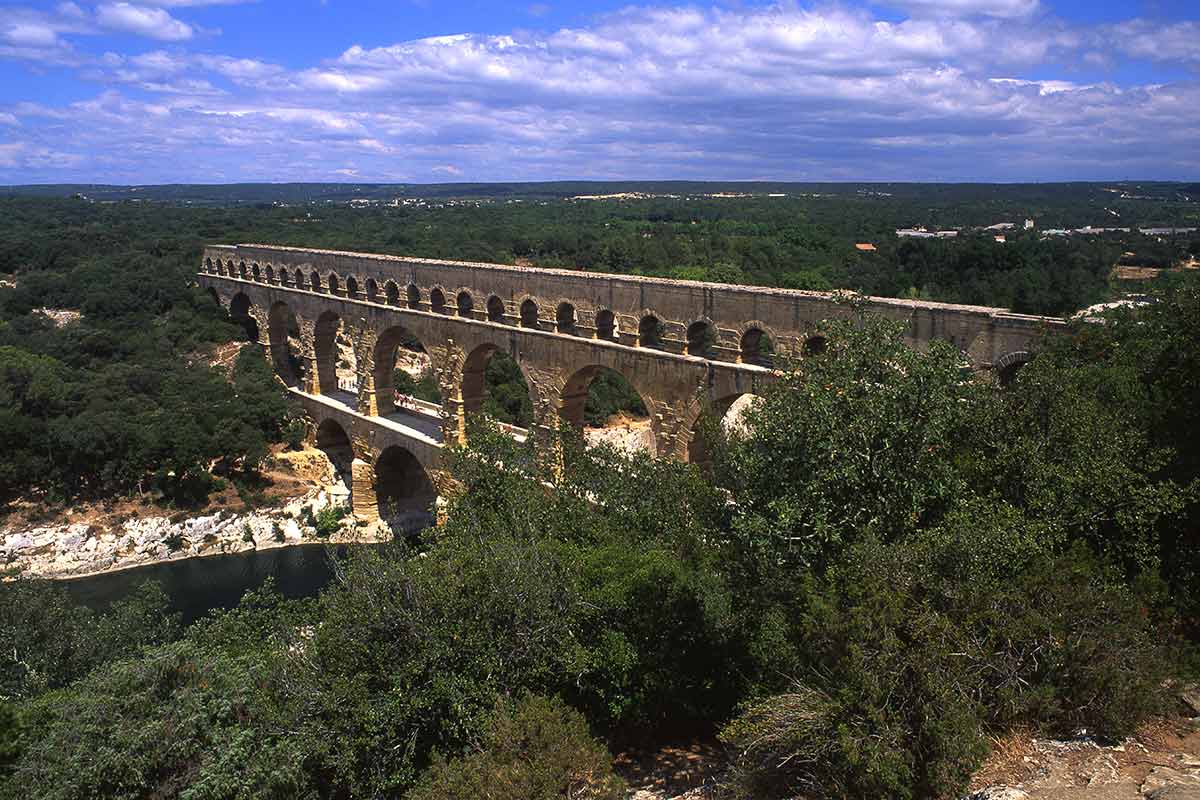
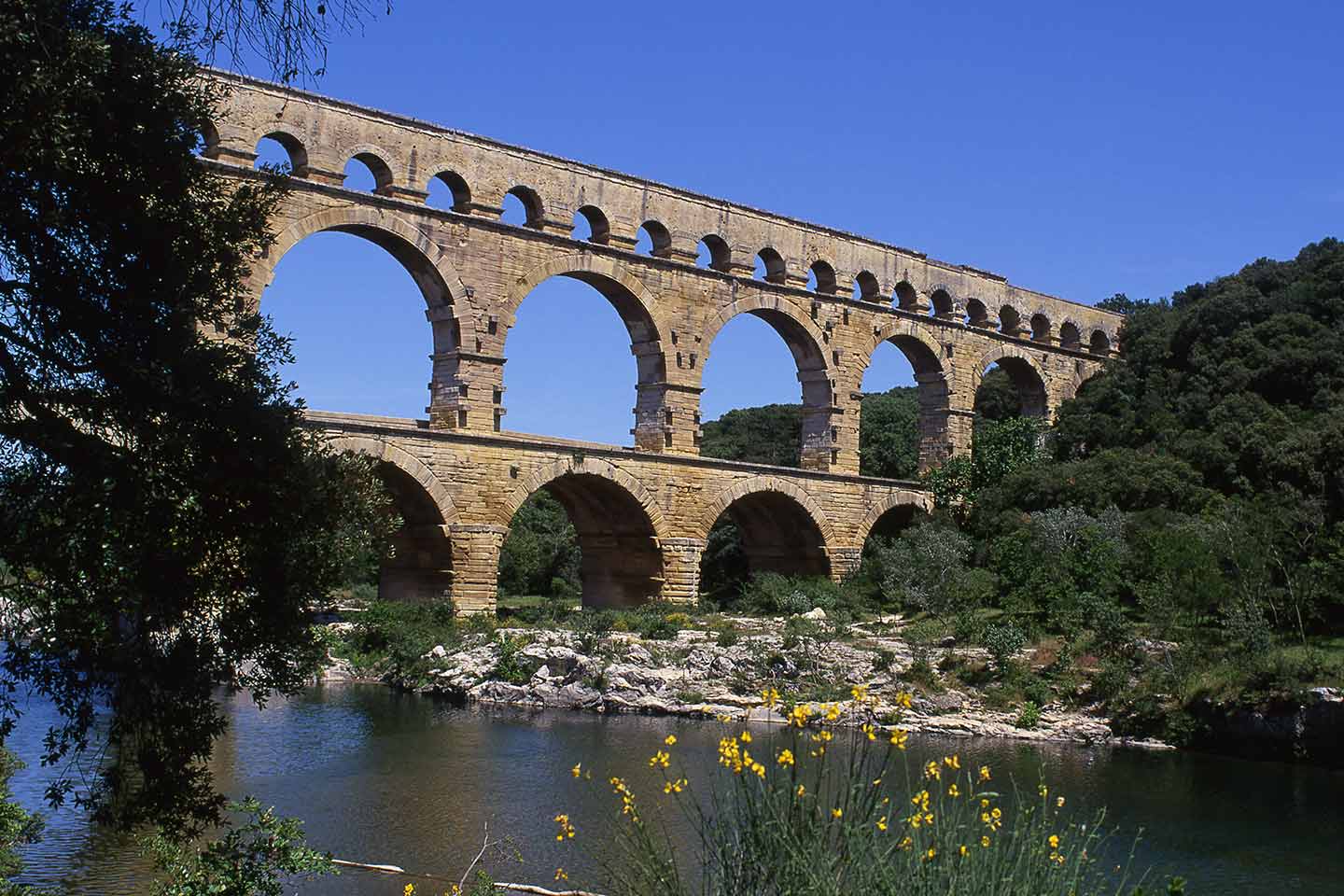
The Pont du Gard aqueduct was built in the 1st century to supply the city of Nemausus (modern Nimes) with water. It’s one of the most iconic bridges in Europe, a version of it depicted on the 5 euro note since it was introduced in 2002.
Its distinctive design, with three layers of arches (with the largest on the bottom and smallest at the top) is instantly recognisable, and it’s well worth travelling well out of your way to see this ancient marvel.
The aqueduct is part of a larger complex with a visitor centre and museum. From there you walk down the gentle hill to the Pont, which spans the River Gardon. You can walk across the lower level of the bridge, and along the banks either side, where some superb views are revealed. In summer you can also hire a canoe or kayak for a boat trip beneath the Pont.
Tickets: You can book your Pont du Gard ticket and audio guide here.
Getting there: For such a big-ticket sight right on its doorstep, services from Nîmes to Pont du Gard are surprisingly infrequent. The 121 bus service runs five times daily from the gare routière (central bus station, next to the train station), and the stop you require is Vers Pont du Gard, a short walk away from the Pont and its Museum. It takes between 45 minutes and an hour from Nîmes.
Uzès
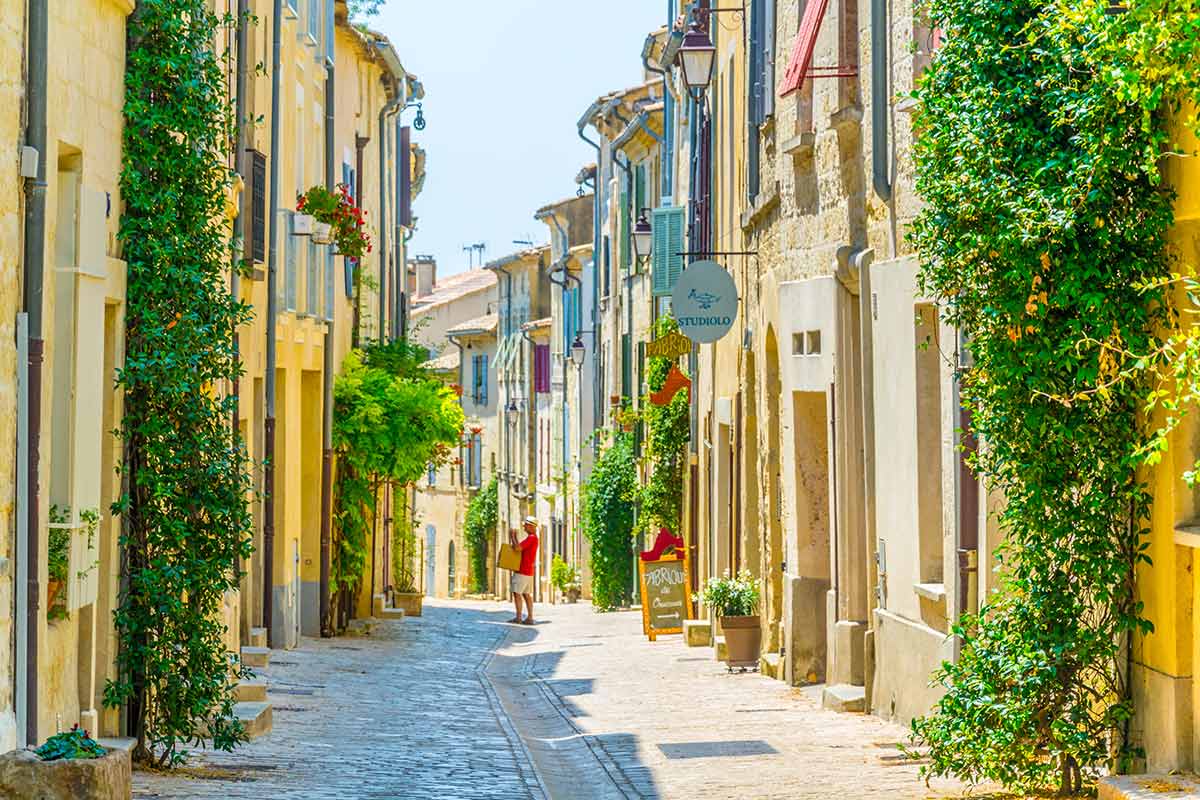
Sometimes you want to keep something under your hat. Uzès (pronounced ‘ooze-ezz’)is one of those places that I hope never changes, that I almost want to preserve in amber or aspic for ever. I couldn’t possibly omit it from this article, as it’s one of the most joyful discoveries that you’ll make in this part of southern France. Put it like this: if I was setting up an invitation-only ‘Les Plus Belles Villes De France’ consortium like the ‘Les Plus Beaux Villages’ one, Uzès would be in the first ten invites I’d send out.
Many visitors head straight for the Château du Duché d’Uzès, the Duchy Palace. It was begun in the 11th century and still appears a formidable fortress, on a hilltop overlooking the town. The military part of the complex was built in the 12th and 13th centuries, while the opulent residential quarters were added in the 16th century. The 17th Duke of Uzès lives there to this day.
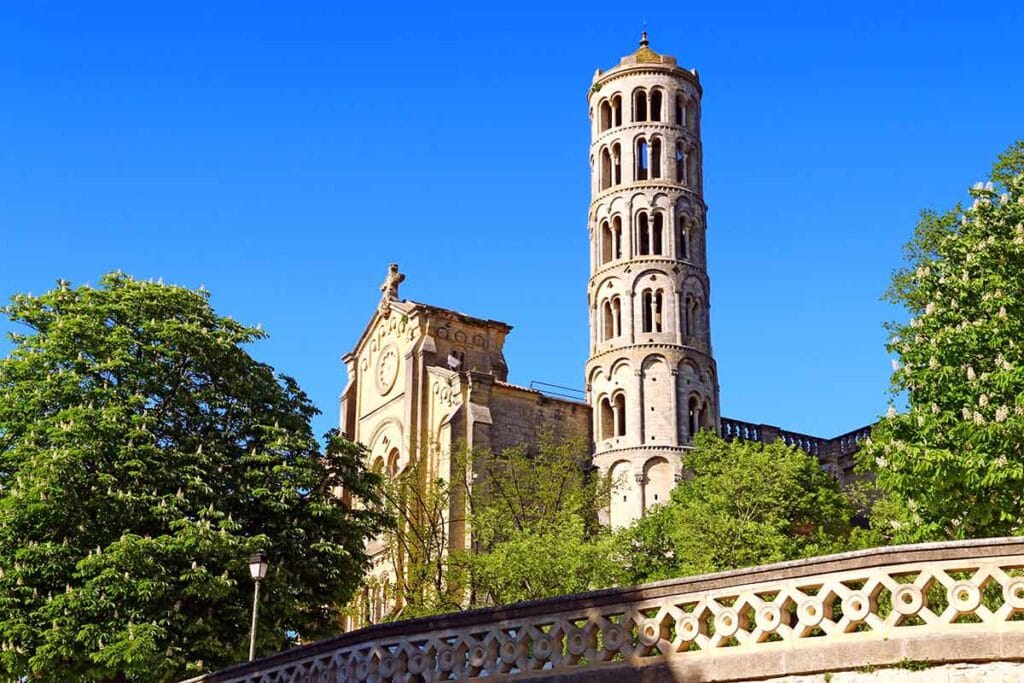
The Wars of Religion (which I mention a few times in the course of this article) took a major toll on Uzès and its churches, but mercifully part of the former Cathedral of St Theoderit survives. Its Romanesque belltower, the Tour Fenestrelle, is the only medieval part of the church to remain, though it didn’t entirely escape – it’s now six storeys high, two less than inn its prime. The rest of it was rebuilt in the 17th and 18th centuries in the Neoclassical style.
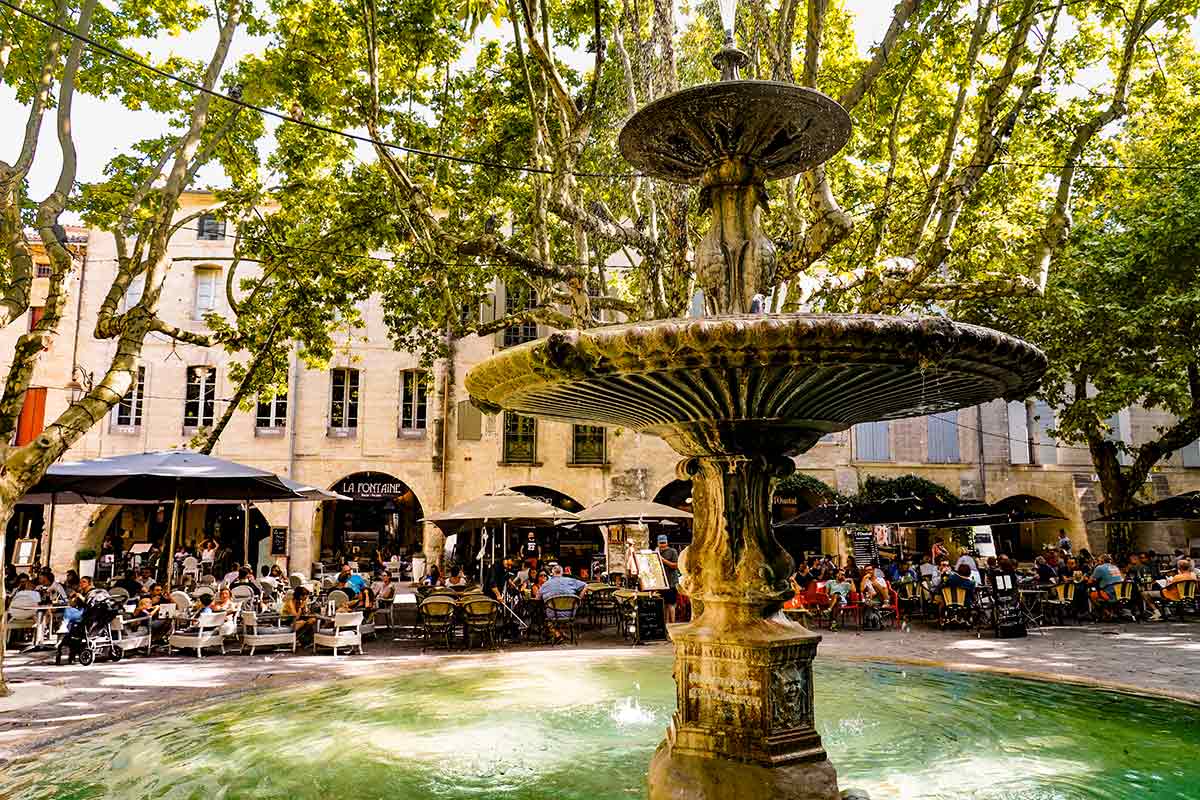
Make sure you wander around Uzès for at least an hour or two, and reward yourself with a drink at a table at one of the cafes on Place aux Herbes, the gorgeous main square which also hosts local farmers’ markets on Wednesdays and Saturdays. The medieval houses around the square are a delight, a beautiful backdrop to one of the best markets in the region.
Getting there: The 121 bus service that runs to Pont du Gard from Nimes continues to Uzès five times daily.
Saint-Gilles-du-Gard
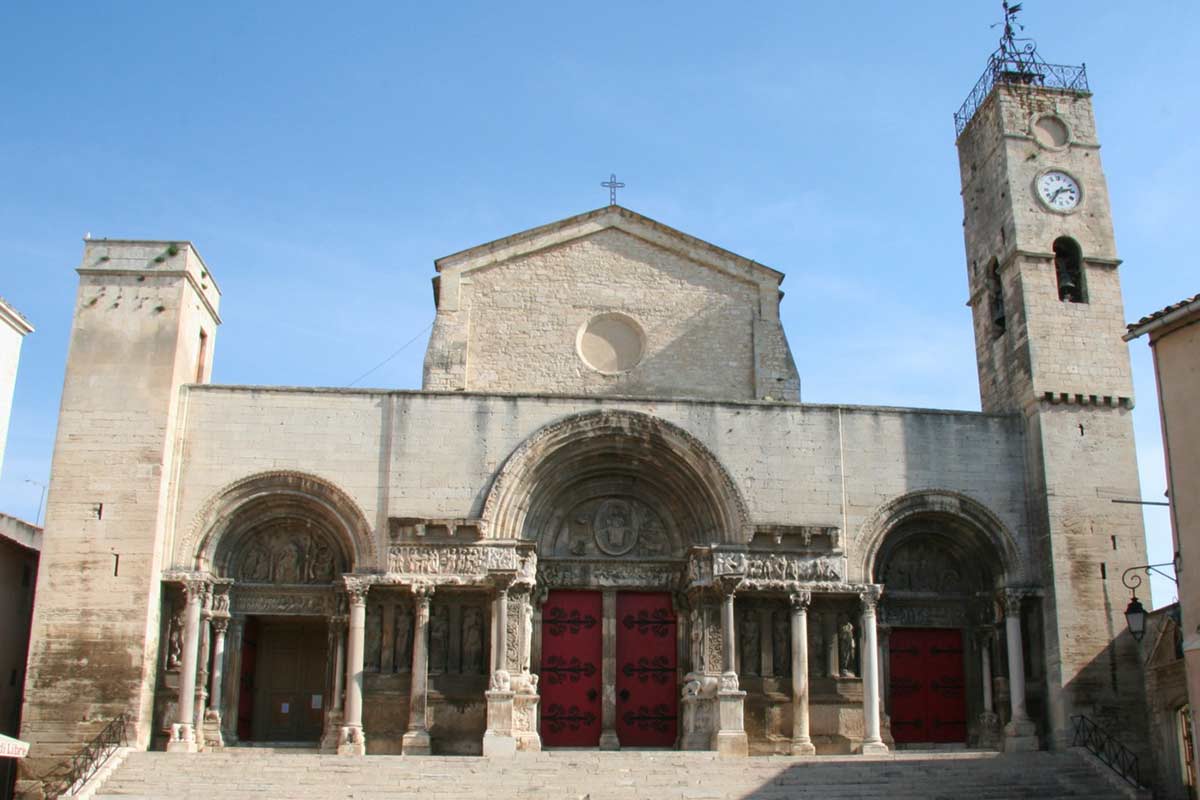
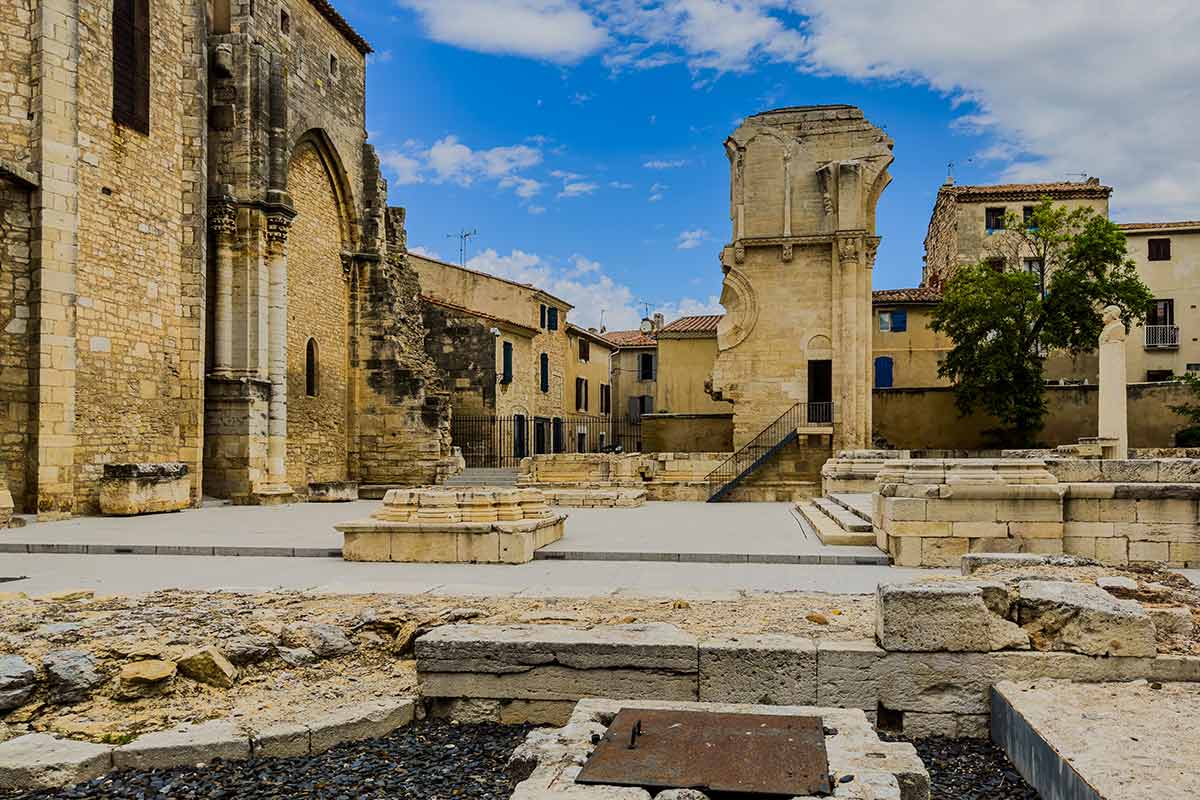
There is such a wealth of places to visit in this part of southern France that it’s so easy to overlook treasures practically staring you in the face – even World Heritage Sites. Such is the case with Saint-Gilles, which is part of the Routes of Santiago Compostela in France World Heritage Site.
This is one of the most wide-ranging UNESCO sites out of over 1,200, with 71 locations across the country, from renowned churches (also including the Abbeys of Conques and Vézelay) as well as bridges and sections of the pilgrims’ routes.
The former Abbey Church dedicated to Saint Gilles (St Giles in English, and he is known as Sant’Egidio in Italy) is one of the finest Romanesque churches in southern France. St Giles was a Greek-born hermit who is believed to have settled in the Rhône region in the 7th century AD, though much of his story may well be legend. He is said to have lived a reclusive, ascetic life in forests near Nîmes, and was once shot with an arrow while protecting a deer, his sole companion, from a hunter.
The east end (chancel and apse) of the church was destroyed during the Wars of religion, but the striking west front, with its outstanding Romanesque portal (worth of comparison with the exquisite example of St-Trophime in nearby Arles) remains. The large crypt (sometimes referred to as the lower church) has survived, and this is where you’ll find the tomb of St Giles. His relics were once taken to Toulouse for safe-keeping, but were returned to Saint-Gilles in the 19th century.
There are two must-see sights in the immediate vicinity of the church. Walk around to the ruined east end, where there’s a small square on the site of the church’s chancel. There is a rare surviving spiral staircase which you can climb, built into one of the pillars that has remained intact. And on the square at the west end of the church, the Maison Romane is a 12th-century house that is now a small museum.
Getting there: Take the frequent T1 bus from the centre (with stops outside the Maison Carree and Arenes) to Costières-Parnasse, and change for the (roughly) hourly bus 42 which takes around 35 minutes to reach Saint-Gilles. Mistral is the closest stop to the former Abbey church. Occasionally services terminate at the preceding stop, Chanzy, which is also close by.
Beaucaire & Tarascon
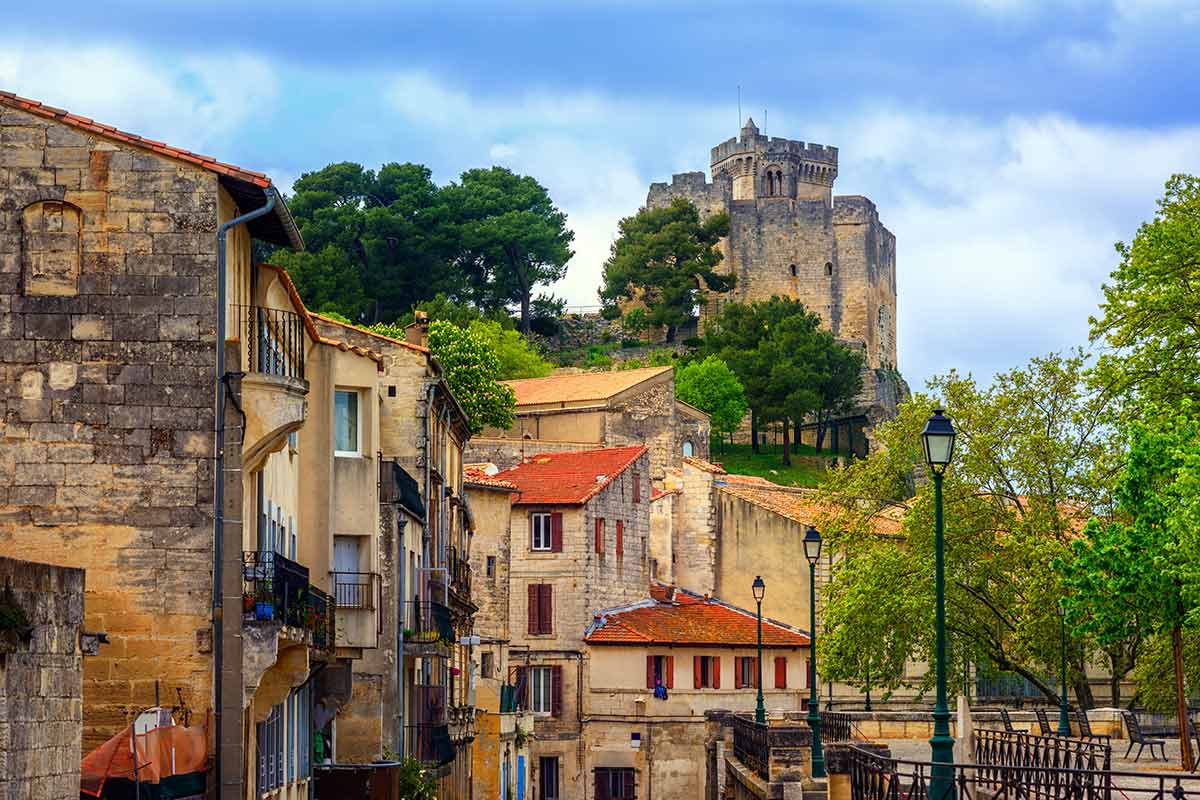
Beaucaire and Tarascon are two wonderful historic towns facing each other across the River Rhône to the southwest of Avignon. Once rivals, they are easy to reach from there or Nimes as they are on the railway line between the two cities. The Rhône forms the boundary between the two towns and also the départements and regions of Gard and Occitanie (Beaucaire to the west) and Bouche-du- Rhône and Provence to the east.
Travelling from Nimes, Beaucaire is the first stop. It’s dominated by its stout hilltop medieval castle, one of several in the region, with a rare triangular donjon (keep) rebuilt by Louis IX in the 13th century. Much of the town was destroyed during the 16th-century Wars of Religion, but it has benefited with many beautiful townhouses from the 17th and 18thcenturies.
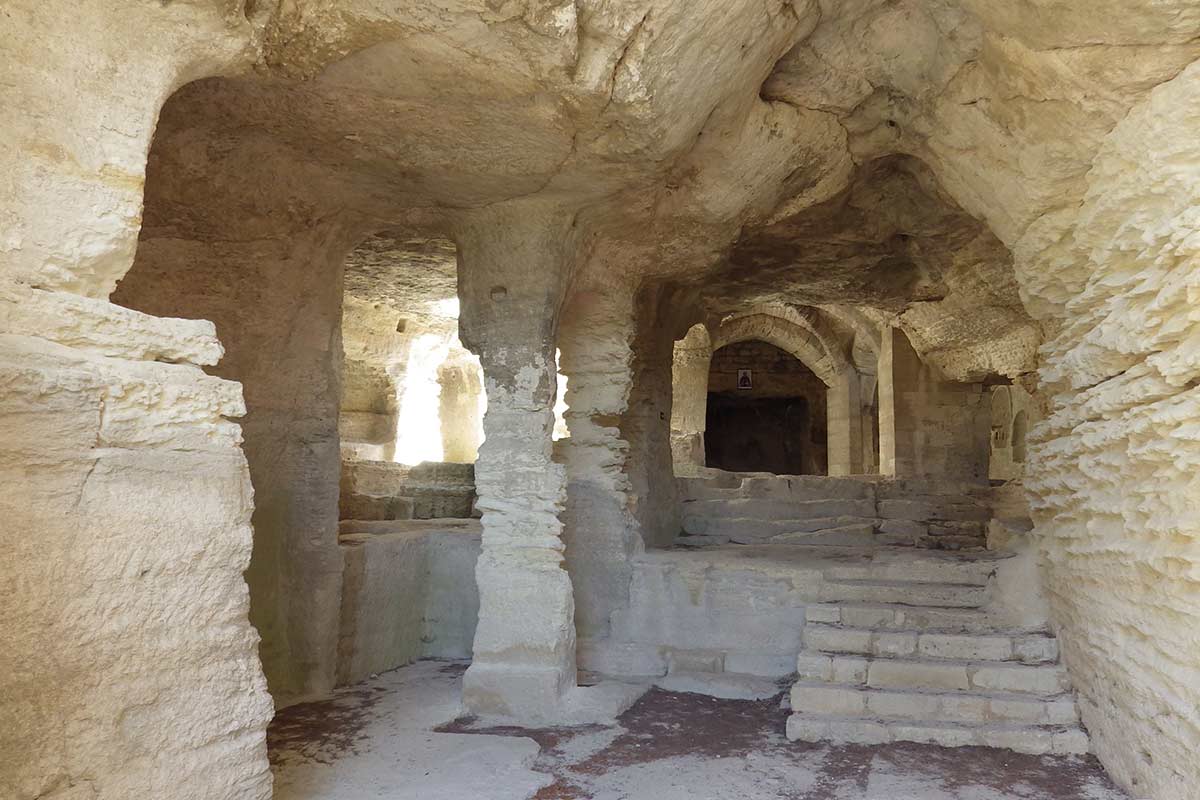
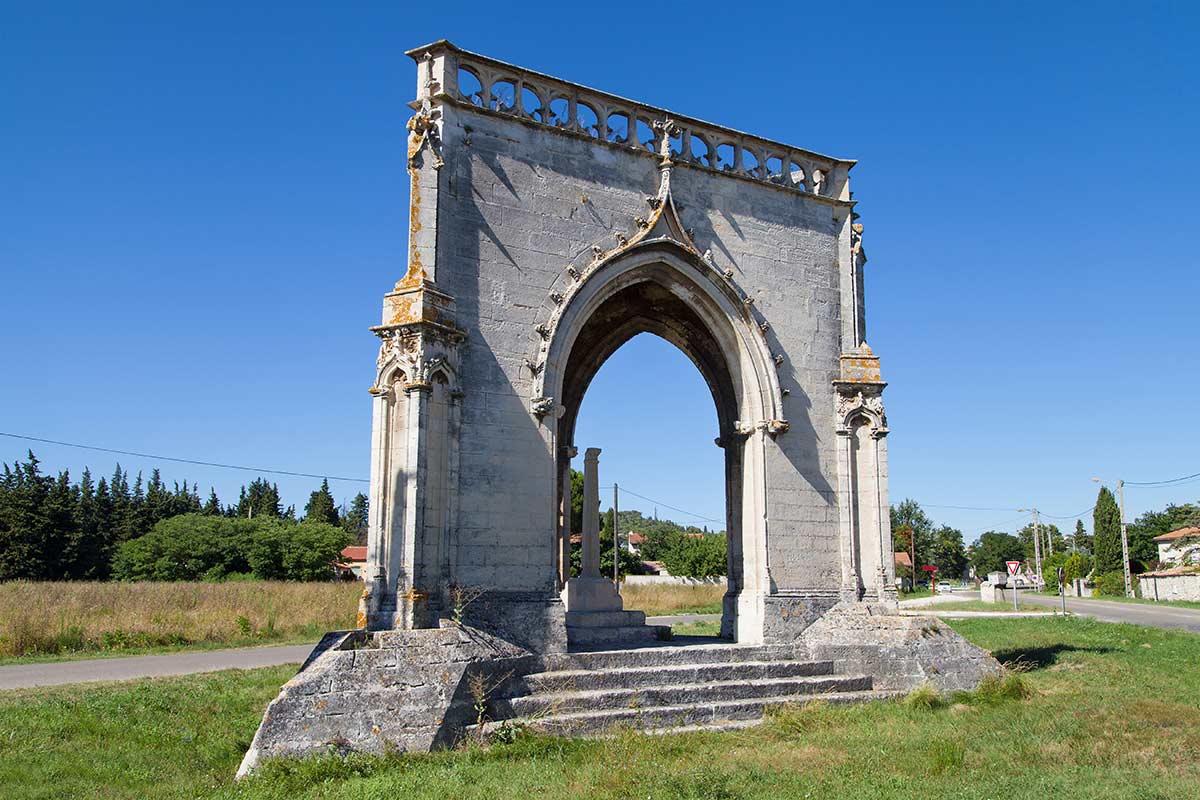
There’s also an unusual cave monastery, the Abbaye de Saint-Roman, built on a mountaintop and eventually abandoned in the 16th century. Also look out for the Gothic oratory of the Croix Couverte de Beaucaire, with a fine 14th-century arch. The original cross is now in the museum within Beaucaire Castle.
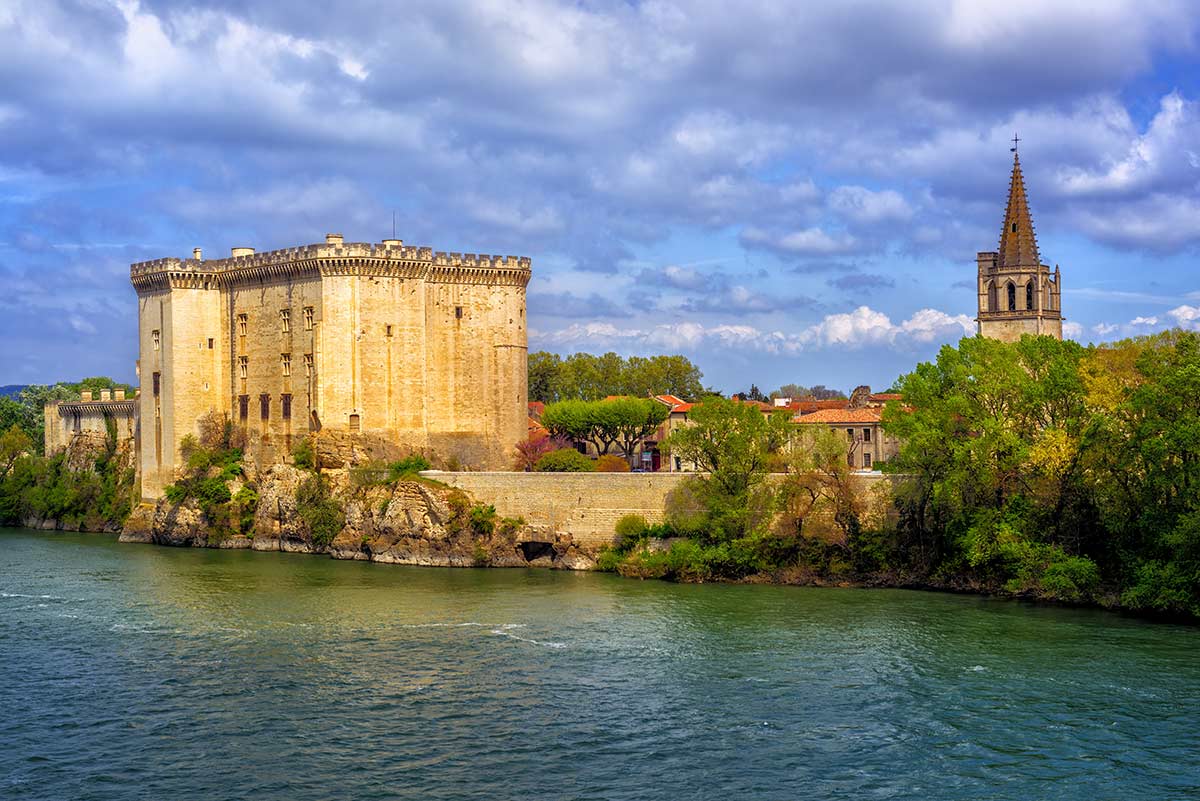
Across the Rhône in Provence, Tarascon became home to Martha of Bethany, sister of Lazarus (raised from the dead by Jesus) around AD 48, and local lore has it that she tamed a dragon (tarasque) in the river, only for locals to then kill it. Memory of the legend is kept alive in Alphonse Daudet’s Tartarin novels written between 1872 and 1890.
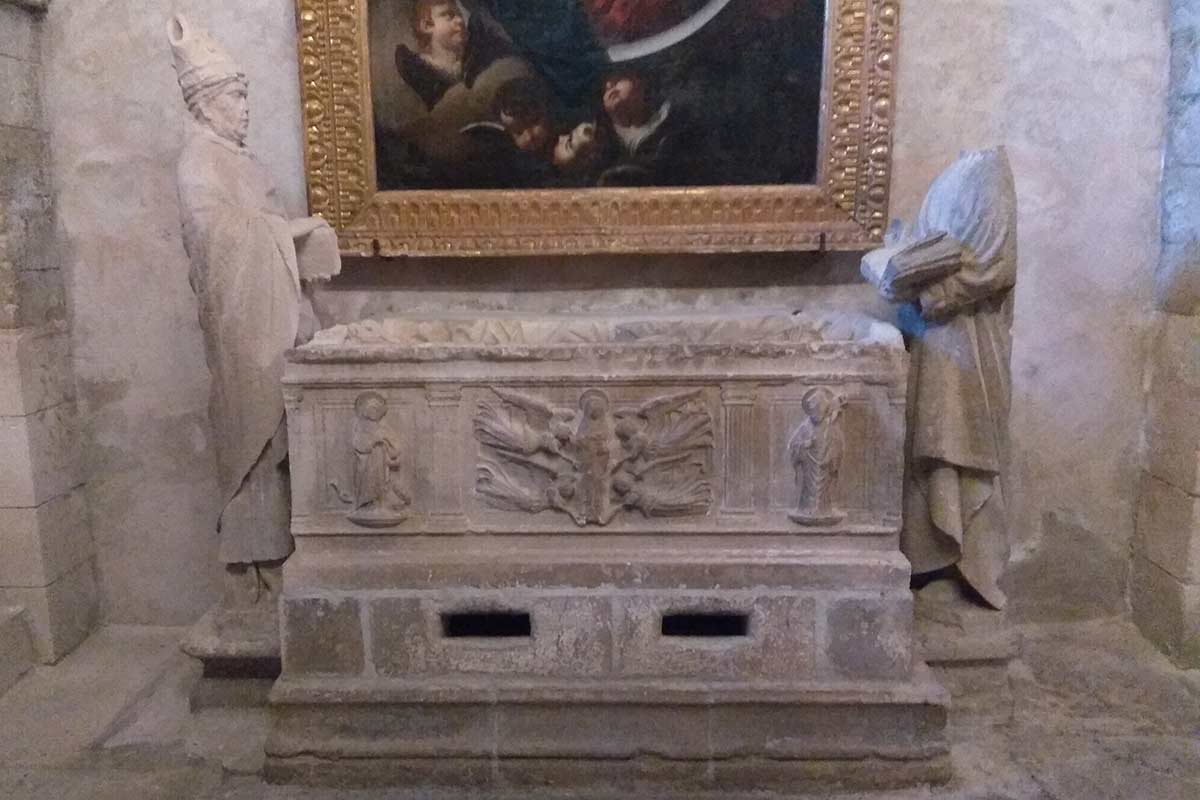
The church dedicated to St Martha stands next to the formidable riverside Castle of King René. Part of the church is from the 12th century Romanesque period, and the rest was built in the Gothic style around two centuries later. Martha is buried in a 4th-century sarcophagus in a 3rd century AD crypt which was restored and reinforced in the 17th century.
The Chateau du Roi René had to be rebuilt following its ransacking in 1399, and this long process was completed under the auspices of René d’Anjou, who was also King of Naples during its construction. The border fortress then held firm until the Wars of Religion the following century, after which it was used as a military prison.
Like Beaucaire, Tarascon is endowed with many fine 17th– and 18th-century townhouses. You could split a day between the two towns, though it’s quite possible that you may end up wanting to spend a day in each.
Getting there: A simple 22-minute journey by train from Nîmes to Beaucaire or Tarascon-sur-Rhone gare SNCF (train station). The stations are a 500-metre walk apart, and trains usually stop at both stations.
Arles


Arles is one of the most seductive cities in the south of France, small enough to see in a day and tempting enough to make a base for a week or more exploring the region. It’s considerably smaller than Nimes, and makes a natural jumping-off point for visiting the wilds and lagoons of the Camargue to the immediate south.
Arles’ main calling card, like Nimes, is its remarkably preserved Arènes, its stunning Roman amphitheatre built in the 1stcentury AD. It’s one of the five or six best-preserved Roman arenas in Europe, and along with those in Tunisia, is among the top ten in the world. It’s still used to this day to host concerts and camarguaise bullfights where the bull runs around with ribbons tied to its horns – the goal of the razeteurs is to remove them, ideally without being gored! There are other fine Roman remains in Arles, including Les Alyscamps, a Roman necropolis.


The city was also home to Vincent van Gogh in the 1880s, where he rented rooms in the now-destroyed Yellow House, and he painted prolifically while living in the city, including the Starry Night On The Rhône, a few metres from his former home. You can also visit the former Hotel-Dieu, now Espace van Gogh, where he stayed after cutting off his ear.
The newest Arles landmark is LUMA Arles, an arts centre designed by the late Frank Gehry. It’s destined to be one of the most iconic buildings in Provence, with an upper half in distinctive Gehry style, looking, as one architectural writer suggested, like a scrunched-up piece of Bacofoil!
Getting there: The quickest and only direct way to get to Arles from Nimes is the li0 bus number 130, which runs from the gare routière (bus station) to Arles every hour, taking 50 minutes. Alternatively you can catch the train from Nimes to Tarascon and change there for the service to Arles.
Avignon


I’ve recommended Avignon as the best base for exploring southern France elsewhere on this site, particularly if you’re reliant on public transport and the odd tour. Like Nimes, the City of the Popes has plenty to see, particularly the Palais des Papes, the imposing, austere 14th-century Gothic palace that was the residence of six popes.
Avignon is also renowned for its famous truncated bridge over the Rhône, the Pont St Bénézet, which inspired the traditional song, Sur le pont d’Avignon. The Cathedral on the hill, Notre Dame du Rocher des Doms, forms the third part of the city’s World Heritage Site.


There’s plenty more to see around the small walled city centre, from grand Gothic churches to the charming dyers’ quarter along Rue des Teinturiers and Place Crillon, one of the loveliest squares in France.
Tours: This Avignon walking tour comes very highly recommended – you just need to travel to the rendezvous point from Nimes to join it.
Getting there: Regular trains run from Nimes to Avignon-Centre, taking between 34 and 40 minutes.
Montpellier
I’ve only ever spent a day in Montpellier, on an epic France road trip in the late ‘80s. I was the tour leader and man with the map, and Montpellier was a bit of a blank spot for me before we arrived, the one place on our trip I knew very little about. One day there and that was cured alright, and I’ve been planning to return there for 38 years since.
Like. Nimes, Montpellier is a mixture of ancient and modern, but less ancient and more modern than the French Rome.
The ancient first: the University, founded in 1160, is one of the oldest in the world, with renowned medieval alumni including Petrarch, Nostradamus and playwright François Rabelais. You can still visit the Faculty of Medicine, created in the 12th century and housed in a 14th-century former monastery.
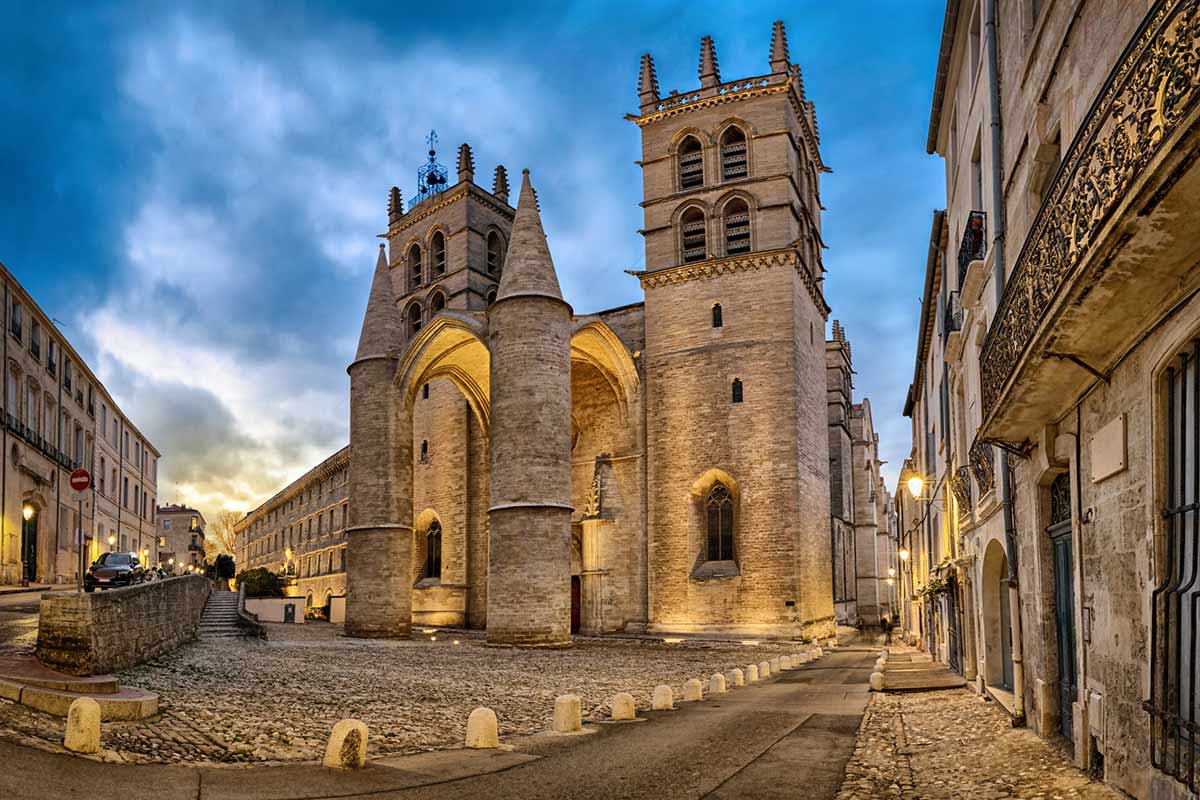
Next door to the Faculty, the Cathedral of St Pierre is the only medieval church in Montpellier to have emerged intact after the Wars of religion in the 16th century. Originally a parish church, it has a striking porch with two turreted pillars supporting the canopy, and inside you’ll find a beautiful late Gothic church rich in stained glass.
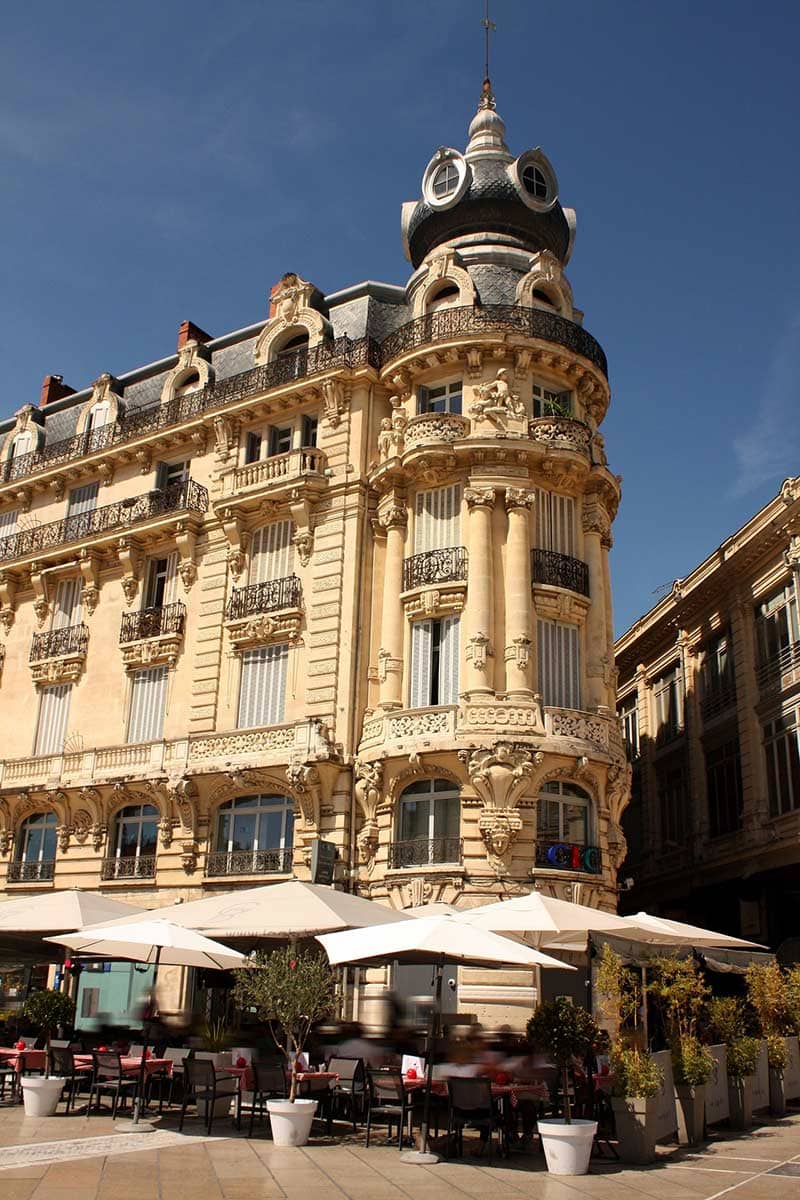
Montpellier grew in the 17th and 18th centuries, partly fuelled by a boom in the wine trade which eventually fizzled out (no pun intended) with an outbreak of phylloxera which killed off many vines in the area. The Porte de Peyrou triumphal arch dates from this period, as do many palaces and mansions around the city. Some of Montpellier’s finest buildings date from the 19th century, including the Opera House on Place de la Comédie, the grandest square in the city.
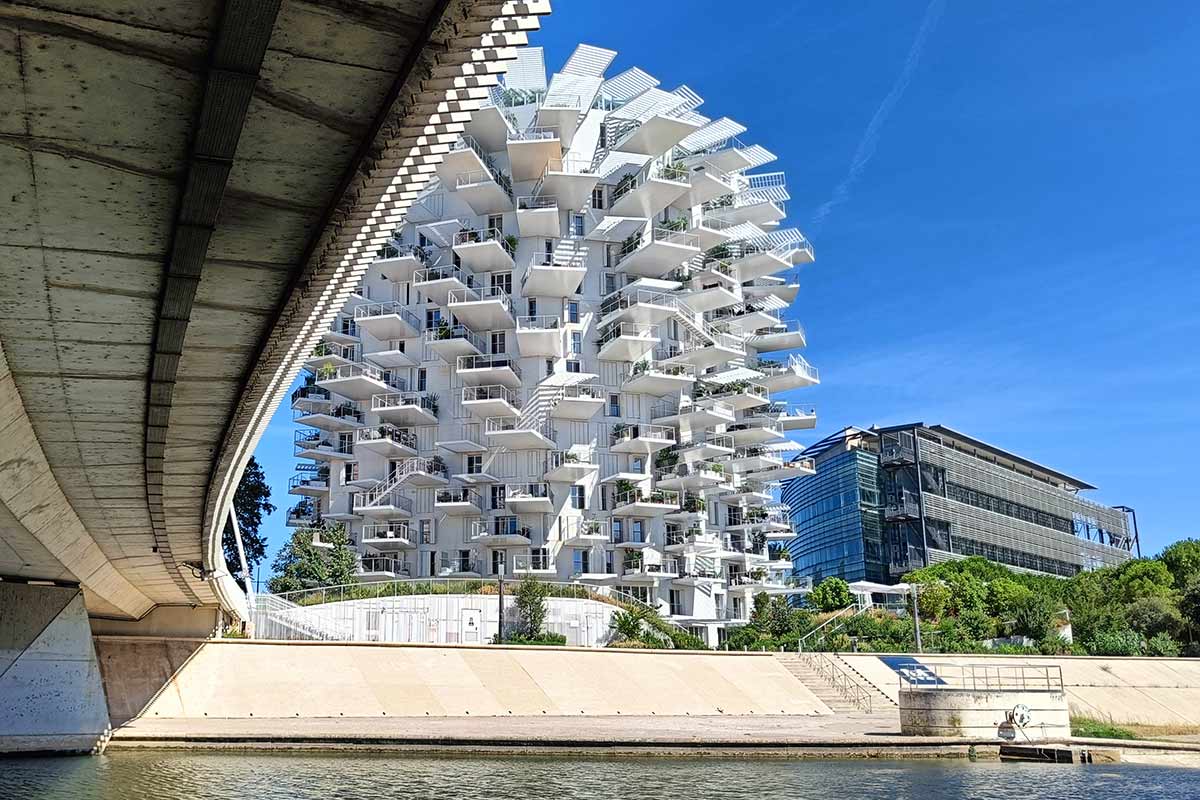
There are several more recent Montpellier landmarks, including the Antigone district (built in the 1980s) and the 2019 Arbre Blanc (‘white tree’), one of the craziest apartment (or any other kind of) buildings you are ever likely to see.
Getting there: Over 20 trains a day run between the two cities, taking between 24 and 45 minutes.
St Rémy de Provence
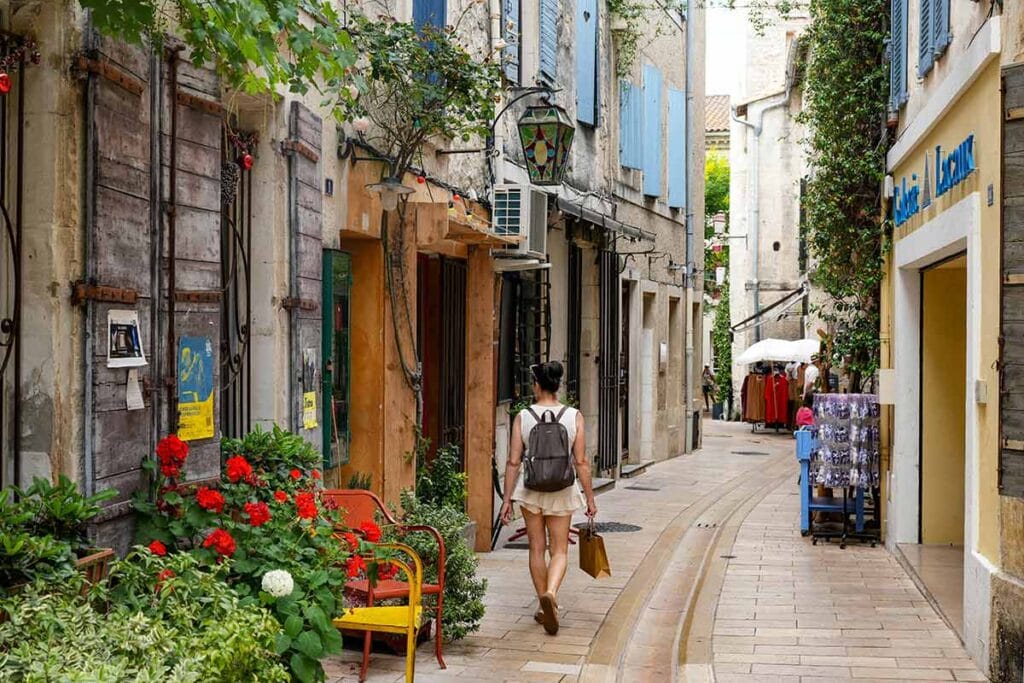
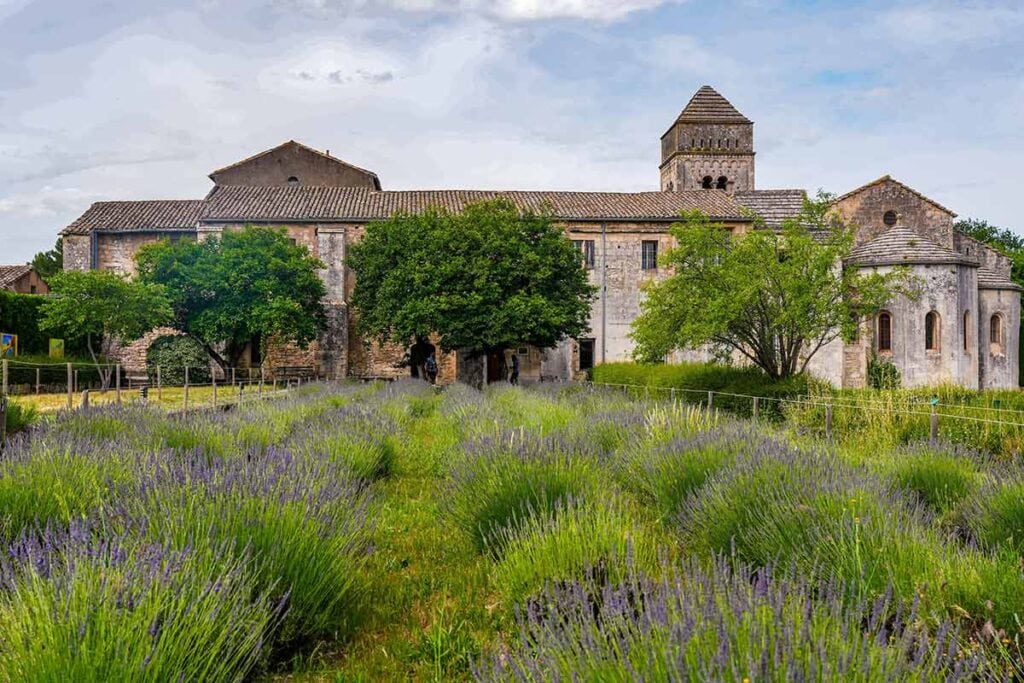
St Rémy de Provence is one of the loveliest country towns in Provence, with shaded squares and pastel-shuttered houses around its medieval centre, which was the birthplace of the 16th-century seer Michel de Notre Dame, better known as Nostradamus.
The main sights of St Rémy are about a mile (1.5 to 2 km) south of the town, on the D5 road towards the Alpilles hills and Les Baux de Provence.
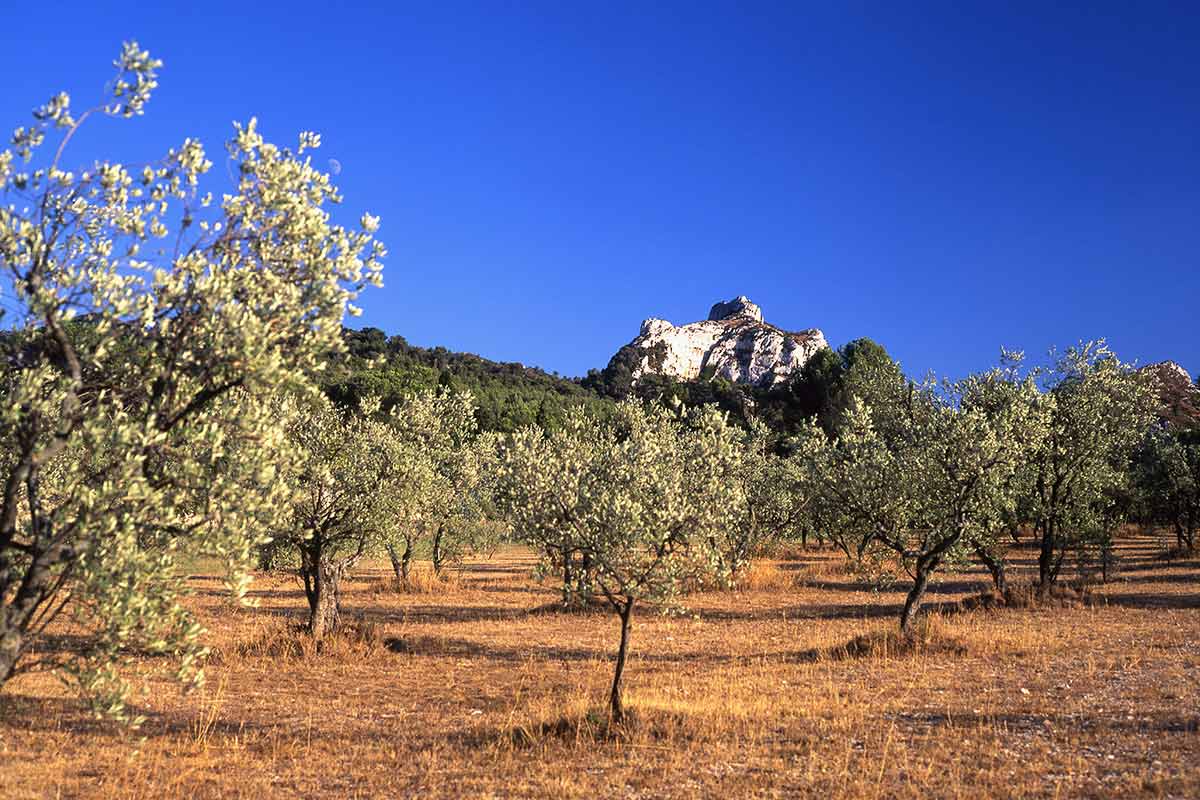
The first one that you reach is the Centre Culturel Saint Paul de Mausole, which has been serving as a psychiatric hospital since 1605. It was here that Vincent van Gogh was treated as an in-patient for a year from 1889 to 1890, his admission following him cutting off his left ear. This was a productive period for him, and he produced a series of works depicting olive trees and the Alpilles, as well as Saint-Paul de Mausole and its garden. Perhaps his best-known work from this period is Starry Night, which he painted looking out of the window of his room.
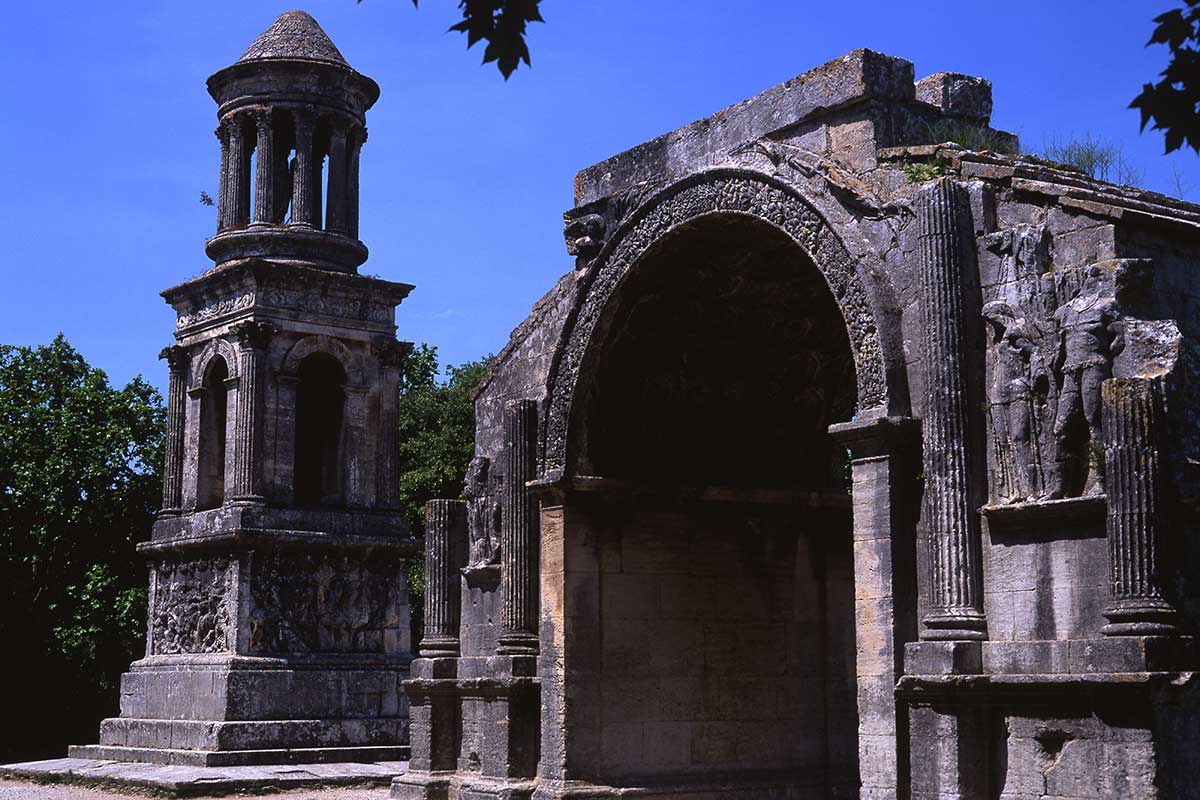
A couple of hundred metres further out of town, don’t miss the turn on the right. It’s the car park for the Glanum ancient town, but the most impressive monuments are next to the car park. Known as Les Antiques, a mausoleum (from between 40 and 20 BC) and a triumphal arch (believed to have been built 10-20 AD) stand side by side. They’re among the finest Roman sites in France, worthy of comparison with the triumphal arch in Orange and the amphitheatres in Arles and Nimes.
I’ve included the nearby village of Les Baux de Provence in the Day Trips From Nimes By Car section of the article.
Getting there: The easiest way to get to St Rémy from Nimes is to catch the train to Beaucaire (a 22-minute journey), then the 704 bus the rest of the way (it continues to Arles).
It’s a longer journey, but you can also get the train to Avignon-Centre and walk the short distance (300 metres, turn right outside the main station entrance) to the gare routière, where you can catch the 707 bus to St Rémy.
Aigues-Mortes and the Camargue
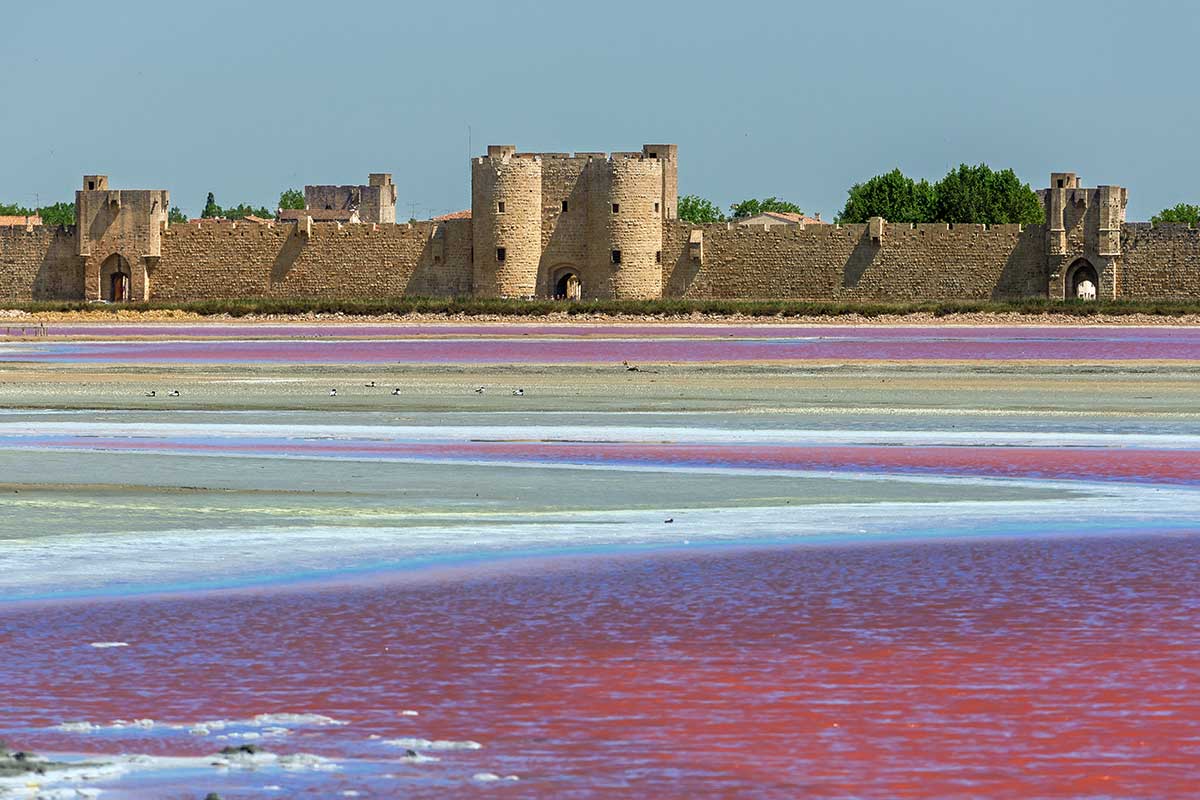
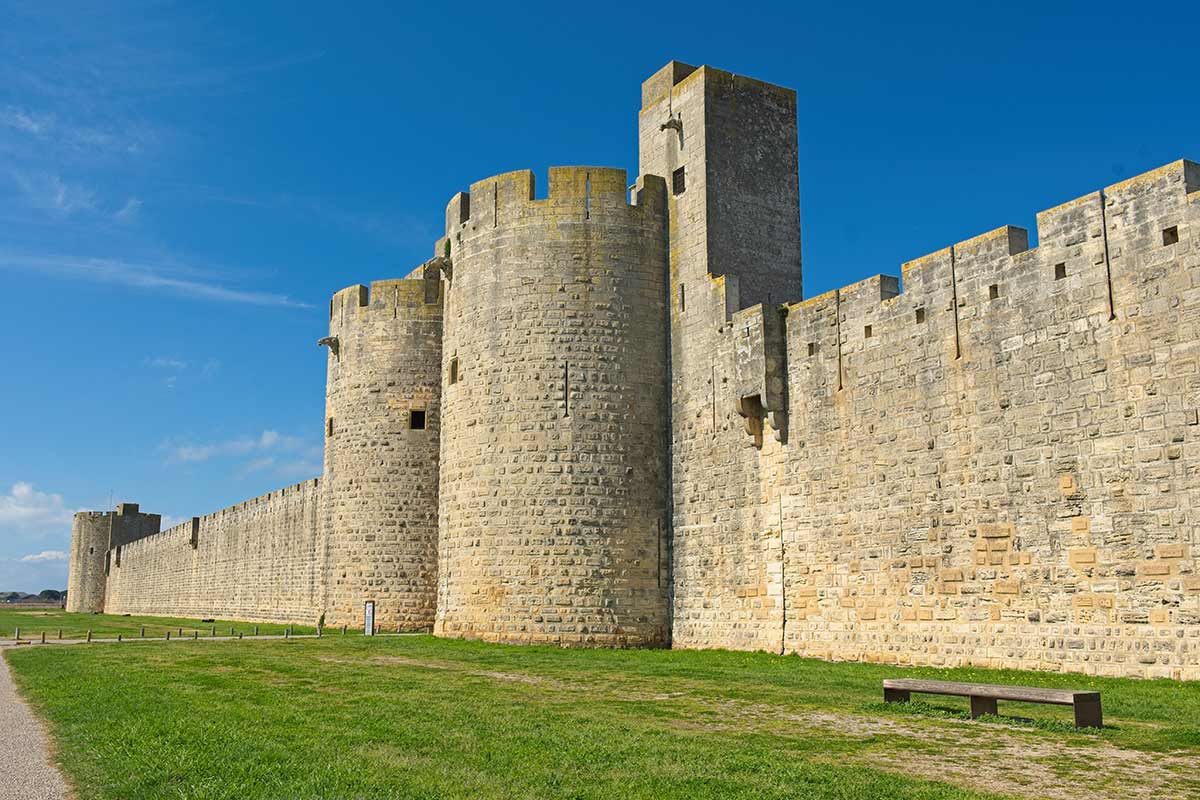
The walled town of Aigues-Mortes is one of the finest in France and Europe, mostly built by King Louis IX in the 13thcentury. Despite being King of France, various other noblemen held access to key ports on the Mediterranean coast, so Louis decided to build one of his own, from which he would set sail on Crusades to the Holy Land.
Louis completed the circuit of town walls – which are over a mile long (1,650 metres in total) and you can still walk the entire ramparts of the town. From high points such as the Tour de Constance, you get a superb view of the surrounding landscape of lagoons, salt marshes and the sea. There is also a fine Gothic church, Notre Dame des Sablons, which was completed in the 13th century. Its 17th and 18th-century decorations were later stripped out, restoring it to something akin to its original medieval appearance.
Aigues-Mortes stands on the edge of the Petite Camargue, in the west of the Rhone delta area, and it’s one of the main gateways to this fascinating landscape and its wildlife.
This is where buses and the train reach their limits. To explore the Camargue properly, you either need your own set of wheels or you need to join a tour.
Along with the Białowieża Forest in eastern Poland and some seabird colonies around the coast of the UK, this is the best place I’ve visited in Europe to see wildlife. Bulls (some of which are bred for non-lethal bullfights) and horses (which turn white after a few years) roam vast areas of the Camargue, and there are some amazing colonies of pink flamingos around the wetlands.
Tours: I strongly recommend this Camargue jeep photo safari which runs from Aigues-Mortes.
Getting there: Public transport saves the day, with a couple of trains daily but more frequent and far cheaper buses from Nimes-Planas to Aigues-Mortes Gare SNCF (railway station). Bear in mind that if you wish to explore the Camargue, you’ll need your own vehicle or to join a tour. And whatever you do, bring a good supply of insect repellent as the mosquitoes are absolutely fiendish.
La Grande Motte
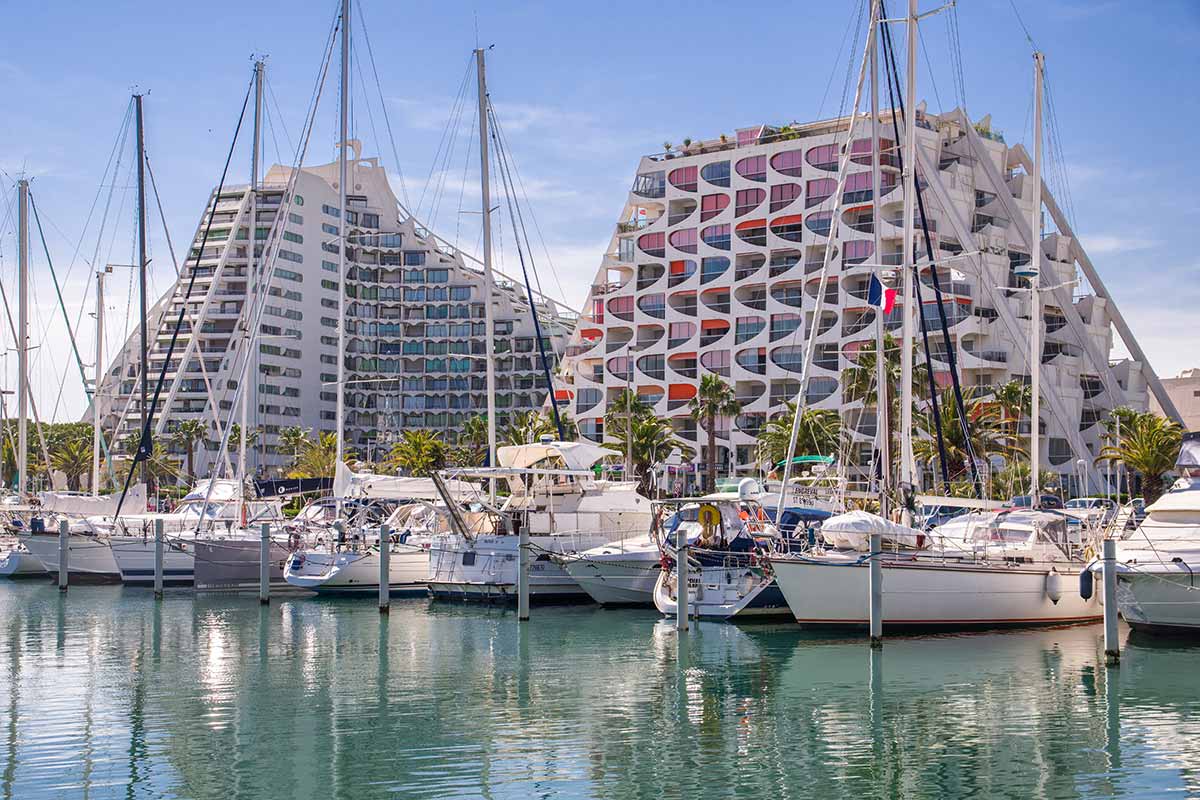
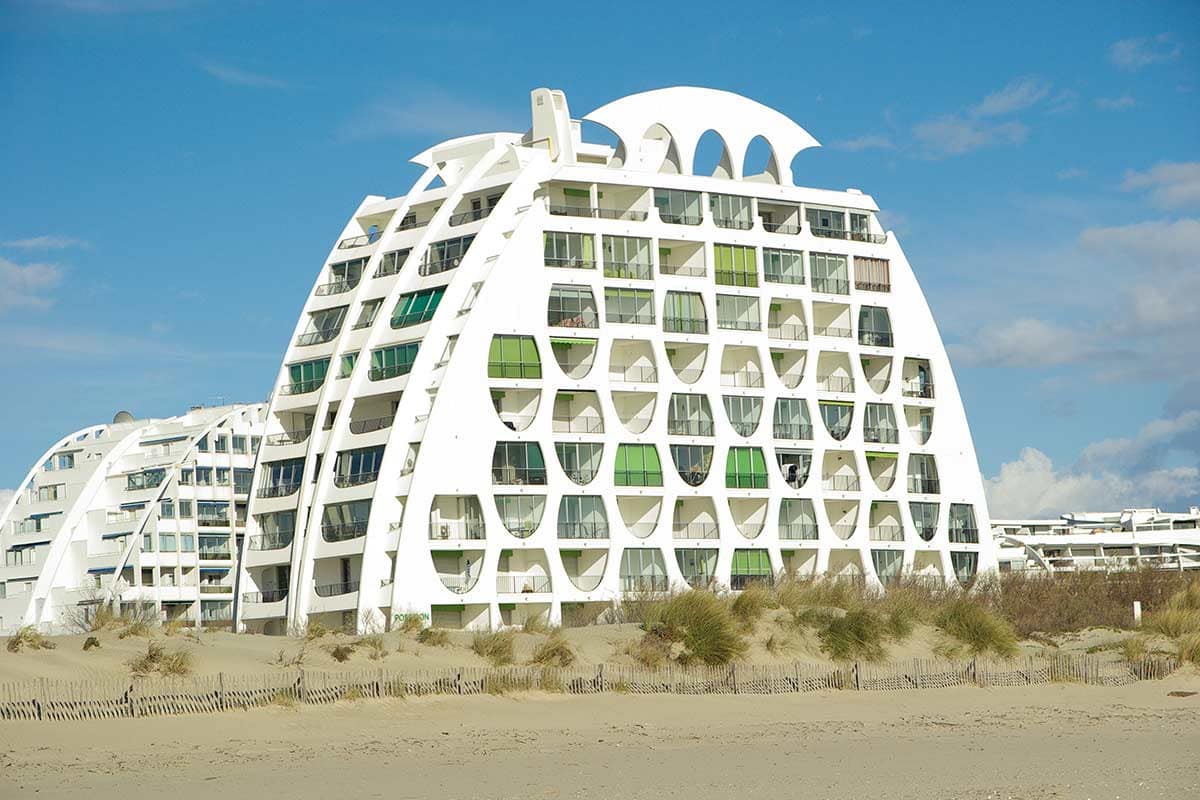
The first time I saw La Grande Motte, on my first epic France road trip in 1988, I thought that this is where aliens from another world would come for a beach holiday. It also reminded me a little of Aldous Huxley’s futuristic Brave New World, which I had read for the first time a few months previously. Almost 40 years on, I think the first comparison holds far more than the second!
The resort had only been built 15 to 20 years beforehand, on dunes close to a Mediterranean beach a few miles south of Montpellier and on the edge of the Camargue.
Designed by architect Jean Balladur, many of the buildings are inspired by and shaped like Central American pyramids, albeit in white concrete, steel and glass. The small town is actually very well laid out, with everywhere close to the beach and plenty of wide-open public spaces. I wouldn’t be at all surprised to see it make the UNESCO World Heritage one day like the rebuilt port of Le Havre in Normandy.
The beach is 7 km (over 4 miles) long, and the promenade along the main town section of it is very pleasant, with lots of cafes and restaurants where you can while away an hour or two.
Getting there: The liO 132 bus service runs from Nimes Planas station to La Grande Motte roughly every two hours, taking around 1 hour 30 to 1 hour 40 minutes.
Day Trips From Nîmes By Car
Les Baux de Provence


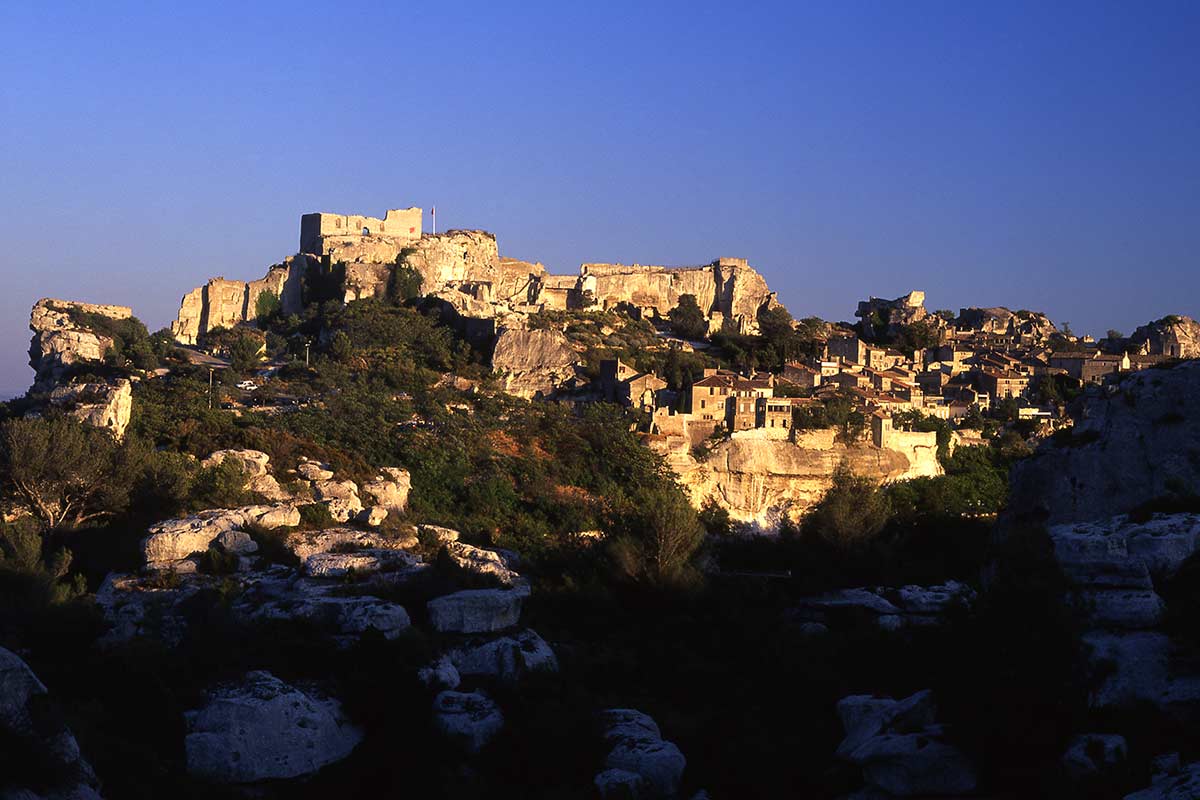

I’ve included Les Baux in this section, even though it’s only a short distance from Arles and St-Remy-de-Provence, as getting there by public transport – and then back – is an act of heroic persistence of which Odysseus would have been proud.
It’s a small hilltop village overlooking the olive groves and vineyards of the coastal plain below the rocky Alpilles range of hills. It’s dominated by its medieval castle, built onto an outcrop of rock, and it’s difficult to see where one starts and the other ends. The Castle also has an excellent collection of medieval siege engines, used both in attack and defence of castles.
Les Baux is a delightful village on the same rocky hill, just below the Chateau. There are two lovely old churches and a few streets full of centuries-old stone houses. The village is very touristed, with several galleries and shops throughout, but it’s well worth the visit if you have wheels and are anywhere in the vicinity.
Several tours also visit Les Baux, usually in combination with St Remy, the Pont du Gard or even both. However these tend to start from Avignon or Aix-en-Provence rather than from Nimes.
Getting there: Despite being one of ‘les plus beaux villages de France’, Les Baux remains a long way behind the pack when it comes to public transport. Twenty-five years after my first visit to Les Baux, it is as devilishly difficult as ever to find a bus that runs there. From Nimes, the train takes you as far as Tarascon, after which it’s an expensive taxi. You’re better off driving.
Saint Guilhem le Désert and Mourèze
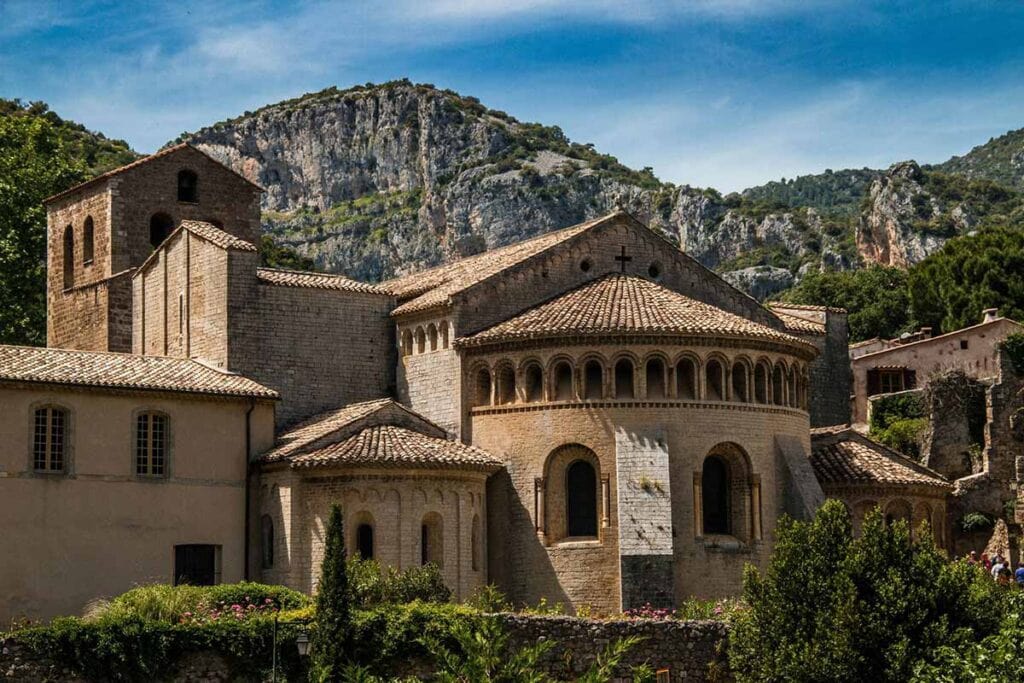
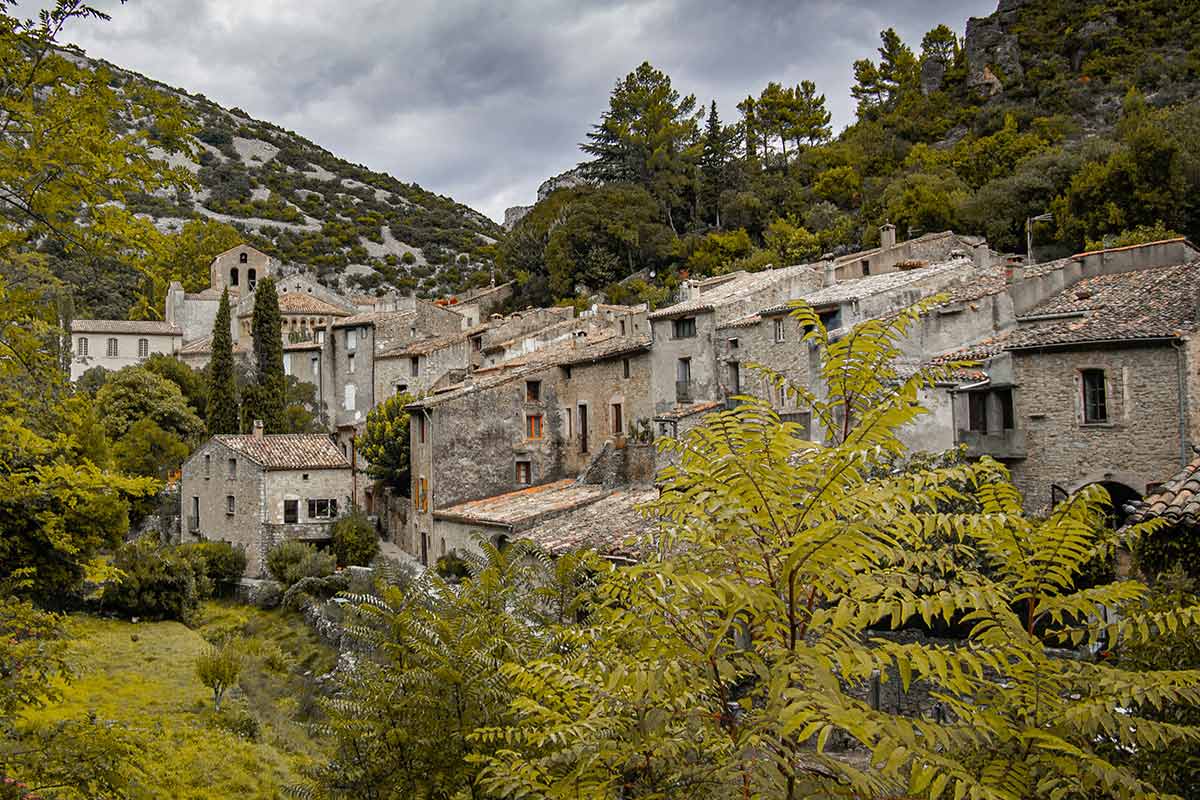
This relatively easy drive into the rocky hills of the Hérault north of Montpellier would be a behemoth of a trek by public transport, but we’ll stick with the 75-minute drive for this.
Saint-Guilhem-le-Désert is a medieval village in the mountains which is an important stop on one of the pilgrimage routes to Santiago de Compostela. It is part of the same World Heritage Site as the Abbey at Saint-Gilles just to the south of Nimes, mentioned earlier in the article.
The medieval stone village is tiny and utterly gorgeous, surrounded by woodland and rugged hills. The Abbey is a humble Romanesque wonder, founded in 804 AD by St Guillaume of Gellone, after whom the village is named with Occitan spelling. His relics were held in the church, along with fragments said to be of the True Cross on which Jesus Christ was crucified. The crypt remains from the early 9th-century church.
Much of the rest of the church remains intact, although after the French Revolution part of the cloister was taken down and sold to the United States, where it is now part of the Cloister Museum in New York.
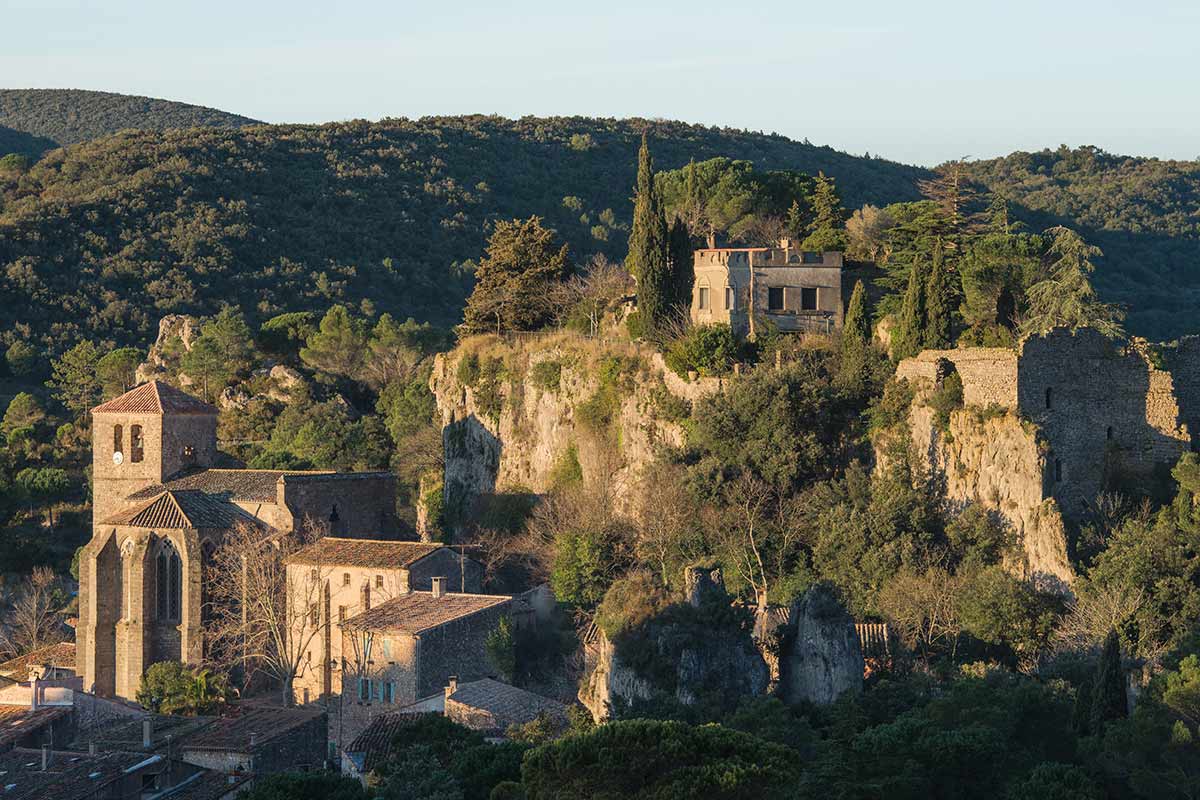
This St Guilhem le Desert tour from Montpellier also visits the dramatic village of Mourèze, which is 18 miles (30 km ) to the west of Saint-Guilhem le Desert. It’s another very old Hérault village, set among the rock pinnacles of the Cirque de Mourèze, a hanging valley formed millions of years ago by glacial action high in the mountains. It’s a fairly easy 40-minute drive between the two villages.
Getting there: Forget public transport – there is very little of it in this part of the world. Driving is the only option.
Best Day Trips From Nîmes – Final Thoughts

I hope that you have enjoyed this article and that it has given you a few ideas for your next visit to the south of France. I suggest taking a look at my guide to spending one day in Nîmes if you’re contemplating using it as a base.
I’ve visited the region many times and written extensively about it and elsewhere in France. Here is a selection of further articles for you to browse:
South of France Road Trip– a 10-day itinerary across Provence and Occitanie
Things To Do In Albi – stunning red-brick World Heritage city with outstanding Toulouse-Lautrec Museum
Things To Do In Carcassonne – one of the most beautiful walled towns in Europe – and the world
One Day In Arles – Roman monuments aplenty, and a chance to follow in the footsteps of Vincent van Gogh
One Day In Avignon – 24 hours by the Rhone in the City of Popes
Best Day Trips From Avignon – 14 fantastic day trips from the City of Popes
Things To Do In St Rémy de Provence – idyllic Provençal country town with superb Roman monuments and the former hospital where Vincent van Gogh spent the penultimate year of his life
Paris Articles
Best Eiffel Tower Views – 28 best places to see the Eiffel Tower in Paris
Arc de Triomphe Paris – all you need to know before visiting this great Paris landmark
Things To Do In Montmartre – the hilltop village that inspired so many artists in the 19th and 20th centuries
Sunset in Paris – the 15 best places to see one
Things To Do In The Latin Quarter Paris – exploring the historic Left Bank
Visiting Place de la Concorde Paris – one of the most iconic squares in Paris
Pont Alexandre III Paris – stunning Belle Epoque Parisian bridge
Famous Churches In Paris – 22 stunning Parisian churches to seek out
Icons of Paris – from the Mona Lisa to the Moulin Rouge, the Arc de Triomphe to Art Nouveau Metro signs, and many more
La Sainte Chapelle Paris – one of the most beautiful Gothic churches ever built
General France Articles
Famous Landmarks In France – 32 of the top sights to tick off your France bucket list
14 Most Amazing Bridges in France – from the Millau Viaduct to the Pont Neuf, and many more