

Art Nouveau Paris flourished briefly for a few years towards the end of the Belle Époque period of 1871 to 1914. In these years, a few Parisian architects and artists took up the baton from Brussels, creating some extraordinary buildings and possibly the most iconic Art Nouveau sights in Europe along the way.
Some of the great Paris Art Nouveau sights were built for the 1900 Paris Exhibition (Exposition Universelle), the extraordinary and exuberant Pont Alexandre III, the Grand Palais and its neighbour, the Petit Palais.
But it’s Hector Guimard’s Metro signs and station entrances which are the most widely known survivals from Paris’ Art Nouveau years. Over 80 of the evocative station signs remain across the city, and they are one of the most powerful icons of Paris, second only perhaps to the Eiffel Tower, Notre Dame and the Arc de Triomphe.
In this article I show you twelve of these Paris Art Nouveau sights, suggesting a fee Art Nouveau hotels to stay in and some tours to help you uncover more of the city’s wondrous Art Nouveau heritage. Enjoy!
Great Art Nouveau Hotels in Paris
One of the best ways to appreciate Art Nouveau in Paris is to stay in one of the hotels from the period. Here are my favourites.
Our Picks
Mandarin Oriental Lutetia Paris – one of the loveliest Art Nouveau hotels in Europe, great location close to the Saint-Germain-des-Prés church and literary quarter
Hotel Miss Fuller – exquisite 4-star hotel full of Art Nouveau furnishing and decoration, including stained-glass by Jacques Gruber, creator of the Galeries Lafayette glass dome – and very close to the Arc de Triomphe
Hotel Élysées Ceramic – beautiful Art Nouveau 3-star hotel a few minutes’ walk down the hill from the Arc de Triomphe
The following twelve sights showcase the very best of Parisian Art Nouveau.
1. Hector Guimard’s Metro Signs and Station Entrances
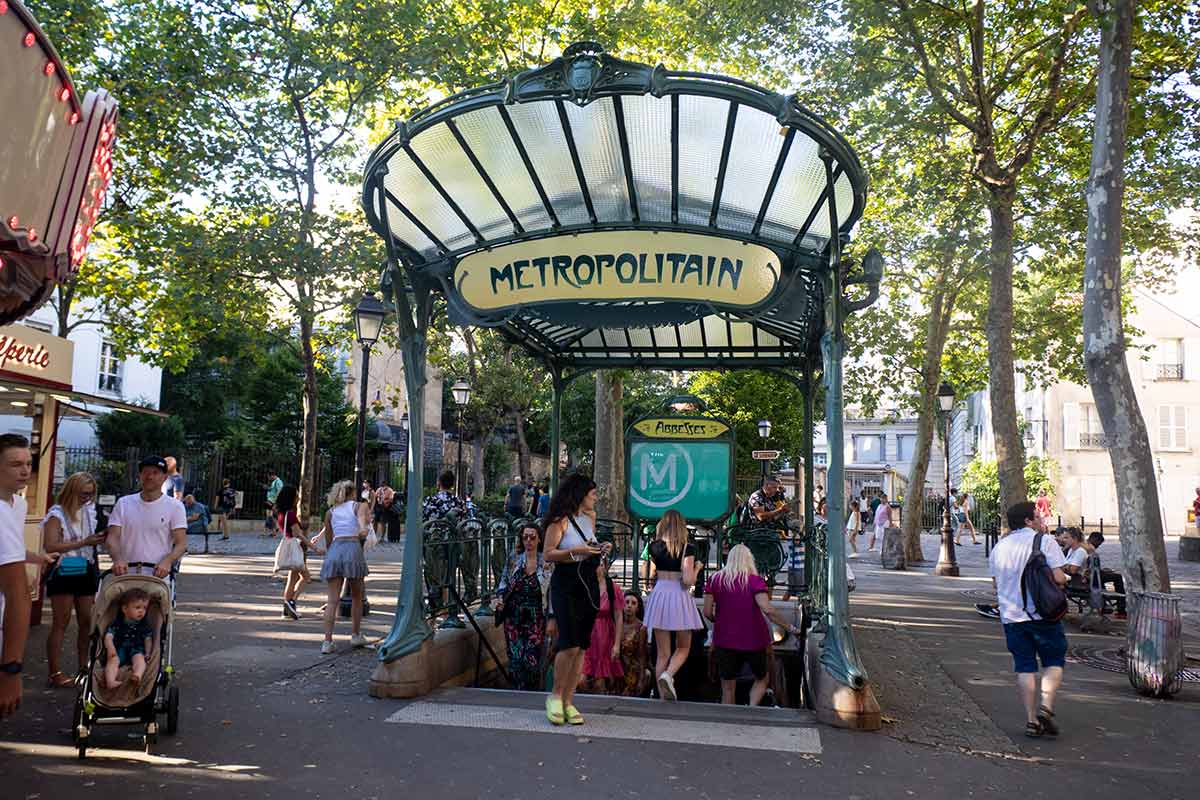
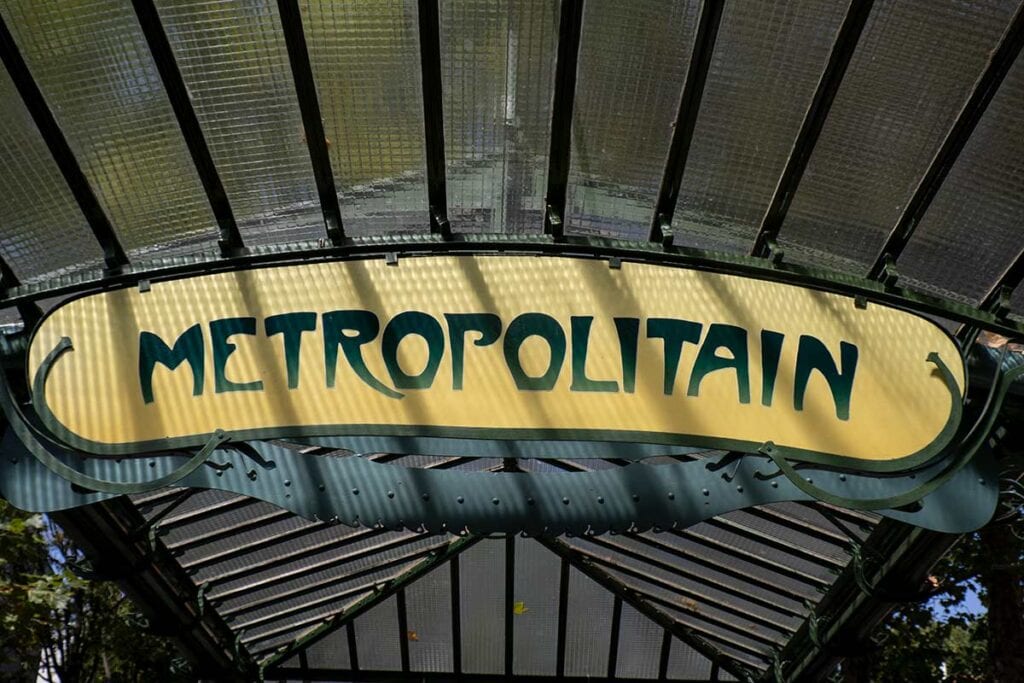
Paris is rightly celebrated for being one of the most beautiful cities in the world, with some of the most renowned and at times radical architecture on the planet. The city’s many Metro signs and station entrances – particularly Hector Guimard’s Métropolitain signs – are among the most evocative and loved icons of Paris.
When I lived in Paris over thirty years ago, I was amazed to find that much of this Paris Art Nouveau heritage had been lost. As in demolished. How could something as beautiful as that be destroyed? This must have been one of the architectural crimes of the 20th century. And some of them were being removed within a few years of installation, to be replaced by more functionalist designs.
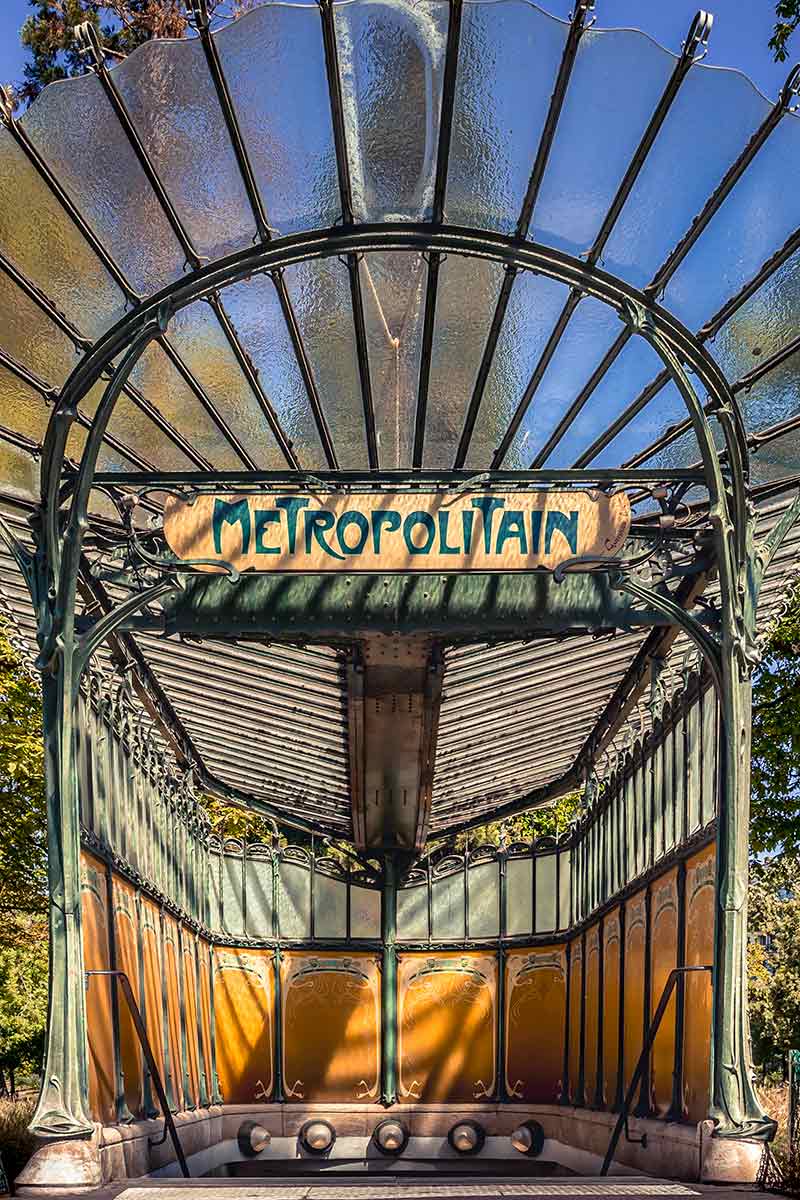
The three pavilion-style station entrances built by Guimard have all been lost. Only two of the Édicule B entrances have survived – at Abbesses Metro station in Montmartre and at Porte Dauphine (above), on the western edge of central Paris close to the Bois de Boulogne. These entrances have glass canopies which some visitors compare to butterfly or dragonfly wings.
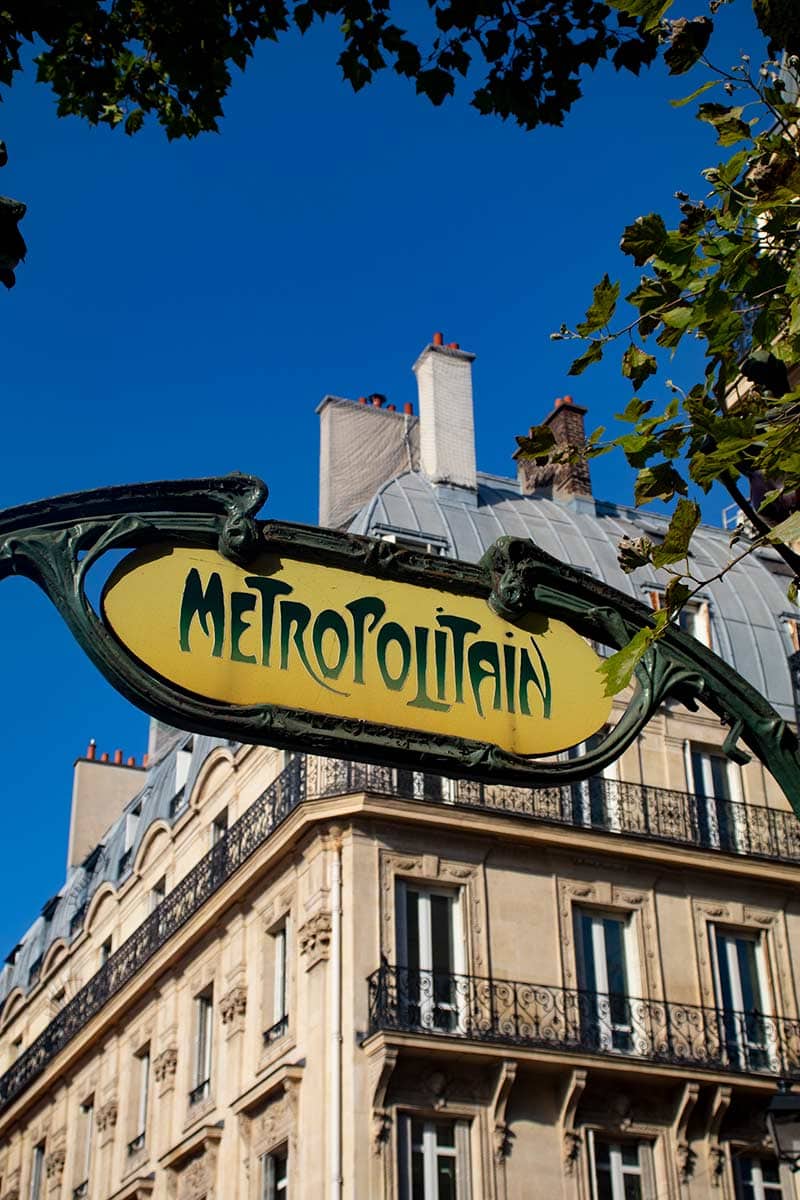

Fortunately a further 84 smaller station signs and entrances have survived, and thankfully someone had the good sense to protect them as historic monuments. These entrances are my favourite Guimard creations, the side pillars resembling the stalks of a plant, and the lamps either side of the sign similar to flowers emerging from a bud or sepal.
And if you’re wondering, the lead shot of this article is from one of the main stations on the Left Bank of the Seine. A photographer rarely reveals his or her secrets!
Tours: This Paris Art Nouveau walking tour takes you to some of the Metro stations, as well as the Ceramic Hotel and Lavirotte Building (see below)
2. Lavirotte Building, 29 Avenue Rapp
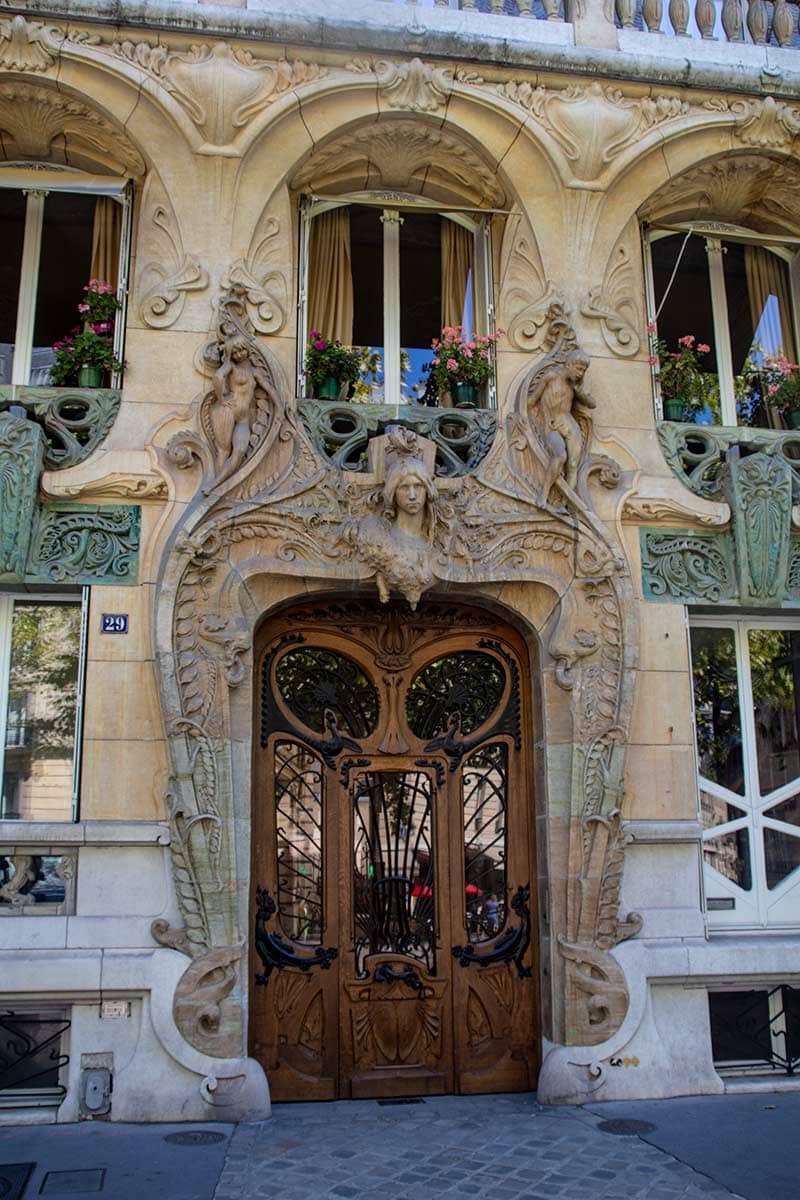
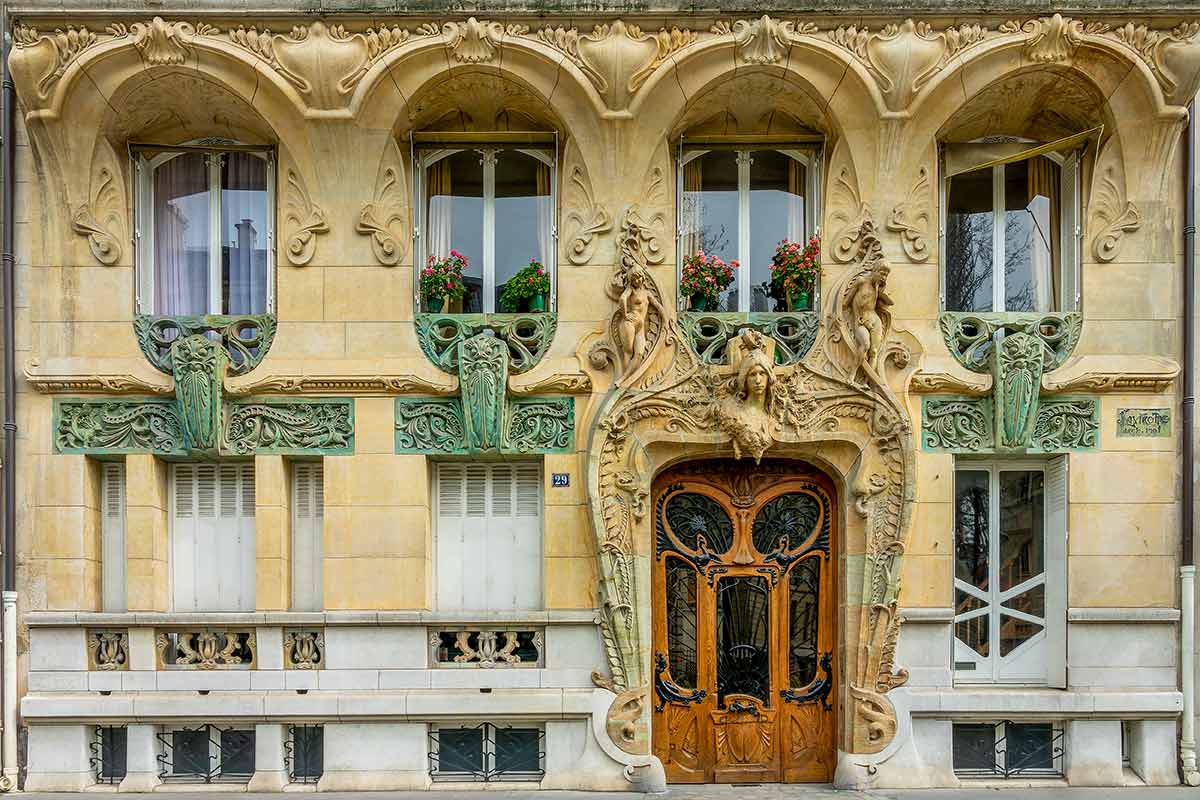
One of the pitfalls of being an architect during the Art Nouveau period was that it wasn’t the most popular artistic and architectural form. It had plenty of detractors who were loud in their condemnation, so a career in Art Nouveau architecture in Paris could often be short – as even Hector Guimard found out. Even the great Ödön Lechner encountered the same problems in Hungary at the same time.
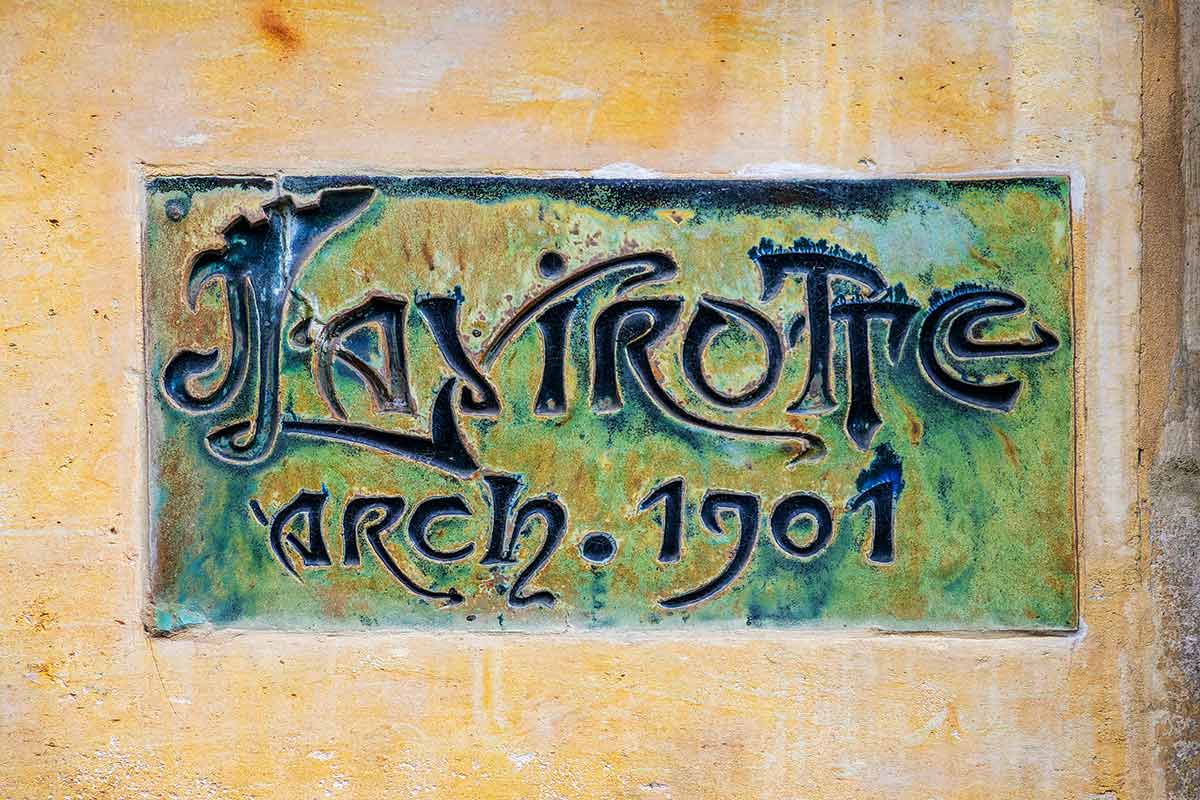
And so it was with Jules Lavirotte, a Lyon-born architect who graduated from the École des Beaux Arts in Paris in 1894. His first few commissions were in this part of the 7th arrondissement, on the Avenue Rapp and its side streets. Lavirotte came to wider attention in 1901 when his façade of 29 Avenue Rapp – often referred to as the Lavirotte Building – was awarded a prize for the most original building façade in Paris.
It’s believed that the building was part-owned by Lavirotte himself, along with Charles Combes, a French industrialist. It’s an incredible work, one of the most striking Art Nouveau buildings in Europe. The doorway is especially impressive, with a richly carved wooden door, oval windows, intricate wrought-ironwork and elaborate relief carvings around it.
The rest of the façade is just as packed with detail, with different-shaped windows, pillars, carved reliefs and extensive use of ceramics, made by former chemistry professor Alexandre Bigot.
Sadly the Immeuble Lavirotte is a private residence and therefore not open to the public. Therefore I can’t tell you much about its interior, other than that Lavirotte built two walls with a small gap between them in parts of the building, in an attempt to provide soundproof living spaces.
Lavirotte received little further recognition, and the importance and merit of his work was eventually recognised in the 1960s. The Lavirotte Building and his other surviving works are now protected as historic monuments.
3. Galeries Lafayette Dome
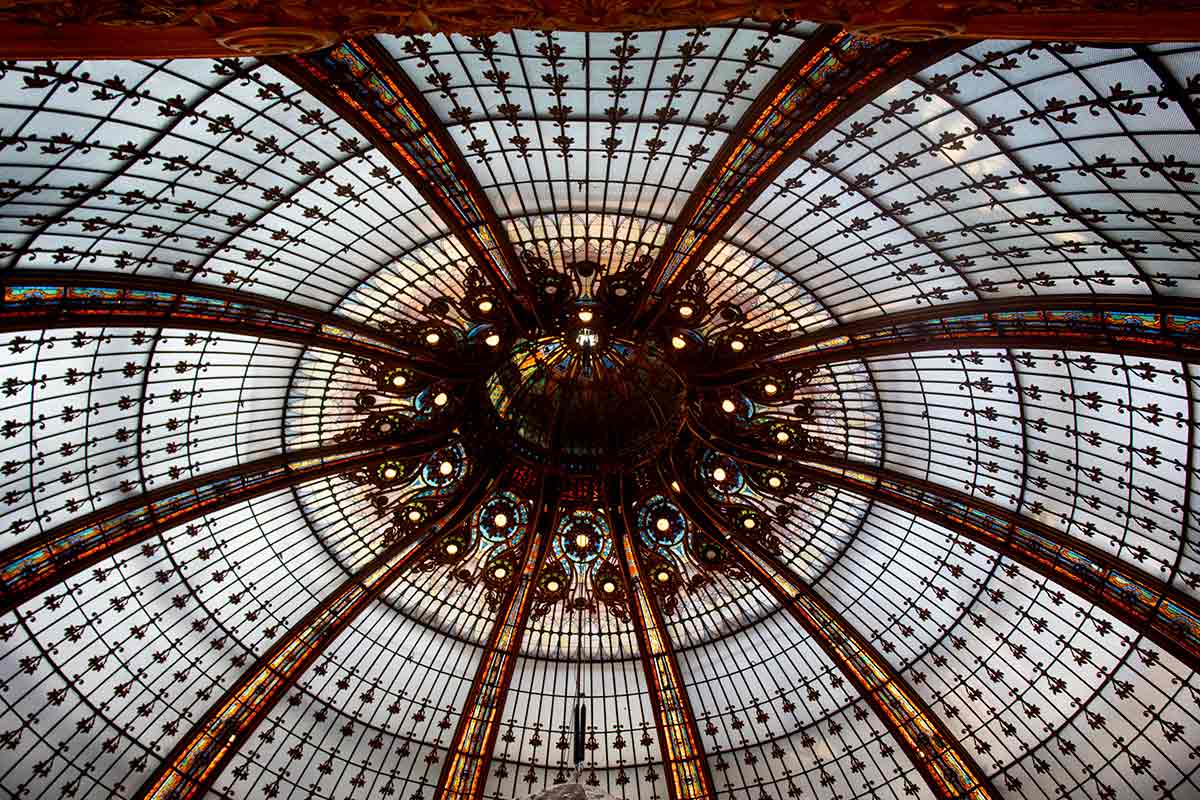
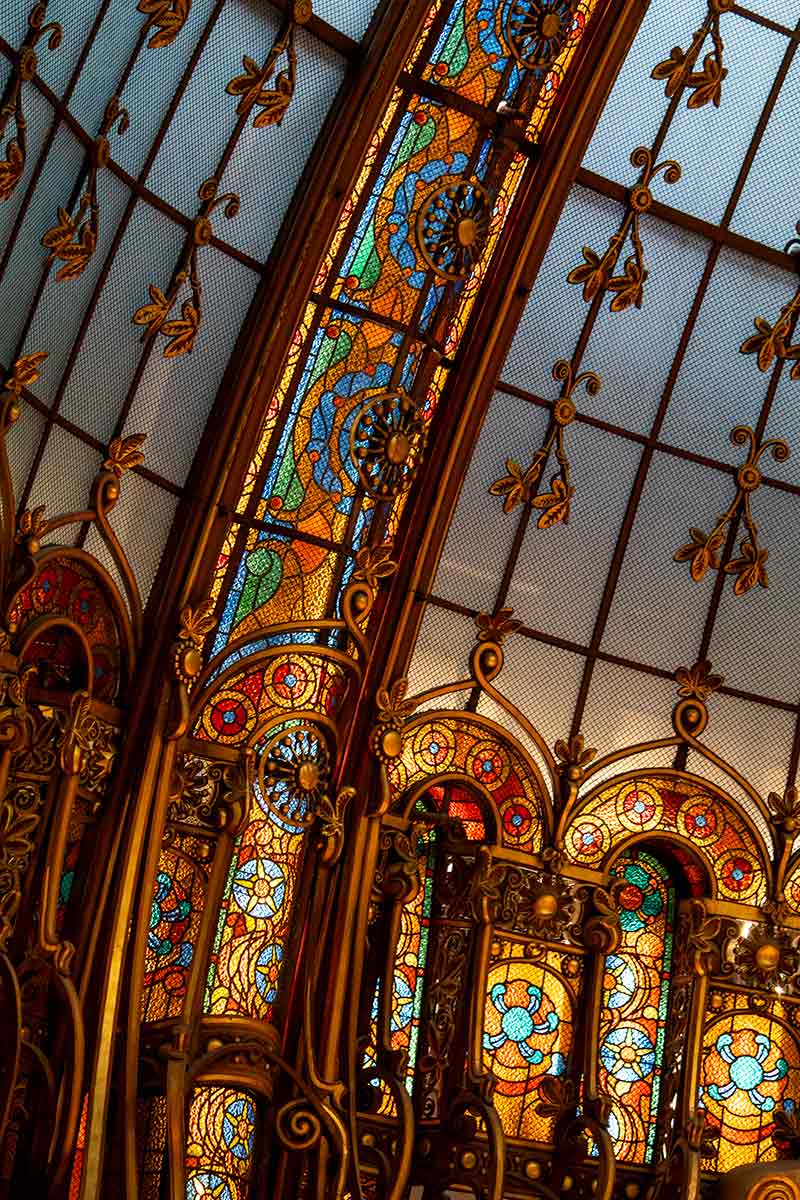
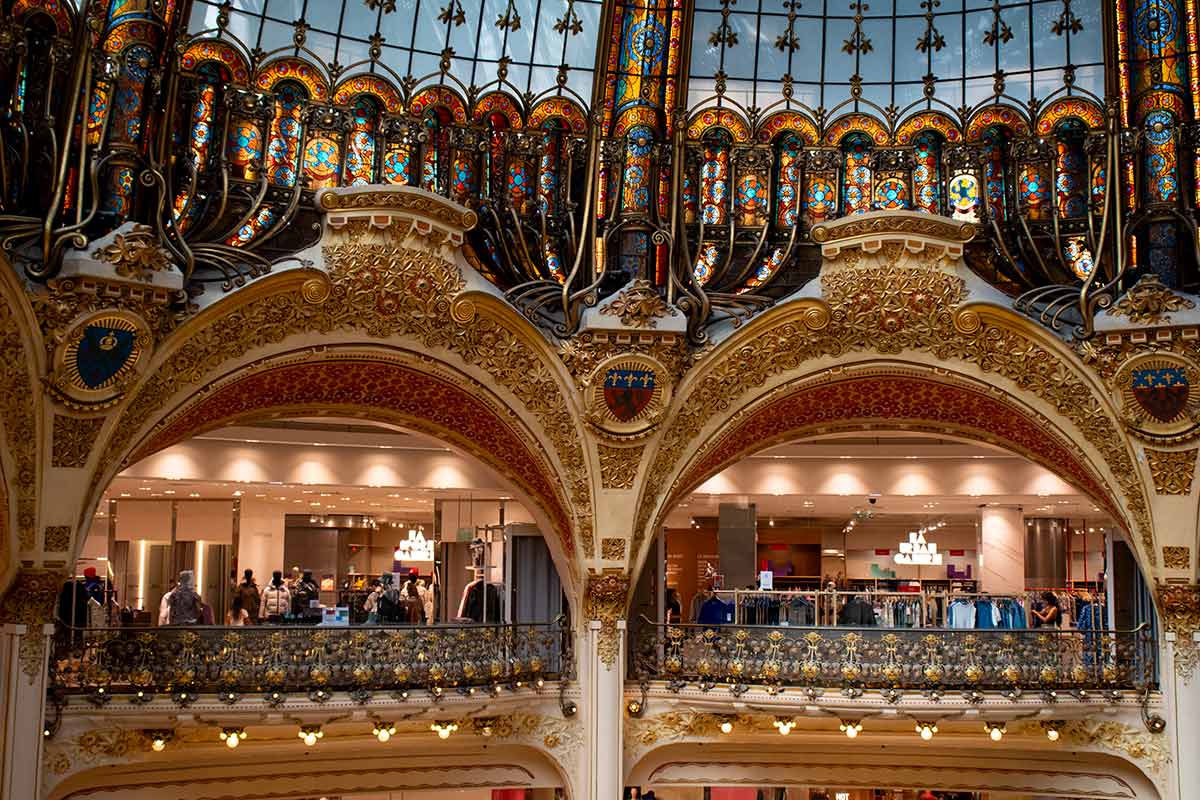
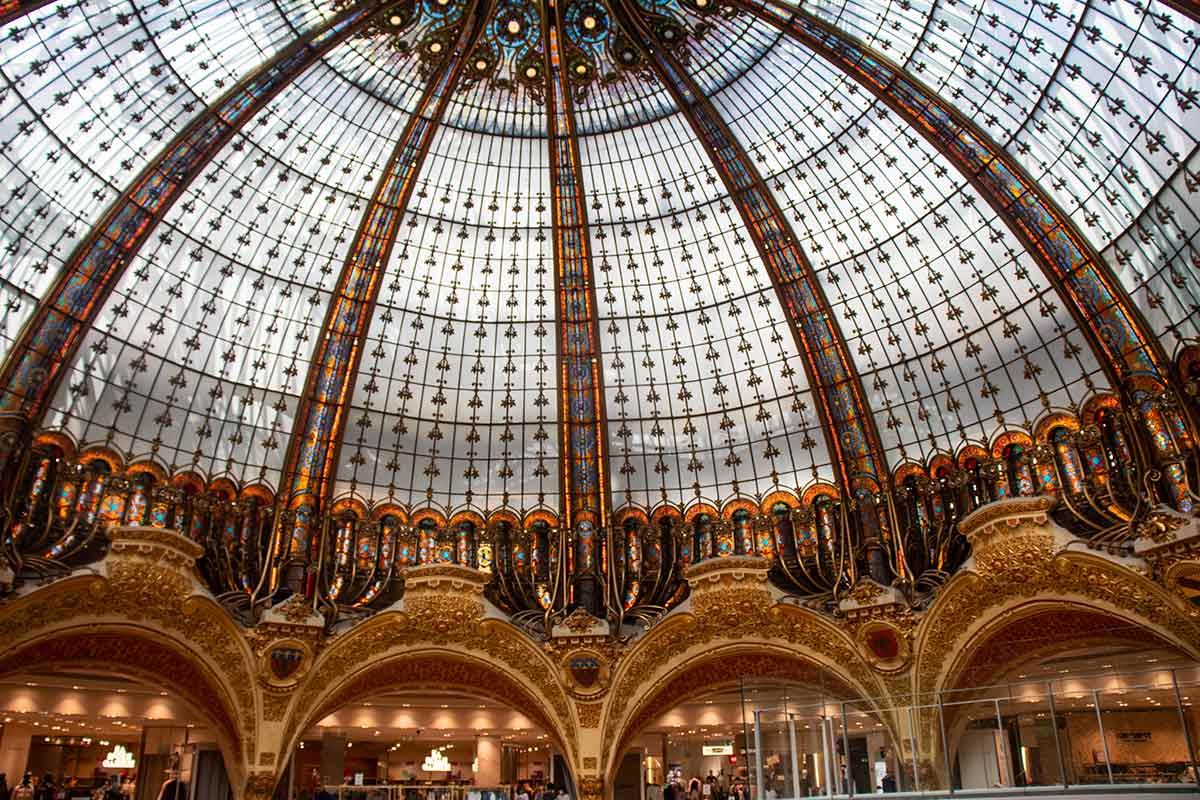
The dome of the grand magasin Galeries Lafayette Haussmann was enough to entice even a non-shopper like me inside to admire it again.
It’s one of the most fabulous Paris Art Nouveau interiors, and along with the dome of the Palau de la Musica Catalana in Barcelona is one of the greatest Art Nouveau glassworks in the world.
This was (and still is) the flagship Galeries Lafayette store, and the dome – all 1,000 square metres of it, with a floral design – was built to complement the gilded arches and balconies below. It also floods the interior with light, especially on a bright day.
The glass dome was designed by Jacques Gruber, one of the founders of the École de Nancy, one of the most influential design collectives of the period. His co-founder and collaborator Louis Majorelle also worked on the Galeries Lafayette store.
You wouldn’t notice it, but the dome is being restored at the time of writing. Panels are removed after closing time to be worked on at night. The dome was also dismantled and as flying broken shards of glass could maim or kill passers-by, so it was taken away, pane by pane, for safe-keeping. Some of the originals were lost, but the vast majority of what you see today is as Gruber intended,
Getting there: Metro to Havre-Caumartin or Opera
TIP: The Galeries Lafayette rooftop is one of the best places to watch a sunset in Paris.
4. Pont Alexandre III
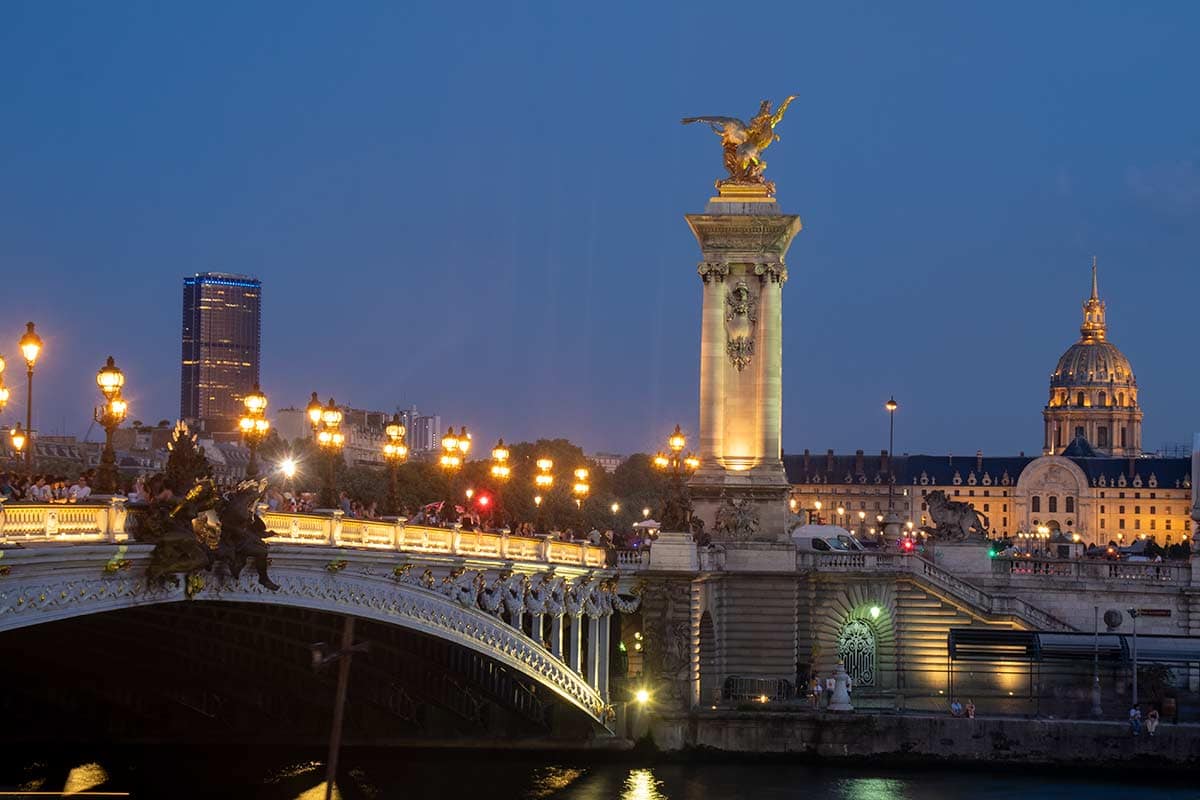
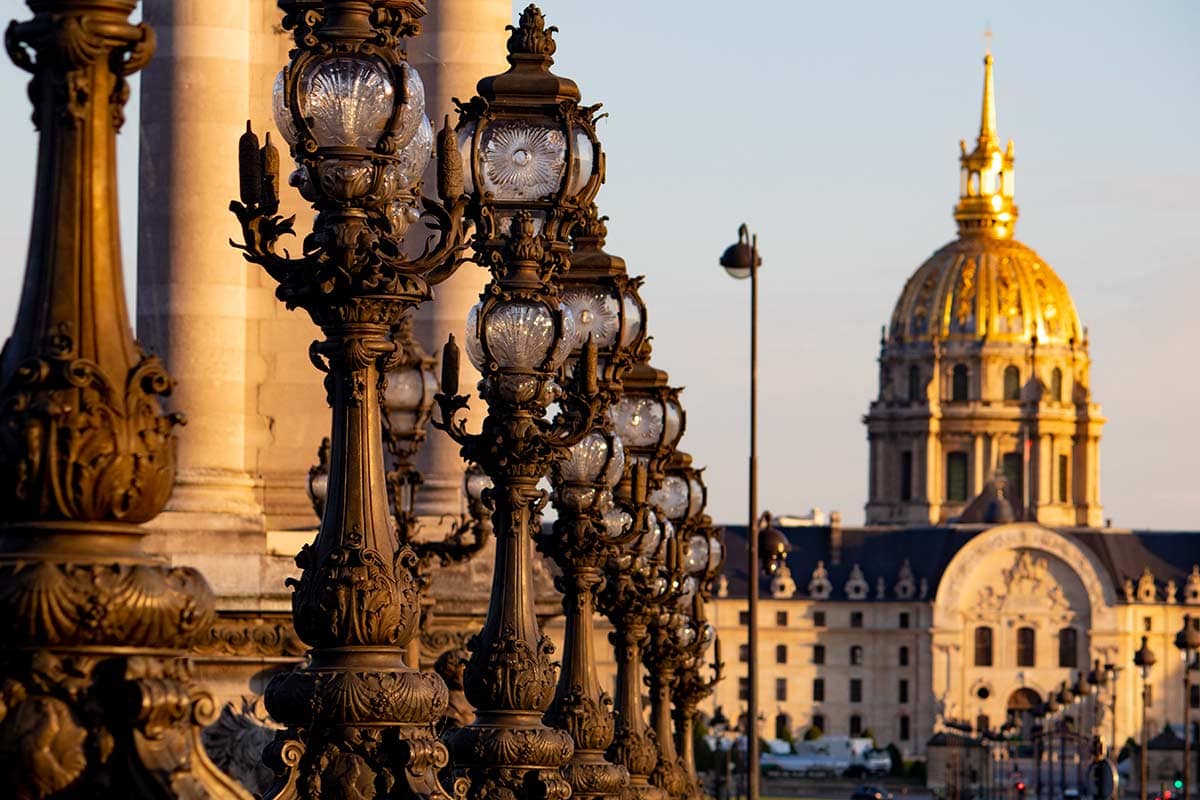
The Pont Alexandre III is the most elaborate and exuberant of bridges in Paris, a celebration of life in stone, statue and ironwork. It was completed in 1900 for the Paris Exhibition (Exposition Universelle), and named after Russian Tsar Alexander III. France had recently entered into an accord with the Russian Empire, and this, along with a bridge built over the Neva in St Petersburg, helped affirm this alliance.
This sumptuous bridge links the Grand Palais and Petit Palais on the Right Bank (rive droite) with the Place des Invalides, dominated by its gold-painted dome, on the Left Bank (rive gauche).
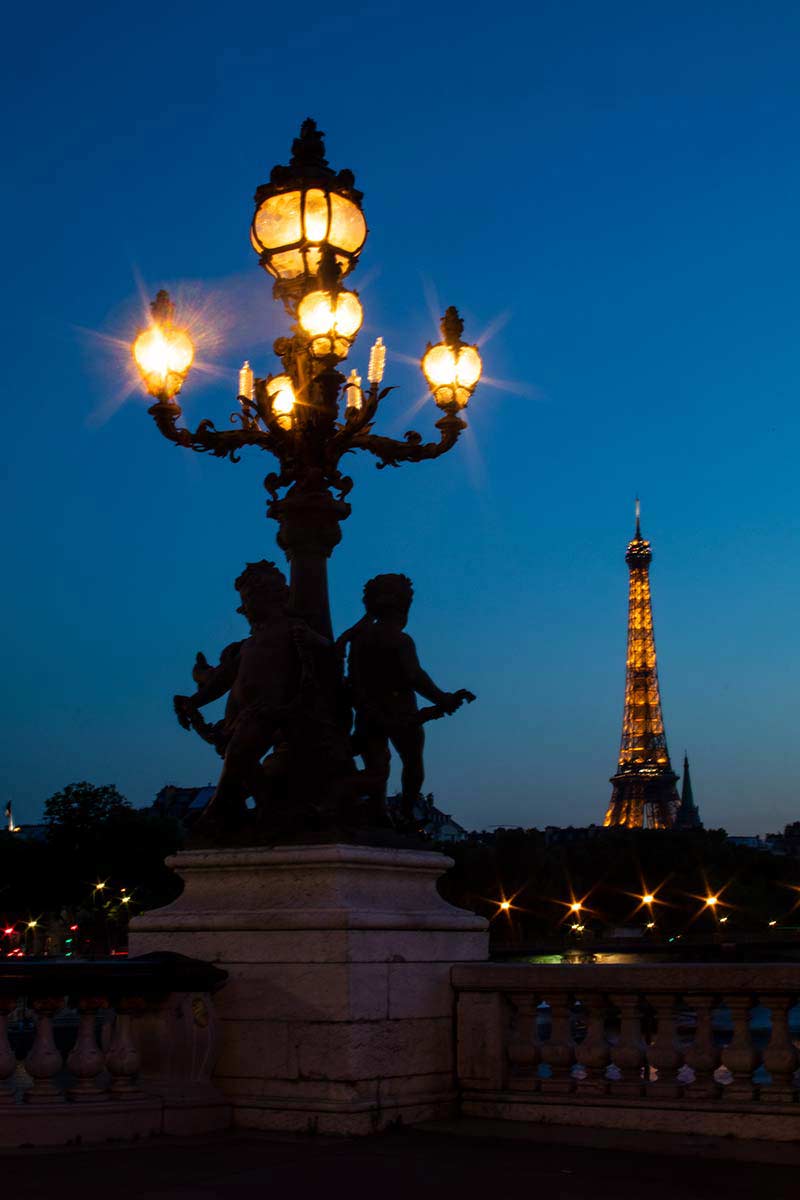
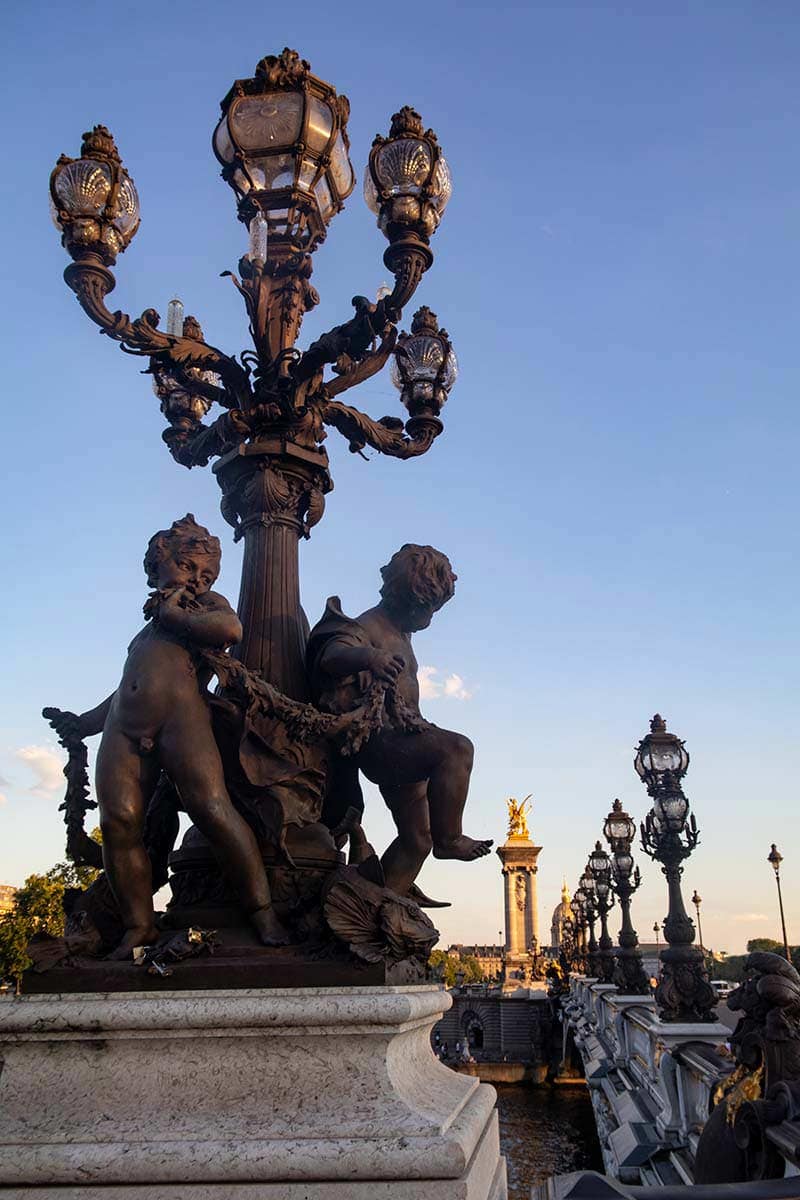
It’s ornately decorated with extravagant Art Nouveau period lamps and statues of cherubim and nymphs. It’s especially beautiful in the golden light an hour before sunset, and until the lamps are turned on at dusk.
TIP: Bear in mind that if you want a dusk shot of the bridge, get it when the lights are first turned on, as they get very bright very quickly and the flare will ruin your photograph.
Cruises: This Seine evening lights cruise is the best way to see Paris at sunset, dusk or night – and it’s when the Pont Alexandre III is at its most beautiful.
Getting there: Invalides – RER line C or Metro lines 8 and 13
5. 3 Square Rapp
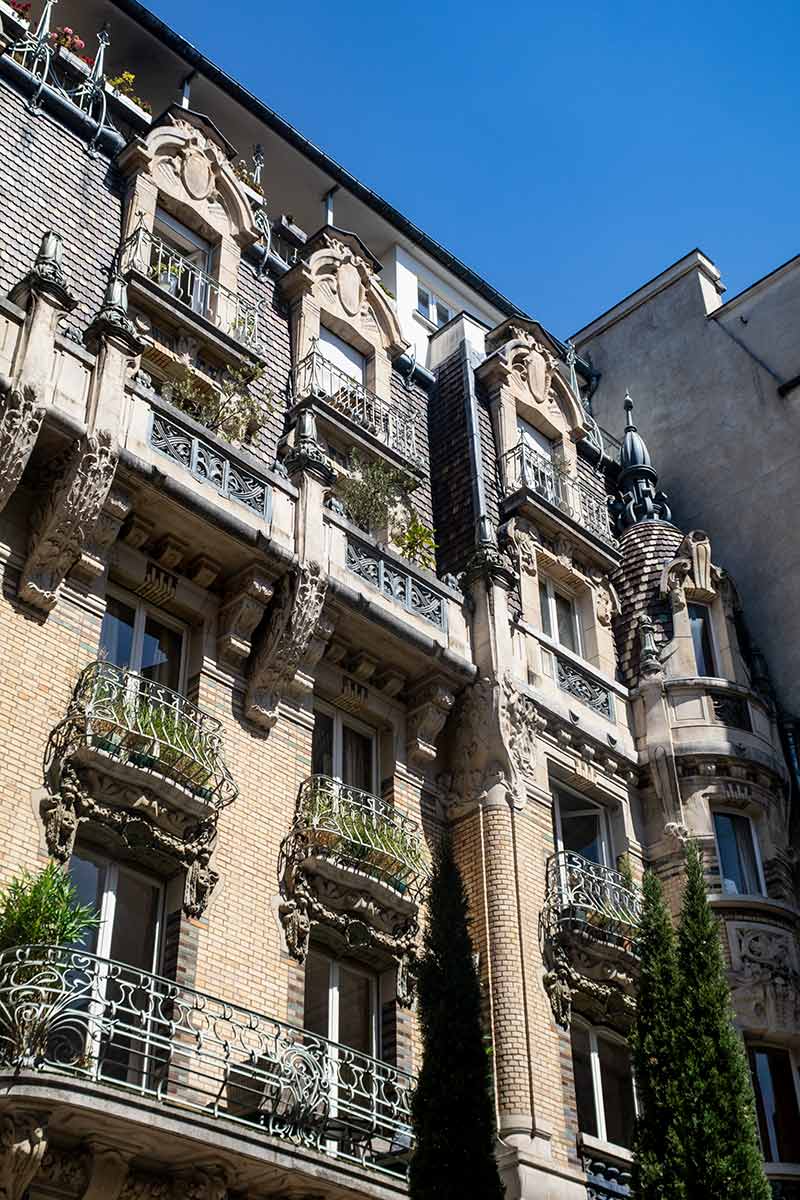
Architect Jules Lavirotte is best known for the façade of his house around the corner (see earlier in the article) at 29 Avenue Rapp. The building he designed at 3 Square Rapp was completed around a year earlier, and Lavirotte resided in. a 5th-floor apartment in the building.
Square Rapp has become known in recent years as one of the best Eiffel Tower viewpoints, but is equally worth a visit to see number 3. The façade is an eclectic mixture of brickwork, wrought-iron balconies, stone reliefs, and a ceramic tiled cupola. The tiles were the work of manufacturer and artist Alexandre Bigot.
Getting there: RER C to Pont de l’Alma then a short walk down Avenue Rapp, or buses 42, 69 or 86 to Rapp – La Bourdonnais.
6. Petit Palais
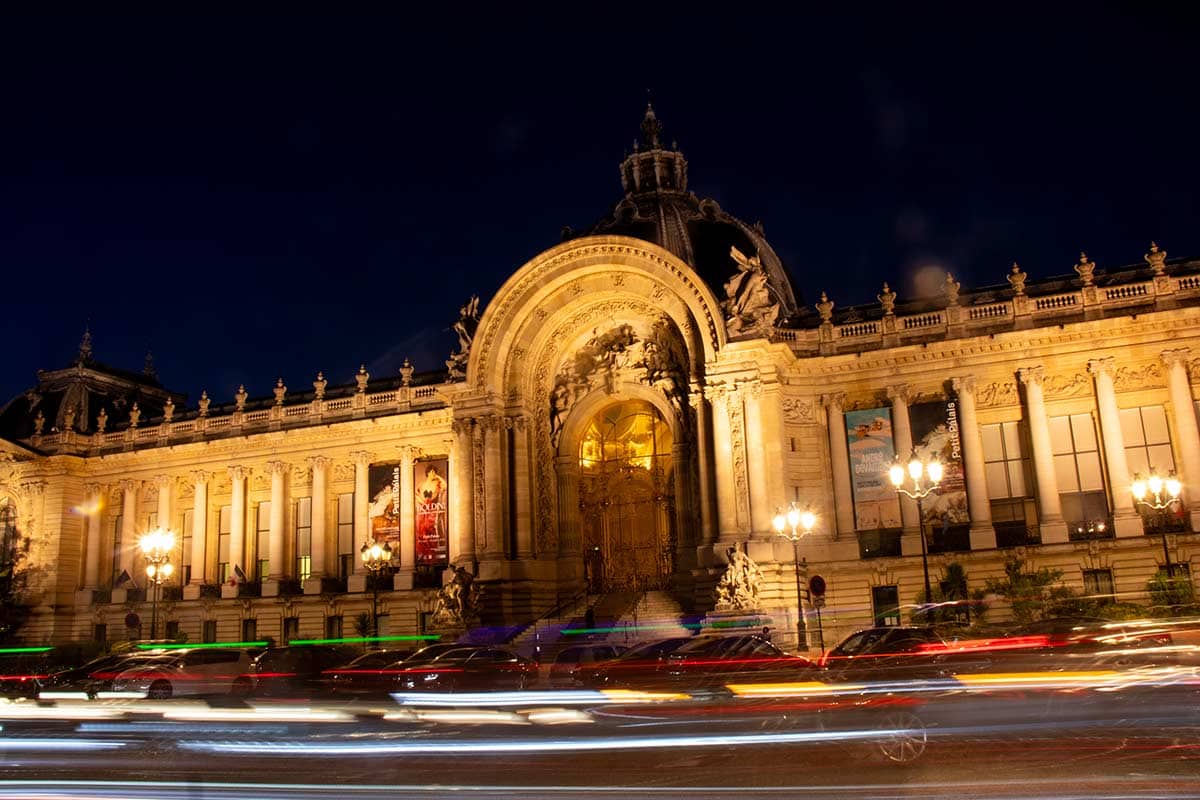
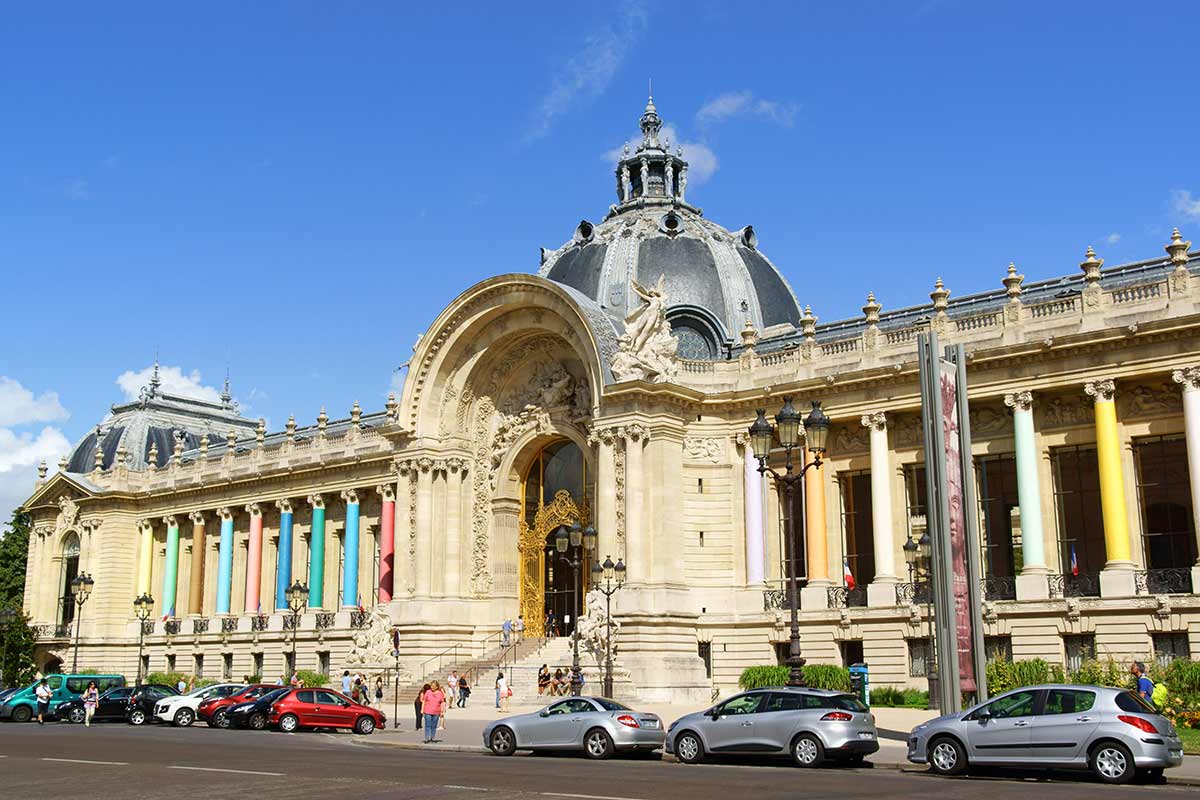
The Petit Palais – just across the Avenue Winston Churchill from the Grand Palais and a few steps from the Pont Alexandre III – was also built for the 1900 Exposition Universelle (World’s Fair) in Paris.
Both Palaces were designed and built under the leadership of Charles Girault, but differ considerably. The Petit Palais façade, with its high central arch, lavish sculptures and dome, may well have had an influence on the architects of the later (1912) Municipal House (Obecni dum), one of the great Art Nouveau buildings of Prague.
The Petit Palais is free to visit, and houses the Paris Museum of Fine Arts. Its main Art Nouveau architectural feature inside is the wrought-iron balustrade of the central staircase. It also houses a substantial Art nouveau collection, including a room deigned and furnished by Hector Guimard.
Getting there: Metro Lines 1 and 13 to Champs-Elysees-Clemenceau
Tours: This Paris World’s Fair-themed walking tour visits several Art Nouveau sites, including the Petit Palais and Pont Alexandre III
7. Saint Jean de Montmartre Church
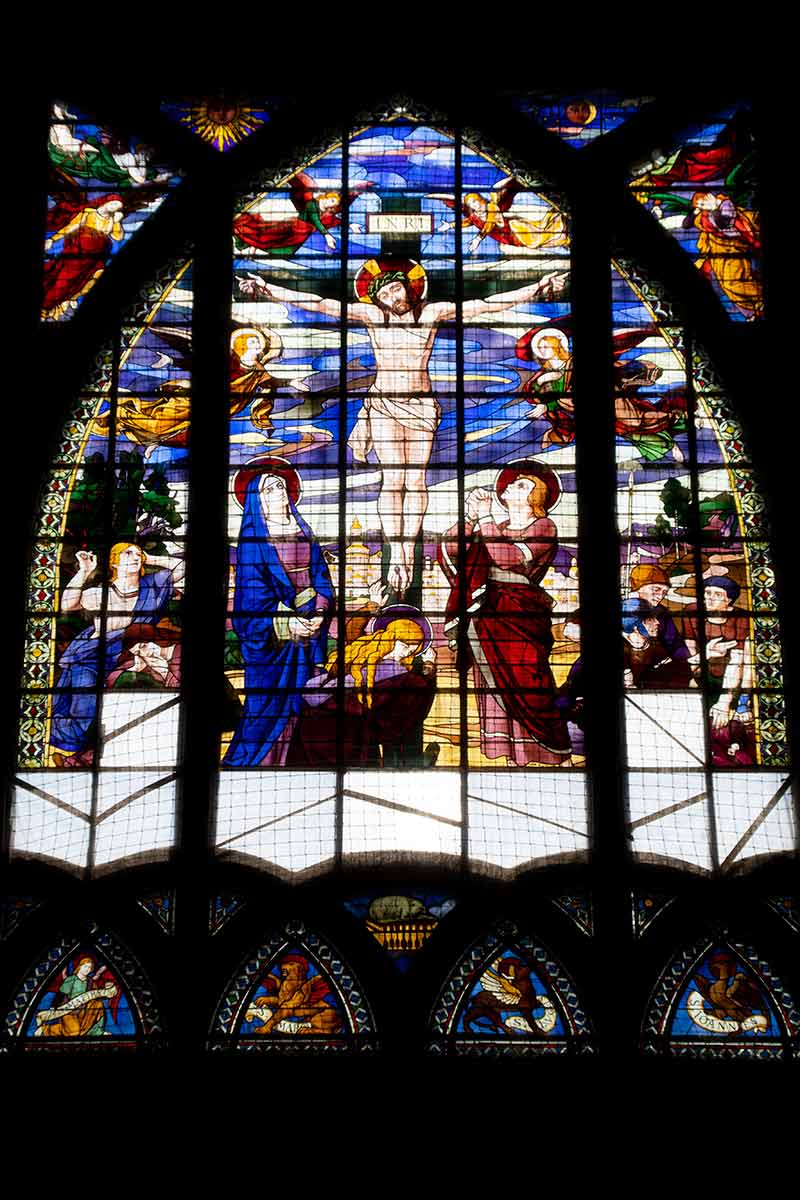
This remarkable Gothic-meets-Art-Nouveau church is just a few metres from another Art Nouveau Paris treasure, the édicule entrance to Abbesses Metro station.
Saint-Jean de Montmartre was built to provide the expanding population of the Butte de Montmartre with an alternative place of worship, as the much older Saint-Pierre de Montmartre couldn’t hold the growing congregation.
It’s one of a small number of Art Nouveau churches in Europe, and was designed by Anatole de Baudet. One of the reasons he gained the commission was the relatively low proposed cost of the church. He was able to do this through his extensive use of reinforced concrete, which is especially evident inside the church. The arches in the clerestory are pointed, a nod to medieval French Gothic.
Much of the exterior is built from red brick, adorned by several striking ceramics and sculptures. The interior of the church is surprisingly dark, almost severe in appearance. The most attractive element within the church is the stained glass, the work of a number of artists. I was most impressed by the east window, which depicts the Crucifixion, which is the work of Leon Tournel. There are also murals in the nave aisles by Eugene Thierry.
Getting there: Abbesses Metro Station (line 12)
8. La Samaritaine
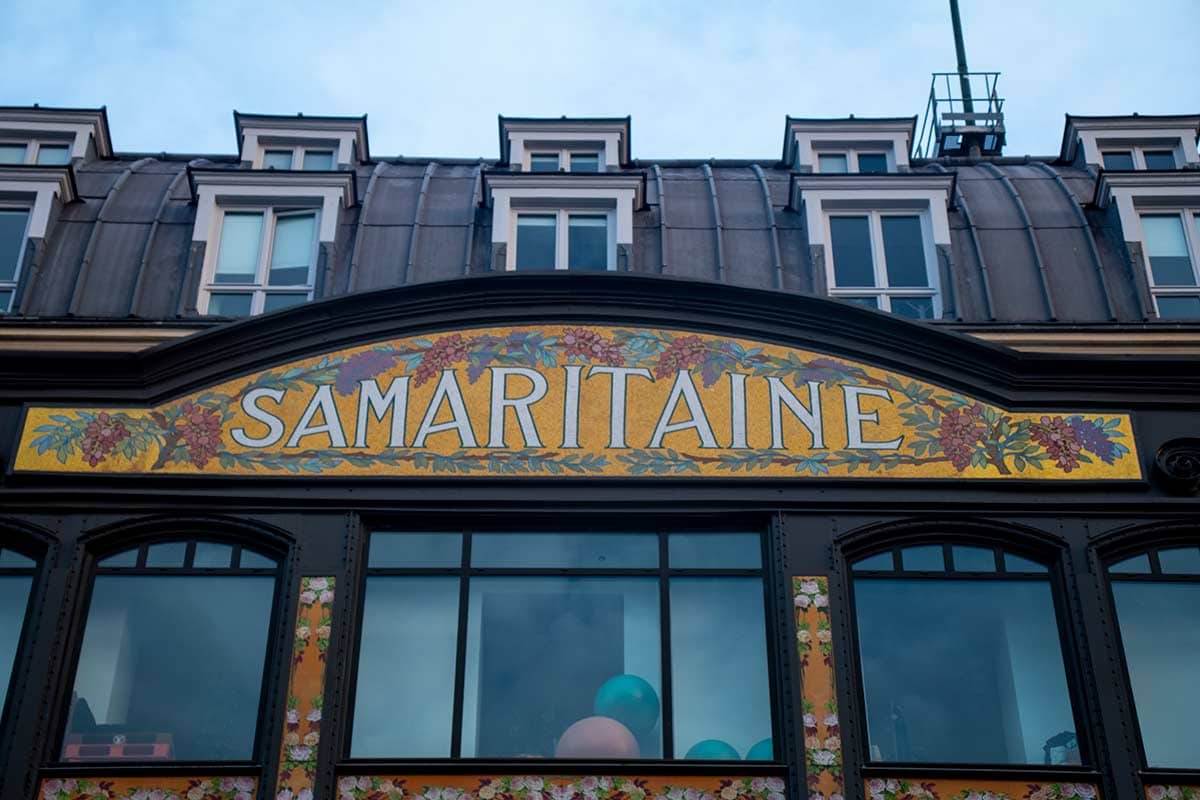
La Samaritaine department store, between the Rue de Rivoli and the Seine, hasn’t fared as well as its rival grands magasins (Galeries Lafayette and Au Printemps) to the north on Boulevard Haussmann. I was delighted to find that it had reopened in 2021, and that this famous example of Paris Art Nouveau had been restored to its former standards.
The store is named after a nearby water pumping station (next to the 400-year-old Pont Neuf), and was founded in 1870. The original store was redesigned by Frantz Jourdain in the early 1890s, and he was also responsible for the store’s extension, the building (photo above) closest to the Seine.
Jourdain commissioned Eugène Grasset to work on the decorative signage on the south façade of the store, including the famous sign (pictured) with the floral background.
Getting there: Metro to Pont Neuf
9. Bir-Hakeim Bridge
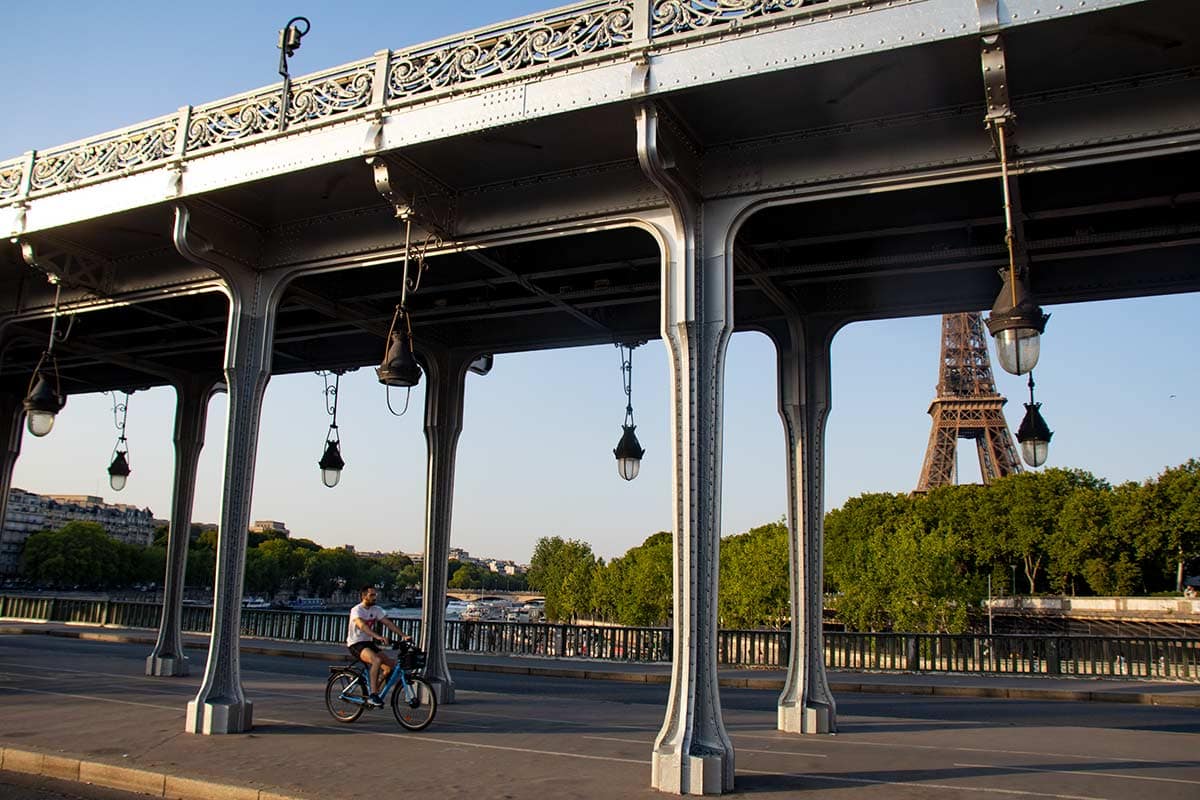
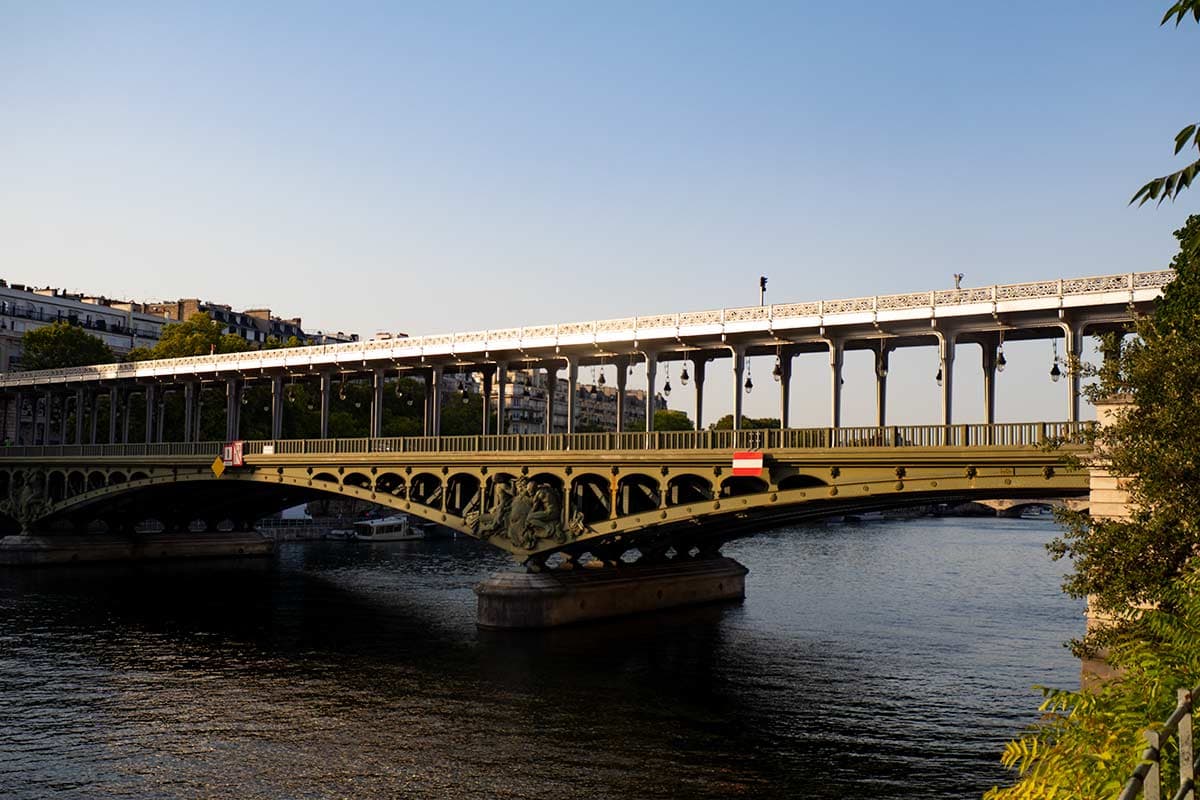
The Pont de Bir-Hakeim – originally the Viaduc de Passy – is one of the hidden gems of Paris. It’s only a short distance downstream from the Eiffel Tower, but is slightly off the beaten tourist and river cruise trail along the Seine.
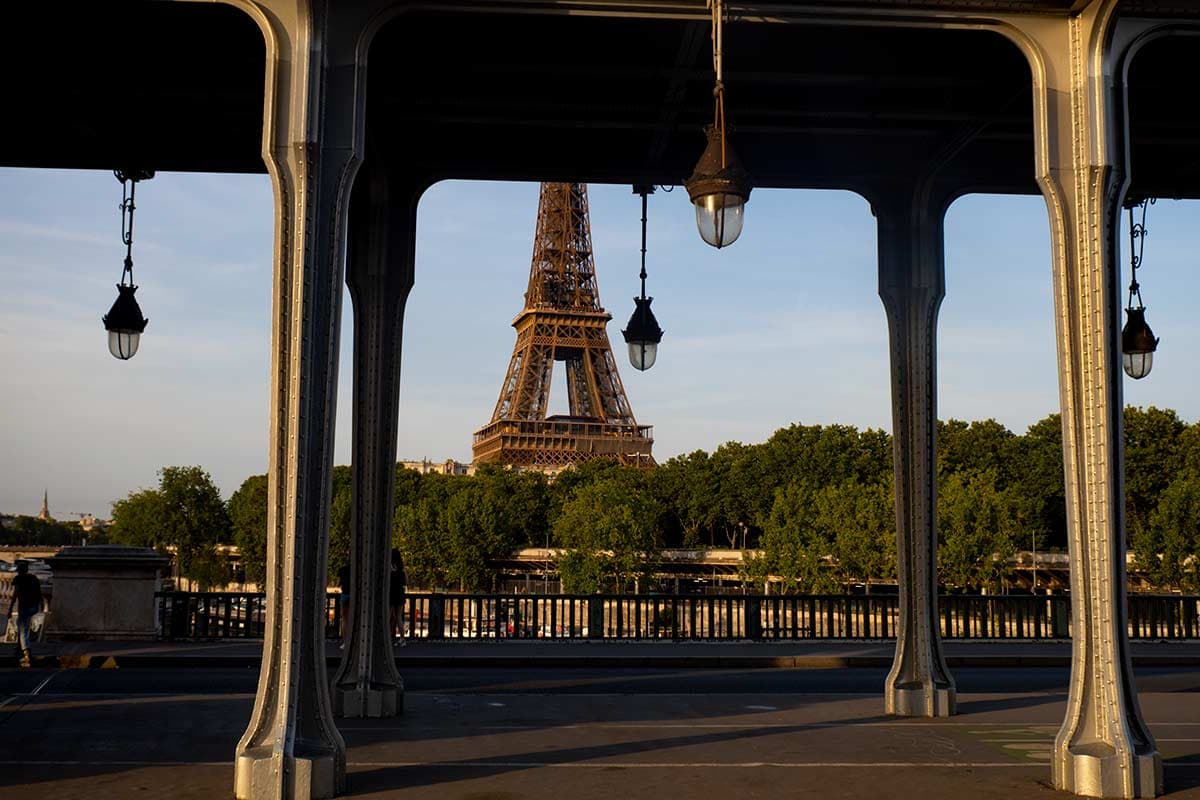
There are three reasons to visit this beautiful bridge. It’s the one bridge over the Seine from which you can see the Eiffel Tower from a Metro train – line 6 trains pass in both directions along its raised upper level. From there, and at the lower level, you can enjoy some of the best Eiffel Tower views in Paris, either framed by the pillars holding up the railway above, or the dramatic France Renascente statue on the bridge’s north side.
Above all, the bridge is a stunning work of art, built between 1903 and 1905 by Jean-Camille Formigé, who also built the Viaduc d’Austerlitz upstream. The main Art Nouveau elements are the upper parapet, pillars and lamps, which also frame those superb views of the Eiffel Tower.
Getting there: Bir-Hakeim Metro station (Line 6)
Cruises – this Seine dinner cruise with music is one of a small number to continue past the Eiffel tower, continuing as far as Bir-Hakeim and beyond there, the most famous of the Statues of Liberty in Paris.
10. Castel Béranger
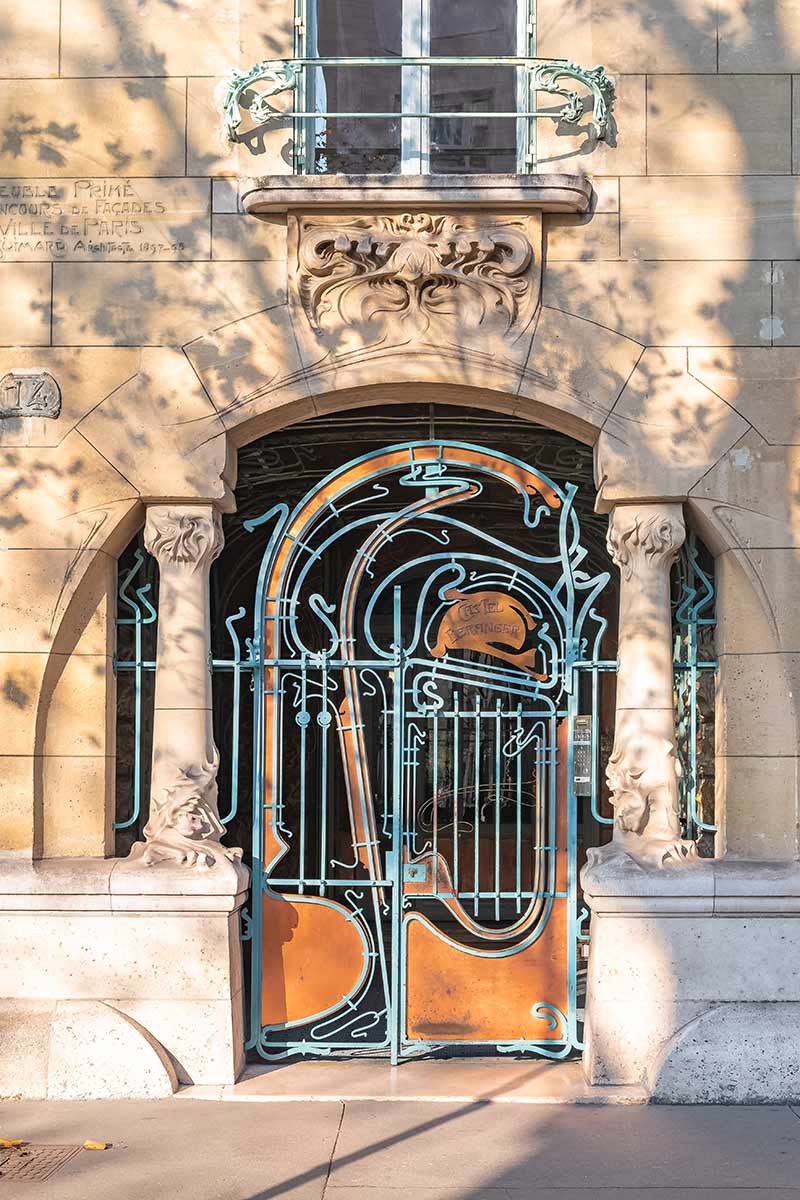
Castel Béranger is the first Art Nouveau building in Paris, an apartment immeuble in Passy completed in 1898 by Hector Guimard, best known for his Metro station entrances and signage.
This building was Guimard’s first foray into Art Nouveau, and he was strongly influenced by his meeting with Art Nouveau pioneer Victor Horta in Brussels. Art Nouveau gained ground in Paris as some grew tired of the prevalent architecture of the Haussmann-built grands boulevards around the city centre, and there was an appetite for something different. Guimard’s design won recognition in twinning the overall first prize in the inaugural city-wide competition for the most original building façade in 1898.
There is some Art Nouveau styling in the shapes of some of the front windows, but the most obvious Art Nouveau elements are in the building’s decoration. This includes a lot of wrought-ironwork, on the balconies outside and the staircase and doorways within, and there’s also some beautiful stained glass inside.
Unfortunately the building is a series of private residences, but you can see plenty of detail on the exterior – look out for the seahorse and a creature below a window that I’m unsure is a vicious-looking cat or a scrawny distressed wolf.
Getting there: it’s in the 16th arrondissement, two blocks from the Seine on Rue Jean de la Fontaine. The nearest station is Avenue du President Kennedy – Maison de Radio France, on RER line C, a 5-minute walk away.
11. Lutetia Hotel
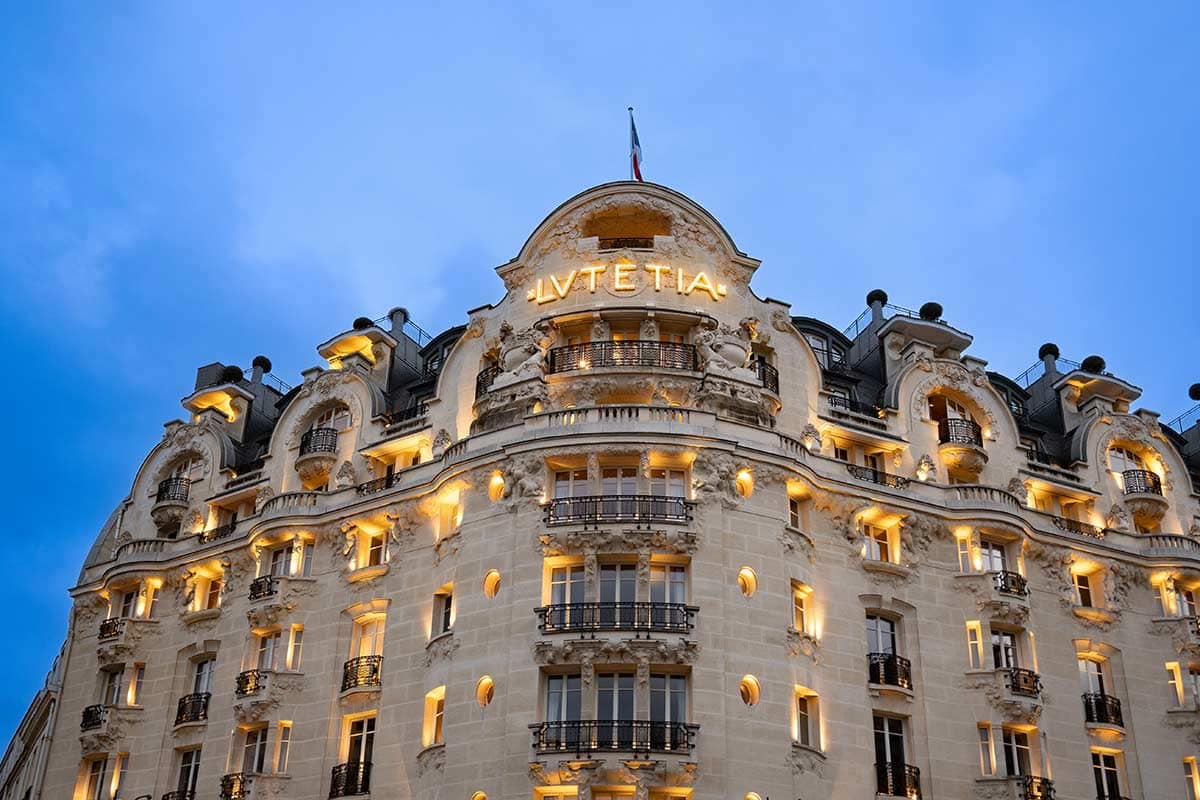
The Lutetia is the most famous Art Nouveau hotel in Paris. It was conceived as a luxury hotel by the Bon Marché department store, intended as a place to stay for customers outside Paris.
The Hotel and store were designed by Louis-Hippolyte Boileau, although they’re very different. The Hotel Lutetia, completed in 1910, occupies a corner plot, and it has always reminded me a little of Antoni Gaudi’s La Pedrera in Barcelona. Boileau’s building curves aren’t as frequent or pronounced as those of Gaudi, but I’ve often wondered if he had been partly inspired by La Pedrera.
You can clearly see several Art Nouveau elements on the curved façade of the Hotel – its curved windows, stylised lettering, floral stone reliefs and the wrought ironwork on the balconies are all hallmarks of the Art Nouveau period.
Much of the interior of the Lutetia was refitted in the later Art Deco style, but some Art Nouveau elements remain within, including the frescoes on the wall of Bar Josephine, named after frequent patron Josephine Baker.
12. Ceramic Hotel
Jules Lavirotte won the Concours de Façades de la Ville de Paris for the second time in 1905 for this building on a narrow plot of land just down the hill from the Arc de Triomphe on the Avenue de Wagram.
The building was originally a furnished house in which rooms were rented out to tenants, and it eventually became a hotel, which it remains today.
Much of the façade was built with reinforced concrete – something of an unsung element in an architectural form renowned for its nature-inspired curves and flowing lines. It’s also decorated with ceramics by Alexandre Bigot and sculptures of plants by Camille Alaphilippe.
The Hotel is now the Hotel Élysées Ceramic, and you can book rooms here or at the link near the beginning of the article.
Getting there: Metro or RER to Charles de Gaulle-Étoile
Art Nouveau Paris – Final Thoughts
I hope that you’ve enjoyed this article and that it helps you discover more of Art Nouveau Paris.
I’ve also written extensively about Art Nouveau architecture across Europe, and here are my other articles on the subject:
Best Art Nouveau cities in Europe
In Search of Ödön Lechner – Hungary’s Art Nouveau genius
I’ve also written many articles on Paris, and here’s a selection of these for you to browse:
General Paris Articles
Best Eiffel Tower Views – over 20 superb vantage points of the most famous landmark in Paris
Sunset in Paris – the best 15 places to see one
Visiting the Arc de Triomphe Paris – all you need to know before you visit one of the great monuments of Paris
Paris Carousels – the best merry-go-rounds in Paris
Statue of Liberty in Paris – seek out the replicas of Lady Liberty across the French capital
Bridges in Paris
Famous Paris Bridges – 15 of the most beautiful bridges on the Seine
Pont Alexandre III Paris – the most flamboyant, ornate bridge in Paris
Bir-Hakeim Bridge Paris – stunning double-decker bridge near the Eiffel Tower
Pont des Arts Paris – elegant iron bridge connecting the Louvre and Institut de France
Pont Neuf Paris – the venerable oldest bridge in Paris, and sometime art installation subject
Churches In Paris
22 Famous Churches in Paris – 22 ecclesiastical wonders
La Sainte Chapelle Paris – one of the wonders of the Gothic Age
Basilica of St Denis Paris – the birthplace of Gothic architecture
Saint Germain des Pres – landmark ancient Left Bank church
Saint Etienne du Mont – stunning Latin Quarter church
Saint Sulpice Church Paris – vast Neoclassical church dominating the Latin Quarter skyline
Pantheon Paris – the resting place of many famous French luminaries
Saint-Séverin Church Paris – Left Bank Gothic wonder
St Julien Le Pauvre – humble ancient church within sight of Notre Dame
Visiting the Cluny Museum Paris – exceptional museum covering art and architecture from the Middle Ages, including many treasures rescued from churches across France and beyond
Montmartre
Abbesses Metro Station Paris – one of the most beautiful Metro stations in Paris
Rue de l’Abreuvoir – one of the most picturesque streets in Paris
Rue St Rustique Paris – ancient Parisian street in the heart of Montmartre
Sacré Coeur Basilica Paris – the white-domed symbol of Montmartre
Parks in Paris
Square du Vert Galant Paris – the most romantic garden in Paris
Jardin du Luxembourg – one of the most beautiful gardens in Paris
Tuileries Garden Paris – amazing garden near the Louvre
Parc Monceau Paris – gorgeous folly-filled park near the Arc de Triomphe