


Prague tram 17 is one of the best tram routes in Europe. It includes a long riverside section with stunning views of one of the most beautiful cities in Europe, with Prague Castle dominating the scene.
It’s a great introduction to the city beyond the usual Prague tourist places, or if you’ve visited Prague before, a wonderful way to see it anew.
Prague tram 17 has been my home tram for over three years, and I’ve made the journey many hundreds of times. Yet it still makes me tingle with anticipation, especially as we pass through the Vyšehrad tunnel and glimpse the spires of St Vitus Cathedral in Prague Castle once again.
Our guide to the 17 Prague tram describes the journey between each of the main stops, with information on what you see along the way. We also suggest places to stop by for a drink or bite to eat where appropriate.
Why Ride Prague Tram 17


The 17 tram is one of the cheapest Prague sightseeing tours you’ll find – and one of the best.
For the price of a Prague tram ticket you get a ride along the Vltava river, from Vyšehrad fortress in the south of the city to Holesovice and Stromovka Park in the north, with the option of continuing to Troja, home to Prague Zoo, Prague Botanical Garden and Troja Castle.
You get a wonderful overview of many Prague attractions, including Prague Castle, the Charles Bridge and the Dancing House.
It also takes you a little further than most visitors ever venture, giving you a perspective that many locals but few visitors ever get to experience.
Where Does The Prague Tram 17 Run


It runs from Sídliště Modřany in the south of Prague to Vozovna Kobylisy in the north, and it takes 52 minutes to complete the 36-stop journey.
The Prague 17 tram runs parallel to the Vltava River for much of its route – from Nádraží Modřany to Strossmayerovo náměstí, and it then crosses the Troja bridge before the final climb to Kobylisy.
The journey between Podolská vodárna and Trojska is one of the best tram routes in Prague, where you’ll see many of the most popular Prague sights.
Prague Tram 17 – Tips Before You Travel

Two types of Prague tram operate on the 17 route – the modern Skoda vehicles with five seating areas and disabled access, and the ‘old red rattlers’, as we call them, which have two carriages which you have to board via three steep steps.
The modern trams are more convenient for this journey. They have three front-facing seating areas (though there are also two pairs of rear-facing seats), with two sections of 10 seats facing inwards. You want to be in one of the front-facing sections.

You also need to bag yourself a seat on the left-hand side of the carriage, where the seats are in pairs. From this side you get a great river view when things get most interesting.
The older ‘red rattlers’ have a row of single seats each side, with most facing forward. Again, you need to be on the left-hand side for the best views.
Prague Tram Tickets
If you haven’t already bought a Prague public transport ticket, (you’ll need the DPP app for this) you can purchase a ticket on any Prague tram after boarding.
You can buy them with contactless card or phone at the orange machines located in each carriage.
A 30-minute ticket costs 30 CZK. That probably won’t cover you for this journey.
A 90-minute ticket costs 40 CZK. This would cover the entire Prague tram 17 route and, possibly, getting to your starting point.
A 24-hour ticket costs 120 CZK. This is worth considering if you are going to be making more journeys by public transport in Prague – it’s also valid on the Metro and buses.
A 72-hour ticket costs 330 CZK. These aren’t normally available at the orange machines on board the trams but are available at the ticket offices in Metro stations.
Prague Tram 17 Route – What To See
Sídliště Modřany to Podolská vodárna

The 17 Prague tram journey begins at the top of the hill in Modřany, gradually descending towards the river Vltava. It runs past many apartment blocks, a side of Prague most visitors don’t see.
They also don’t see the lovely Baroque church of St Jan Nepomuk, which sits on the forested ridge across the river. You catch occasional glimpses of it along the way.
There isn’t a great deal to see along this stretch of the Prague 17 tram route. You catch sight of the river a few times, but apart from the popular grass beach in Prague, Zluté lazně, there’s not much reason to get off the tram when there are better things to do in Prague a short journey down the river.
Podolská vodárna to Výtoň


I suggest beginning your tram 17 Prague journey at Podolská vodárna, the Podoli water works stop just below Vyšehrad Prague. The fortress is over a thousand years old, and the traditional home of the Přemyslid dynasty that ruled Bohemia in the early Middle Ages.
The sturdy Baroque fortifications and spires of the Basilica of SS Peter and Paul are one of the most recognizable landmarks of Prague, and if you venture up there (easily walkable from either tram stop) you’ll discover one of the best Prague parks, along with one of the best beer gardens in the city.


The short tunnel passes beneath the oldest part of Vyšehrad, and soon after you emerge you get a superb view of the city, with the main bridges in Prague and Prague Castle on the hill two miles downstream.
You also pass several Cubist buildings along the run into Výtoň. This form of architecture only caught on in Prague and parts of Bohemia, and only then for a few brief years before the outbreak of the First World War.
Look out for the striking white Vila Kovařovicova on the right, just before you reach the Výtoň stop.
What To See And Do

It’s a 5-10 minute uphill walk to Vyšehrad, or if you’re hungry we heartily recommend Restaurace Pod Vyšehradem. If you’d prefer gelato or coffee, join the queue at Puro Gelato across the street from the tram stop.
I also suggest taking along the Naplavka, or riverbank, which is lined with boat bars and restaurants and one of the best places to go out in Prague during the warmer months.
Also note the much-loved railway bridge whose future is under discussion at the time of writing.
Výtoň to Palackého náměstí

You’re now in historic New Town Prague, and the view gets better by the metre. Smichov is across the river, with Petřin Hill looming to the right.
Palackého náměstí is a very busy stop, where many local commuters alight, either for the nearby offices and shops or the Metro station across the square.
What To See And Do

There’s not a great deal to see at Palackého náměstí, other than take a look at the statue of historian Josef Palacky (which looks rather like Herman Munster).
The unusual twisting spires of the Emmaus Monastery replaced the original church which was destroyed by an Allied bombing raid in February 1945. It’s one of the most intriguing churches in Prague, with some gorgeous 14th-century frescoes in the cloister.
Palackého náměstí to Jiráskovo náměstí

The next section takes you further along the riverside, stopping just after the Dancing House Prague. The tram stops just after the statue of Alois Jirasek, the writer after whom the square and bridge across the street are named.
What To See And Do


The Dancing House is important as it was the first major building in Prague following the velvet Revolution and the end of Communism. It was designed by Frank Gehry and Vlado Milunic, and nicknamed Fred and Ginger by Gehry.
The concrete and glass building does resemble the outline of a man and woman dancing. You can stay in it, have a coffee in the ground floor café or head up to the rooftop bar, which I have to say is one of the best viewpoints in Prague.
You could also venture halfway up Resslova to the Orthodox Cathedral of SS Cyril and Methodius. The crypt is one of the most important Prague World War 2 Sites, as it was the scene of the final shootout between the group responsible for the assassination of prominent Nazi Reinhard Heydrich and the SS. It was a heroic last stand, which culminated in the deaths of all seven men. The Crypt is now the National Heydrich Memorial.
Jiráskovo náměstí to Národní divadlo

This is one of the shortest but most interesting section of the Prague tram 17 journey. The tram continues past the medieval Šitkov water tower and Manes Arts Centre, along Masarykovo nábřeží, one of the most handsome Prague streets, with its fine Art Nouveau mansions.
The Národní divadlo – National Theatre – stop has recently been moved to its new location just before the Theatre.
It is also very close to the bridge to Slovansky ostrov (Slav or Slavonic Island), where the yellow Palac Zofin is another concert venue. There is also a great children’s playground on the island.
What To See And Do


The National Theatre is a breathtaking venue for opera, ballet and drama – it’s well worth checking their programme of events before you visit Prague.
Just across the street from there, the Art Deco recently refurbished and rejuvenated Kavarna Slavia is one of the best cafes in Prague, serving everything from traditional Czech meals to coffee and cake.
You can also change at Národní divadlo for the Prague tram 22 to the Castle – the stop is on Národní třida.
Národní divadlo to Karlovy lázně


The next section takes you past the beautiful Legion Bridge and alongside the river to a new stop, Karlovy lázně, named after the nightclub.
It’s the scenic highlight of the entire Prague trams network, with Prague Castle, the towers and domes of Mala Strana and the Charles Bridge on your left. You almost want to be held up in traffic to savour it for longer.
What To See And Do


Karlovy lázně is one of two recommended tram stops for Charles Bridge, so many visitors alight here. Cross the road, then continue through the arcade until you reach Křižovnické náměstí, one of the smallest but most beautiful Prague squares.

At this point you can turn left and cross the Charles Bridge, passing beneath the Old Town Bridge Tower arch on the way. Otherwise you can cross the street and continue along the popular tourist route to Old Town Square.
Karlovy lázně to Staroměstská


The tram then heads along a narrow section of road, but keep your eyes on the left-hand side as you’ll experience a short fix of public transport architectural ecstasy as you pass through Křižovnické náměstí with Charles Bridge, a statue of King Charles, the Old Town Bridge Tower and the domed church of St Francis of Assisi visible for a few fleeting moments.
Locals seldom look up from their phones. I don’t think I’ve missed it having passed over a thousand times.
The tram then stops at Staroměstská, the main stop for Old Town Prague.
What To See And Do


Staroměstská is a busy location, with trams 2 and 18 also using the same stop, and the Metro station of the same name is around the corner on Kaprova.
The Old Town Square is a five-minute walk from the tram stop, crossing Náměstí Franze Kafky, a small square named after one of Prague’s most famous writers, Franz Kafka.
Old Town Square is one of the most beautiful squares in Europe, dominated by the fairytale Gothic spires and pinnacles of Tyn Church Prague. Most visitors head to the foot of the Old Town Hall Tower (one of the best towers in Prague to climb for views of the city) to see the world-famous Astronomical Clock to strike the hour.


The Old Town Square area isn’t the best for eating out as portions are small and prices generally exorbitant. However, we do recommend Restaurace U Parlamentu, near the tram stop on Valentinska, and Café Mozart on the Old Town Square.
The Staroměstská tram stop is also very close to Josefov, the Jewish Quarter of Prague. Most Prague Jewish sites are part of the Jewish Museum of Prague, including the Pinkas Synagogue, the adjacent Old Jewish Cemetery and the Maisel, Spanish and Old-New Synagogues. These are all within a 200-metre radius of the Cemetery.
Staroměstská to Pravnická fakulta

You then pass the grand Rudolfinum concert hall, home to the Czech Philharmonic Orchestra, and the Manes Bridge, with a great view of Prague Castle. You then continue past the perimeter wall of the Old Jewish Cemetery, reaching Pravnická fakulta – the Law Faculty of Charles University – a minute or so later.
What To See And Do

The tram stop is close to the corner of Pařížská, one of the most glamorous streets in Prague and also one of the hardest to pronounce (‘Par-ZHEEZH-skah).
It means ‘Paris Street’, and is full of high-end boutiques, and if you’re in Prague in winter you’ll see some beautiful Art Nouveau buildings that are often partly hidden behind the tree cover. The street eventually ends at Old Town Square.
The riverside either side of Čechův most is the departure point for many Prague boat trips. These are generally good value, unlike the cafes down there which are a shameless rip-off.
Pravnická fakulta to Čechův most


Čechův most – the Svatopluk Čech Bridge – is one of the wonders of Art Nouveau Prague, an exuberant masterpiece with statues holding torches and a superb view of Prague Castle.
The tram then stops just beyond the bridge.
What To See And Do


The Čechův most tram stop is a few steps away from sloping paths or stairways up to Letna Park Prague. We love this park – if you head up one of the paths on the left-hand side you’ll reach a couple of outstanding viewpoints over the city.
If you head up the right-hand side you’ll soon reach the Letna Park beer garden, one of the best in the city. This is also close to the Prague Metronome, which was built in 1991 on the site of a hated statue of Soviet dictator Josef Stalin, which was destroyed in 1962.
Čechův most to Strossmayerovo náměstí


Sit back for three minutes or so and enjoy the view of the river and city as you cruise along the left bank of the Vltava. From here, you get an interesting view of the north side of the Old Town, including the marvellous St Agnes Convent, one of the best hidden gems in Prague. You’ll also get an uninterrupted view of the Žižkov TV Tower, one of the most visible remnants of Communist Prague.
The tram then reaches the heart of the suburb of Holešovice Prague, stopping just before the main square, Strossmayerovo náměstí.
What To See And Do
The best thing to do in this part of Holešovice is to grab a coffee at one of the many cafes around the square and up the hill on Milada Horakova. Our favourite café in this area is Kafe Francin, on the opposite side of the junction from the 17 tram stop.
Strossmayerovo náměstí to Veletržní palác

As the tram moves on, look right at the Gothic revival church of St Anthony of Padua. It’s evidently inspired by the Tyn Church across the river and an impressive local landmark.
The tram continues the short distance to Veletržní palác – Trade Fair Palace. This massive functionalist building is now one of the branches of the National Gallery Prague, and houses the Art of the Long Century (1796-1918) collection.
Veletržní palác to Výstaviště

Before heading off into Prague suburbia, the tram makes the short trip under the bridge to Výstaviště, the popular Prague Exhibition grounds. Some Prague tram 17 services terminate here – if so they bear left after the bridge, pulling over on the edge of Stromovka Park.
If the tram is continuing to Trojska and Kobylisy, it will turn right and stop shortly afterwards.
What To See And Do


This area is hugely popular with locals. Stromovka Park Prague is one of the best in the city, with great walks, several playgrounds, a wonderful area with lakes and attractions including Prague Planetarium. There are also restaurants and bars ideal for stopping by for a while.
The Industrial Palace (pictured) is undergoing restoration at the time of writing, though there are several things to see close by including the Aquarium (Morsky Svet) and Lapidarium (museum of historical statues).
The area behind the Industrial Palace is the venue for fairs throughout the year, including the popular Matejska pout’ in the springtime.
Výstaviště to Trojska


The tram then continues to Nádraží Holešovice and over the modern Troja Bridge, turning left before stopping at Trojska. It then continues up the hill to Kobylisy or Vozovna Kobylisy, a little further on.
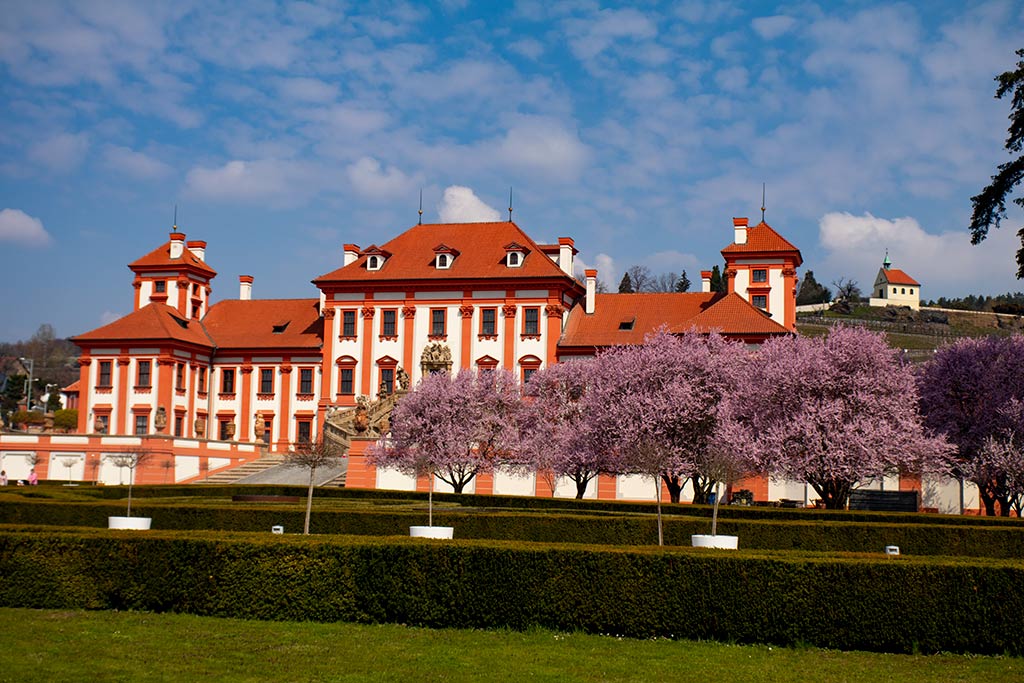

We often alight at Trojska and walk the 150 metres back to the Povltavska bus stop, where we catch the 112 or 234 bus to Prague Zoo (Zoologicka Zahrada). This is also the stop for Troja Castle Prague, a beautiful Baroque chateau and garden open from April to October, and Prague Botanical Garden is a short walk uphill from there.
Prague Tram 17 – Final Words
I hope you’ve enjoyed this virtual journey along the Prague 17 tram route.
Many years ago I spoke with a merchant in the bazaar in Esfahan in Iran, very close to the main square, one of the most beautiful in the world. ”Every time I walk onto the square”, he said, ”it feels like the first time.”
And this is just how I feel about catching the 17 tram into Prague.
The 17 tram Prague is also a great way to get an overview of the Vltava River in Prague. It passes the pick of the bridges in Prague along the way, including the Charles Bridge.
I also recommend Prague tram 17 as a great introduction to the skyline of the City of a Hundred Spires. You see so many of its church towers and spires along the way.
It’s a wonderful way to see a bit more of the city than many do, and to see the more familiar parts of it from a fresh angle. And all for £1.10 ($1.40) for a one-way ticket.

David Angel is a British photographer, writer and historian. He is a European travel expert with over 30 years’ experience exploring Europe. He has a degree in History from Manchester University, and his work is regularly featured in global media including the BBC, Condé Nast Traveler, The Guardian, The Times, and The Sunday Times. David is fluent in French and Welsh, and can also converse in Italian, German, Portuguese, Spanish, Czech and Polish.