


There’s more to Pisa than the Leaning Tower, but most visitors don’t get the time to see it. One day in Pisa would be a luxury for most travellers, who are lucky to spend more than an hour or two snapping their selfies before heading off on their way. I think Pisa deserves a full day trip, and in this guide I’ll show you why.
The Leaning Tower is one of the most famous landmarks in the world, and it’s just one element of one of the most beautiful squares on the planet. Everything in Pisa seems to be geared to getting you onto the conveyor belt to the Tower and Campo dei Miracoli (the surrounding square, the Field of Miracles), then out again.
In the early Middle Ages, this city was one of the leading powers in the Mediterranean, with a fleet of ships to match Genoa and Venice. Much of the rest of Pisa could easily be mistaken for a small provincial Italian city, a hidden gem yet to be discovered.
As well as showing you other things to see in Pisa, I’ll run through:
the practicalities of getting there
booking tickets in advance
where to stay in Pisa
places to visit near Pisa
I hope you find it helpful and get to see this fascinating city for yourself sometime soon.
One Day In Pisa Itinerary – Planning Tips And Tickets

Booking tickets in advance – especially if you intend to climb the Leaning Tower – is absolutely essential.
If you book a basic Leaning Tower and Cathedral ticket, you are tied to the stated time for climbing the Tower, but can visit the Cathedral any time during the same time.
Likewise, if you book a Leaning Tower + 4 attractions ticket, you have to visit the Leaning Tower at the designated time, but you are free to visit the other four sites (Cathedral, Baptistery, Camposanto Monumental Cemetery and Museo dell’Opera del Duomo) over the rest of the day at any time.
If you visit all five sites in the Campo dei Miracoli, you’ll probably spend half the day, possibly more, there.
The streets in the immediate vicinity of the Campo dei Miracoli are a tourist trap, full of shops selling overpriced kitsch souvenirs, and mediocre rip-off restaurants. However, the experience two or three blocks away is very different, with better restaurants and far less crowds.
Pisa In One Day Itinerary
Morning – 9.00 am to 10.00 am – Leaning Tower

Start the day early, arriving in Pisa (or leaving your hotel) around 8.30 am, aiming to arrive at the Campo dei Miracoli by 9.00 am. This is when the Tower, Baptistery and Camposanto cemetery around the monumental square open for visitors. The Cathedral opens later, at 10.00 am.
The tour buses tend to arrive after 10.00 am, so the first hour of the day tends to be considerably quieter. Alternatively the Tower is open as late as 8.00 pm during the summer months, which is sometimes extended to 10.00 pm.
The Leaning Tower of Pisa (Torre Pendente di Pisa) is one of the most famous travel icons in the world. It is the belltower (campanile in Italian) of the Cathedral. Italy has many leaning towers (Burano and Bologna for starters) but none anywhere near as famous.

This is probably because it’s so ornate. Each storey is decorated and supported by capitals all around the tower, and as the tower leans a few degrees out of the perpendicular, so do all of these pillars. And this adds to the effect of the lean. It’s not just a structure with two sides (as you view it) leaning) – it’s around 100 pillars as well!
The Tower was begun decades after the other buildings in the Campo dei Miracoli, but in the same style – Pisan Romanesque – around 1172. You only find this style, called Pisan Romanesque, in the western part of Tuscany.
However, it soon became clear that there was a problem with the Campanile. By the time the first storey of the building was leaning – a result of it having been built on unstable ground which could not support its foundations. It took 200 years to complete the remainder of the Tower.

The Tower was eventually stabilized during works around the millennium, and opened to visitors once again.
If at all possible, aim to be on one of the early entries to the Leaning Tower. The space inside is quite confined, and there are 297 steps, which requires a good level of cardiovascular fitness.
Once you’re in the Tower, there is no time limit on how long you can spend there, so feel free to take your time. You can stop at each of the stages of the Tower to enjoy the view.
A morning slot means that you get the superb view over the Cathedral, Baptistery and the rest of the Campo dei Miracoli. This would apply all through the morning.
Morning – 10.00 am to 12.00 pm Pisa Cathedral and Baptistery

Pisa’s Cathedral of Santa Maria Assunta opens to visitors at 10.00 am, and it’s where you’ll likely spend most time over the rest of the day.
The Cathedral was begun in 1064, and the original church was completed in 1092. The Pisans wanted to outdo their historic rivals, the Venetians, by building a spectacular church – which was outside the original city walls. The stunning west façade was added in the 12th century, and the detailed stonework (frieze carvings of animals and flowers, and human heads on capitals) is extraordinary.

After the build-up of anticipation, the interior (unlike the Duomo in Florence) does not disappoint. The nave has a beautiful 17th-century wooden coffered ceiling, and a magnificent marble pulpit by Giovanni Pisano, sculpted between 1302 and 1310. It’s richly decorated with scenes from the Life of Christ, but may not be in its original form. It was dismantled after a fire which damaged the Cathedral in 1595, and wasn’t reassembled until 1926. So some pieces may not be where they were originally intended to be!
The Cathedral holds many more outstanding artworks, including the apse mosaic depicting Christ Enthroned With The Virgin and St John. The figure of St John, on the right-hand side of the mosaic, is the only work by Florentine artist Giovanni Cimabue for which there is documentary proof.
There are also paintings by renowned Florence artist Andrea del Sarto and Sienese artist Il Sodoma. And as you enter (or leave) the Cathedral, don’t miss the bronze doors, which have been attributed to Giambologna.

The Baptistery, like the Leaning Tower, took almost 200 years to complete. It began as a Romanesque building, characterized by the rounded arches within. But by the time of its completion there were also some contemporary Gothic touches.
After the visual feast inside the Cathedral, the interior of the Baptistery is a more sombre, austere affair. The main decorative element is the astonishing marble pulpit by Nicola Pisano, son of Giovanni. The panels around the pulpit depict the Nativity, Adoration of the Magi and Crucifixion in astonishing detail. But it’s a small figure on a corner of the pulpit that most excites art historians.
The figure of Fortitude is modelled on the Greek god Hercules, and is the first representation of gods from Classical times in centuries. This small figure is considered by some to be one of the main precursors of the Renaissance which followed 200 years later.
Lunch 12.00 to 1.00 pm

For lunch, take a break from the monuments for an hour or so. You’ll see many a nenu turistico sign in the streets next to the Campo dei MIracoli. Ignore them, and head half a mile or so away towards Borgo Stretto, Pisa’s main shopping street.
Last time I was in Pisa I lunched at Pizzeria Il Borgo 21, 50 metres up the street from the statue of Galileo. There are a few good restaurants in the immediate vicinity, including Tumi Osteria (across the street along Vicolo dei Tinti) and a branch of the Branzo seafood chain around the corner on Via Ulisse Dini.
Afternoon 1.00 pm to 2.00 pm – Piazza dei Cavalieri


After lunch, I suggest heading back to the Campo dei Miracoli via Pisa’s second most beautiful square, the Piazza dei Cavalieri. The dominant building in the square is the Palazzo della Carovana, which was the work of Renaissance polymath Giorgio Vasari.It was the headquarters of the Order of the Knights of St Stephen, and is now part of the Scuola Normale Superiore, the University of Pisa. The most striking aspect of the Palazzo is the sgraffito decoration on the façade – which was restored in the 19th century.
Next door to the Palazzo, the Church of Santo Stefano dei Cavalieri was built as the Knights’ place of worship. It was also partly designed by Giorgio Vasari. It was built between 1565 and 1572, and some of the interior artworks depict battles fought by the Order. Some flags captured from Saracen ships are also on display in the church.
2.00 pm to 3.00 pm – Camposanto and Museo dell’Opera del Duomo


After exploring the Piazza dei Cavalieri I suggest returning to the Campo dei Miracoli to see whatever else you haven’t managed so far.
The Camposanto, at the northern end of the square, is the quietest part of the complex, a monumental cemetery that may have been intended as a church when begun. Some of the soil in the central part of the Camposanto is said to have been from Golgotha, the hill in Jerusalem where Christ was crucified.
The Camposanto is reminiscent of a cloister – albeit elongated – in layout, with arcaded galleries surrounding an open central space. Some of the walls are decorated with frescoes, created at various times between the 14th and early 17th centuries. You can see some of the preliminary sketches of these in the Museo delle Sinopie, on the other side of the Campo dei MIracoli. There are also numerous Roman and Etruscan sarcophagi and later funerary monuments, such as the delightful marble figure pictured above.
The tracery of the open windows also makes a great photographic subject, especially if you are using one of them to frame the dome of the Cathedral (also see above).
Within the Camposanto there are three Chapels. In the Cappella Aulla, you’ll find the lamp which Galileo Galilei observed before understanding how to calculate the movement of a pendulum. He made these observations in the Cathedral, where another (larger) lamp now hangs. And the Cathedral’s collection of holy relics is kept in the Dal Pozzo Chapel. These include tiny pieces of what is supposedly the True Cross (on which Christ was crucified) and a thorn purportedly from the Crown of Thorns placed on his head that day.
You’ll also find a Museo dell’Opera del Duomo in many an Italian city. These are basically museums of the Cathedral’s treasures. These include the original Griffin of Pisa, a replica of which stands on the Cathedral roof. It’s believed that this was of Islamic origin, possibly from Spain, and that it was captured by the Pisans during one of their many naval battles.
Afternoon – 3.00 pm to 5.00 pm – the Lungarno and Santa Maria della Spina


One of the overlooked joys of Pisa is its riverfront, the Lungarno, especially when viewed from the main bridge over the Arno, the Ponte Solferino.
On each side, the Lungarno (it simply means ‘along the Arno’) is lined with some fine palazzi. On the north side (right bank of the river) these include the 16th-century Palazzo Reale, built by the Medici and home to many portraits of the dynasty. One of the most important works in the collection is Raphael’s The Miracle of The Two Hanged Men.

On the left bank (south side) of the Arno, don’t miss the exquisite Gothic church of Santa Maria della Spina (St Mary of the Thorn). It was originally built to house one of the most important relics held by Pisa, a thorn from the Crown of Thorns worn by Christ when he was crucified. The tiny 13th century church had to be rebuilt in the 19th century at a higher level where it was less prone to flooding from the Arno. Although this caused much consternation for English writer John Ruskin, who thought the rebuild and restoration was terrible!
The church is closed on Mondays. From April to September it’s open Tuesdays to Sundays 10.00 am to 2.00 pm, and from 3.00 pm to 6.00 pm (7.00 pm Sundays). From October to March it’s only open from 10.00 am to 2.00 pm Tuesdays to Sundays.
And after that, it’s dinner or departure!
Pisa One Day Itinerary Summary

8.00-8.30 am – Arrive in Pisa or depart Pisa hotel
9.00 am – Arrive in Campo dei Miracoli. Visit Leaning Tower or Baptistery
10.00 am – Visit Pisa Cathedral and Baptistery or Leaning Tower
12.00 pm – lunch
1.00 pm – Piazza dei Cavalieri, Borgo Stretto then walk back to Campo dei Miracoli
2.00 pm – Camposanto and Museo dell’Opera del Duomo
3.00 pm – Explore the Lungarno and Santa Maria della Spina church
5.00 pm – Dinner or departure
More Than 1 Day In Pisa – Other Things To Do In Pisa

Unusually for cities about which I write ‘one day in’ articles, there’s not a great deal to keep you in town much longer than a day.
I strongly suggest taking a look at the Orto Botanico di Pisa (Botanical Garden) if it’s open when you’re in town. It’s believed to be the oldest (or at least joint oldest, along with that in Padua) in the world,
Pisa does have several other fine churches, and if you have the time available, San Michele in Borgo and Santa Caterina d’Alessandria are both well worth the effort.
Pisa also has several more museums. The Museo Nazionale di San Matteo has an excellent collection of medieval art. Nearby, the Museum of Ancient Ships is housed in the Medici Arsenal buildings. The ancient vessels on show here predate Pisa’s maritime glory days by centuries, and are well worth an hour of your time.
Day Trips From Pisa
Pisa makes an excellent base for exploring the western part of Tuscany, whether you’re driving or using public transport. It’s also a possible base for a trip into Liguria and the Cinque Terre coastal villages near La Spezia.
The nearest city to Pisa is Lucca, one of the best places to visit in Tuscany. It’s a beautiful time-warp of a city, tucked away inside town walls which double as a park. Ideally it’s somewhere to linger for two or three days, gradually finding your way around the warren of medieval lanes.
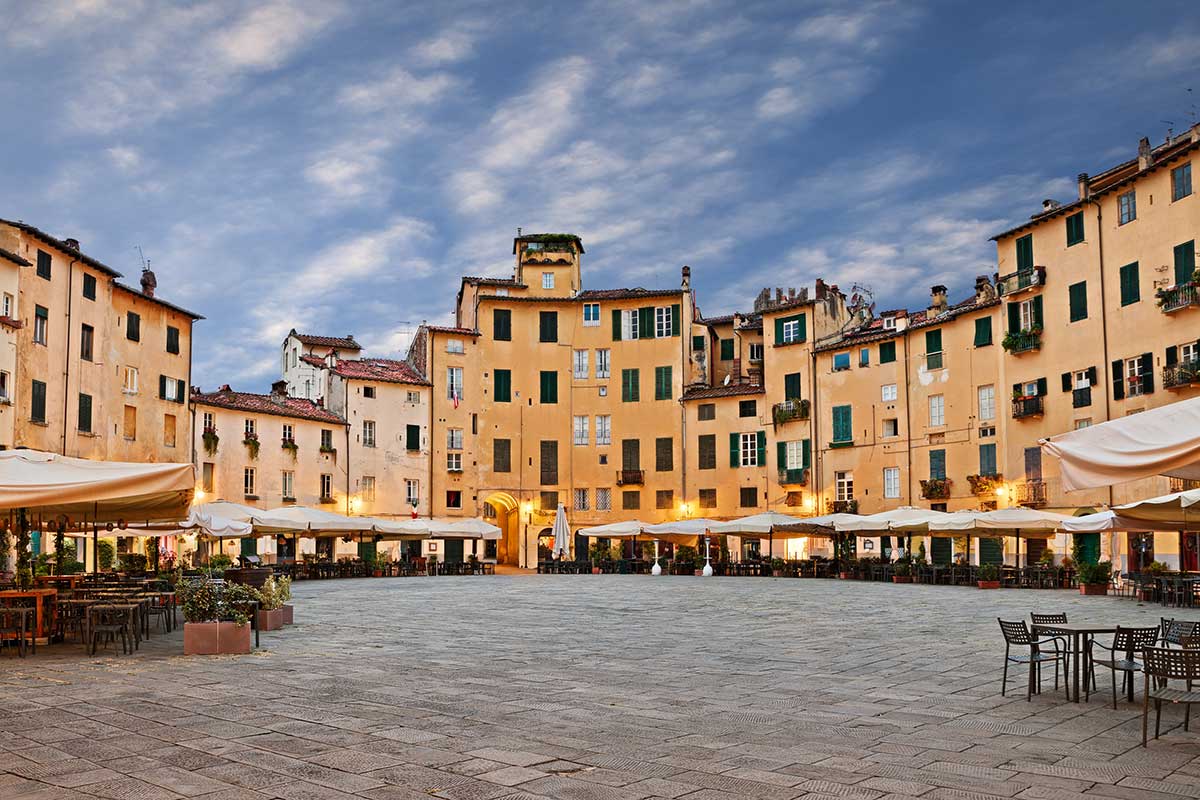
It doesn’t have any ‘big ticket’ sights like Pisa, which is probably to its benefit. Instead there are several fine churches – the Duomo and San Michele in Foro have fine Pisan Romanesque facades – and the quirky charm of an oval-shaped square built on the foundations of its Roman amphitheatre, and a tower (Torre Guinigi) with a tree growing out of its top.

Only quarter of an hour away by train, Viareggio is one of the loveliest Italian seaside resorts. A taster for the Tuscan Riviera to the south, it has a fantastic and enormous sandy beach, and a beautiful promenade with several fine Art Nouveau facades.
Livorno, just to the south, is a more workaday port city. It may not have the glamour of Viareggio but it has some superb medieval buildings including the Old Fort in its harbour. It’s also an essential stop on my recommended Italy food tour, as it’s home to cacciucco, an outstanding tomato-based fish stew.
The Cinque Terre villages are an hour north of Pisa. You can catch a train to La Spezia, then change for a local train. Or you can book a day tour from Pisa to Cinque Terre, including a boat ride along the coast and visits to three of the five villages. There is also the option of a full day tour from Florence to Cinque Terre, which takes you to four of the villages.
Where Is Pisa
Pisa is a short distance inland from the west coast of Tuscany, in central Italy.
Here are some sample distances to Pisa from nearby major cities:
Florence to Pisa – 68 km (42 miles)
Lucca to Pisa – 21 km (13 miles)
Livorno to Pisa – 24 km (15 miles)
Rome to Pisa – 350 km (217 miles)
Genoa to Pisa – 170 km (106 miles)
How To Get To Pisa

The two best ways to get to Pisa are by flying or taking the train.
Pisa Airport is the main flight gateway to Tuscany, with flights from all over Europe. Some national carriers (British Airways, Aer Lingus, SAS) fly there, as do most of the budget airlines (easyjet, Ryanair and Wizz).
The Pisa Mover train makes the short (little more than a mile) journey from Pisa Centrale station to the airport station. The journey takes only five minutes, but costs €6.50 each way, per person – exorbitant for such a short journey. Pisa is still a fairly budget-friendly city, but this is a bit of a rip-off.
Pisa Centrale is an important railway junction, with services east to Florence and Bologna, south to Livorno and Rome, and north to Viareggio, La Spezia (for the Cinque Terre villages) and Genoa.
How To Get Around Pisa
Pisa is small enough to get around on foot. The longest distance you would have to walk is from the train station to the Campo dei Miracoli, which takes about 25 minutes. If you’reonly spending the one day in Pisa, I suggest taking the bus to the Campo dei MIracoli in the morning, then walking back via some of the other attractions I’ve also mentioned above.
Bus 1+ takes you from the station (Pisa Stazione) to Torre di Pisa 1 stop, and you can return to the station from the Torre di Pisa 2 stop across the street.
You can buy tickets from the machines at the stops outside the train station, or via the at bus app.
Best Time To Visit Pisa

You could visit Pisa at any time of year. One of the joys of visiting Italy in winter – especially January – is that there’s a lull in the tourist crowds, and hotel prices tend to be discounted in the main cities.
I’ve visited Pisa three times – once in March (springtime) and twice in September. It was fairly crowded every time I visited, so if you want to avoid the worst of this, I suggest visiting in the low and shoulder seasons (October to March). As you’ll almost certainly be photographing the Leaning Tower the lower light of the this time of year often makes for better images.
Where To Stay In Pisa
**** – Palazzo Feroci – Residenza d’Epoca – historic palace in the centro storico (old town) of Pisa
**** – Rinascimento Bed & Breakfast – gorgeous guesthouse in historic building less than ten minutes’ walk from the Leaning Tower
*** – Prato dei Miracoli Residenza d’Epoca – superb guesthouse on the Campo dei Miracoli, front-facing rooms with views of Leaning Tower and Cathedral from a few metres away
*** – Hotel di Stefano – great mid-range hotel 500 metres from the Leaning Tower, where I stayed in Pisa on my first visit in the 1990s
How Many Days In Pisa, Ideally?
Pisa is a small city, and you can comfortably see the best of it in a full single day. If you intend to visit most of the museums in the city, then allocate a second day to allow yourself time. Allow more time if you intend to use it as a base for day trips around western Tuscany.
One Day In Pisa – Final Thoughts

I hope you’ve enjoyed this guide. Pisa is a great city for a short visit and a great base, especially if you’re planning to travel around western Tuscany by public transport.
Here are some more articles on Tuscany and Italy, followed by a selection of articles from my ‘One Day In…’ itinerary series.
Best Places To Stay In Tuscany
15 Wonderful Tuscany Hidden Gems
Best Churches In Florence To Visit
How To Visit La Verna Sanctuary, Tuscany
15 Most Beautiful Squares In Italy
Things To Do In Bologna – the fabulous food capital of Italy
Things To Do In Padua – the most underrated city in Italy
14 Most Beautiful Churches In Venice
And take a look at more articles from across Europe in my ‘One Day In…’ series:
One Day in Avignon – a day in the City of Popes
One Day in Santorini – a whistle-stop trip around one of the most beautiful Greek islands
One Day In Heraklion – a day in the fascinating capital of Crete
One Day in Brno – 24 hours in the Czech Republic’s superb second city
One Day in Zagreb – 24 hours in the Croatian capital
One Day in Bath – a day in the stunning Georgian twice-over World Heritage city
1 Day London Itinerary – the perfect 24 hours in London
One Day In Nuremberg – 24 hours in the Imperial City
One Day In Dresden – an introduction to the Florence of the Elbe
One Day In Hamburg – a short trip to Germany’s maritime melting pot