
Visiting The Cluny Museum Paris – 15 Amazing Highlights
If you’re fascinated by the Middle Ages, then visiting the Cluny Museum Paris should be in the top five places to visit in the French capital. Along with the great Gothic churches of Notre Dame, Sainte-Chapelle and the Basilica of Saint-Denis, it’s home to some of the finest artworks from the Middle Ages.
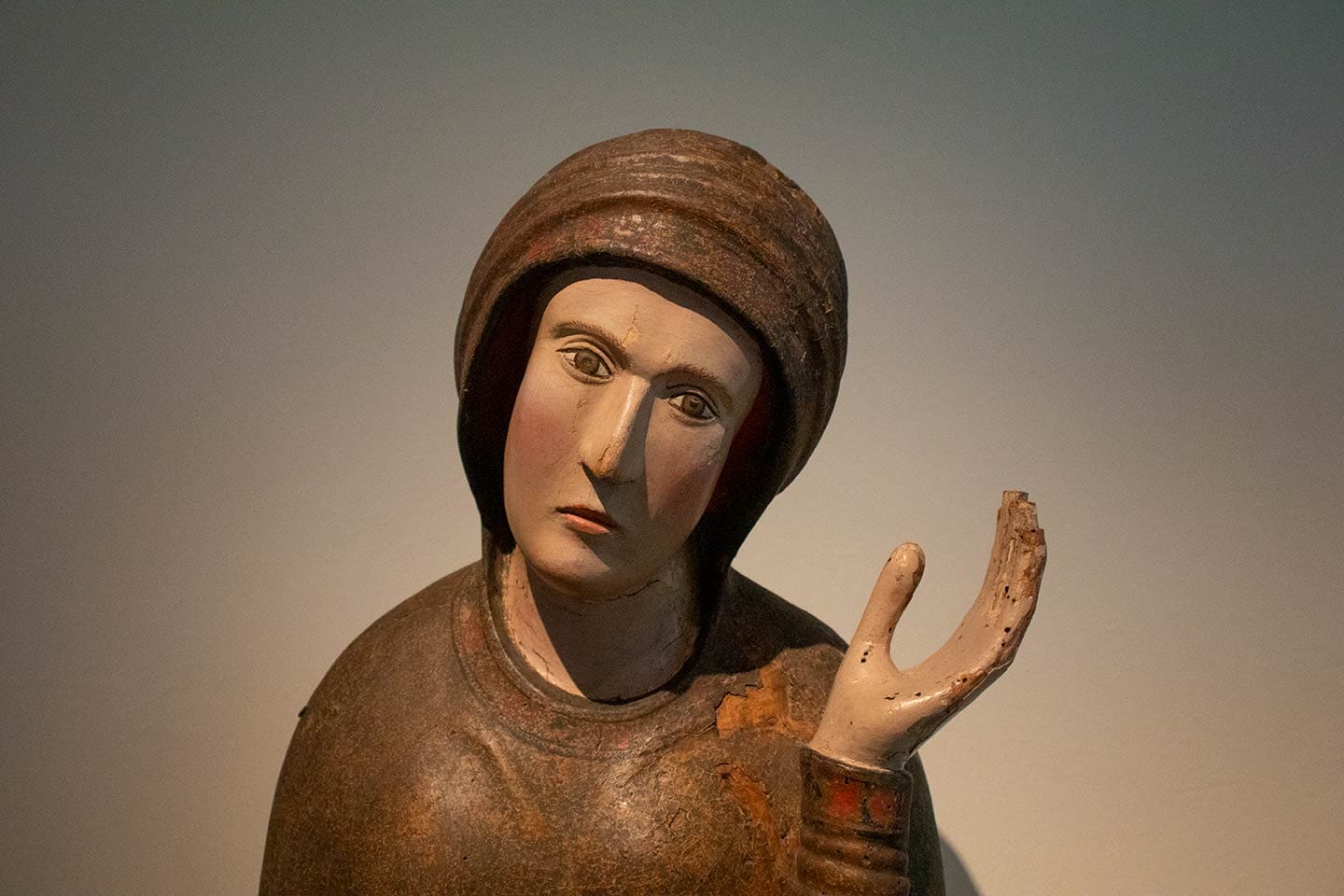
It’s also known formally as the Musée National du Moyen Age – the National Museum of the Middle Ages – but more widely known as the Cluny Museum. Many of the works of art held there are religious, though there are also numerous secular examples. The range of items is amazing, from an archway from one of the finest churches in Paris to a reliquary made for a saint’s finger. There are exquisite wooden statues from the 13th century – like the Virgin Mary in the lead shot for the article – to an intricate ivory altarpiece.
These are from all over France and beyond – my selection includes works from Tuscany and Flanders, but there are also items from Switzerland and Spain, Germany and the Islamic world.
In this article I’ll show my selection of 15 unmissable highlights from the Cluny Museum, and advise you on obtaining your tickets, and other places to see nearby in the Latin Quarter of Paris, including several other outstanding museums.
I hope you enjoy it and find it helpful.
Cluny Museum Tickets and Tours
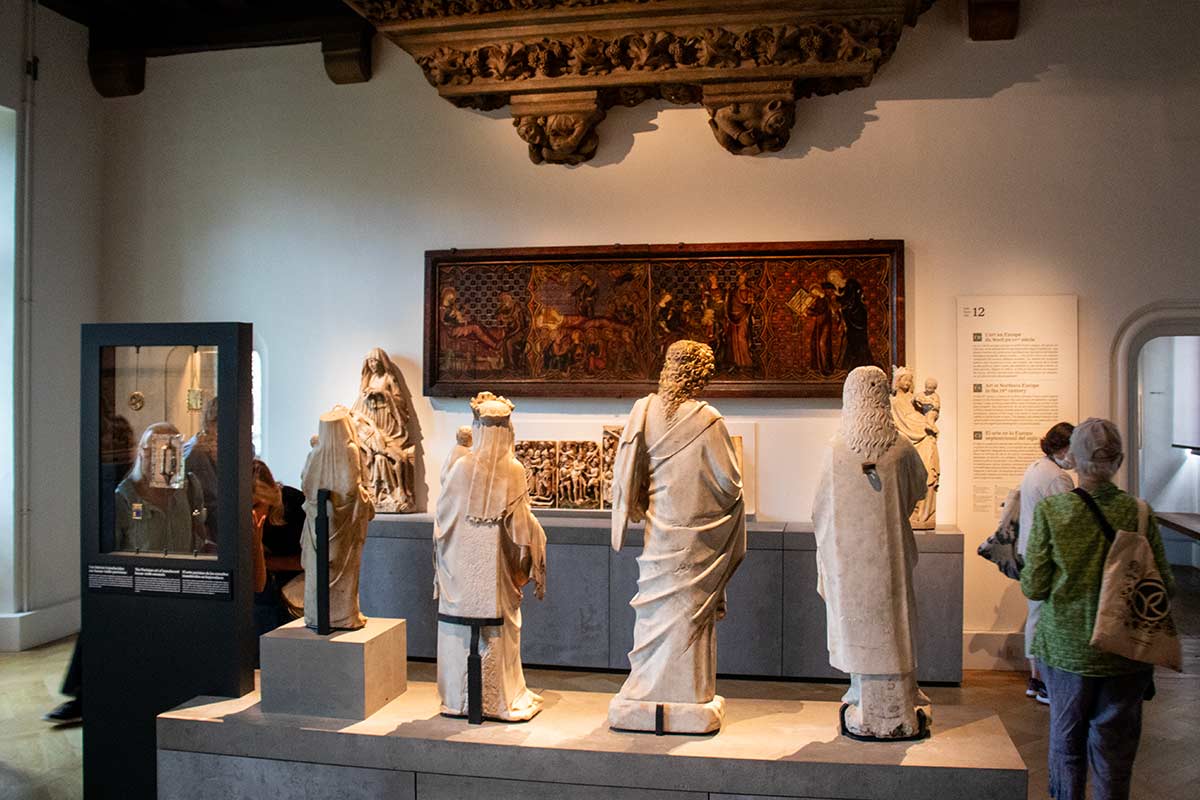
When visiting Paris, I always buy a Paris Museum Pass, which covers over 80 museums and attractions around the city. It saves you a lot of money if you’re planning to visit any number of museums, and it comes in The Cluny Museum is included in the Paris Museum Pass, which comes in 2- day, 4-day or 6-day options.
You can order your Paris Museum Pass here (for any of the three durations).
This Old Town and Latin Quarter walking tour is an excellent introduction to the area around the Cluny Museum, also visiting the area’s famous cafes, the Sorbonne, Jardin du Luxembourg and Pantheon.
And this Latin Quarter walking tour with tastings is another great way to learn about the area and find your bearings, with some delicious patisseries to keep you going!
Visiting Cluny Museum Paris Highlights
The Lady and the Unicorn Tapestries
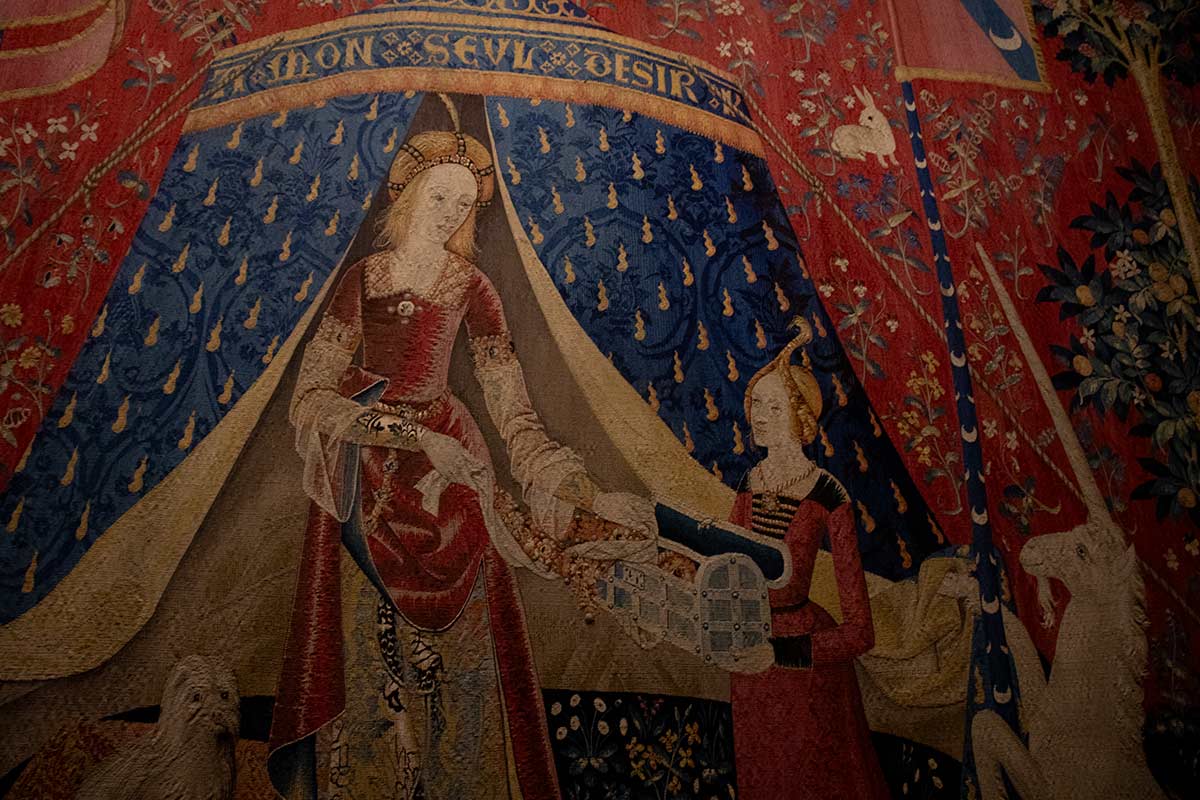
This series of six tapestries is probably the best-known exhibit in the Cluny Museum and is in the penultimate room of the Museum. They were woven in Flanders around 1500, based on designs created in Paris, and are believed to have been commissioned by the wealthy Le Viste family.
The six tapestries were discovered in the Chateau de Boussac (in the Limousin region) in 1841 by writer and historian Prosper Mérimée, and novelist George Sand helped date them to around 1500. Sand’s efforts helped spread awareness of them to the French public, and their safety was secured with their acquisition by the Musée de Cluny.
The first five of the tapestries are believed to depict the five senses – touch, taste, smell, hearing and sight. Each depicts a lady in a garden, with a lion and unicorn for company, as well as numerous other animals including a hungry monkey and a dog.
In the sixth tapestry, the lady stands at the entrance to a tent which has an inscription, À mon seul désir (‘To my only desire’) above its entrance. There have been many suggestions as to the overall meaning of the tapestries, ranging from a depiction of the pleasures of life to the medieval tradition of courtly love. As no suitor is shown in the tapestries, I’m inclined to say that they may well be about the joys of life, albeit with some hidden, probably forever indecipherable meaning behind them!
Some of you may also recognise the tapestries from the Harry Potter movies. Copies of them hung on the walls of the Gryffindor common room at Hogwarts.
Virgin Mary from Prato Cathedral, Tuscany, 13th century
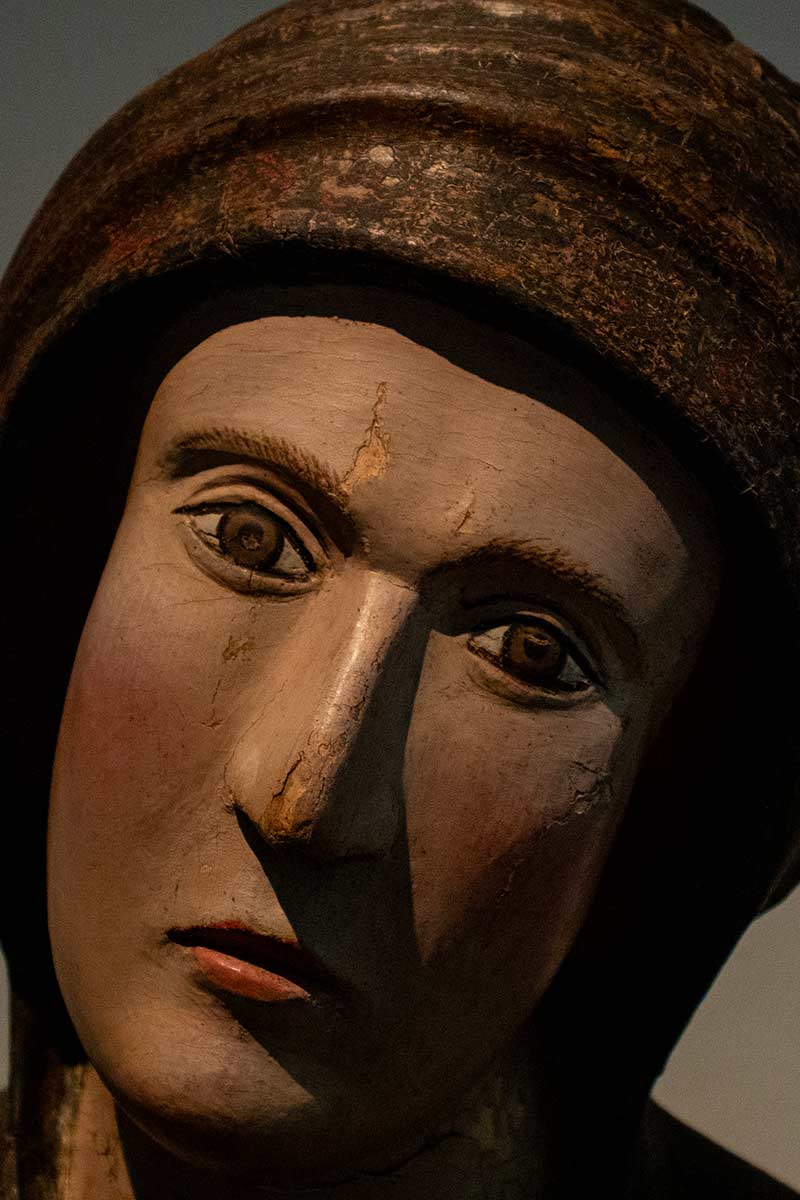
This 13th-century figure of the Virgin Mary is, for me, one of the highlights of the Cluny Museum.
It’s displayed alone, but was originally from an ensemble of figures in a depiction of Christ’s Descent from the Cross, which was originally in Prato Cathedral (Duomo) in Tuscany, just to the west of and one of the most intriguing day trips from Florence.
Another statue from the group, of St John, is also on display in the Cluny Museum, again alone and out of its original context. These two figures stood at opposite edges of the group, their hands gesturing towards the viewer the main subject, the dying Christ.
Golden Casket with Apostles Peter and Paul
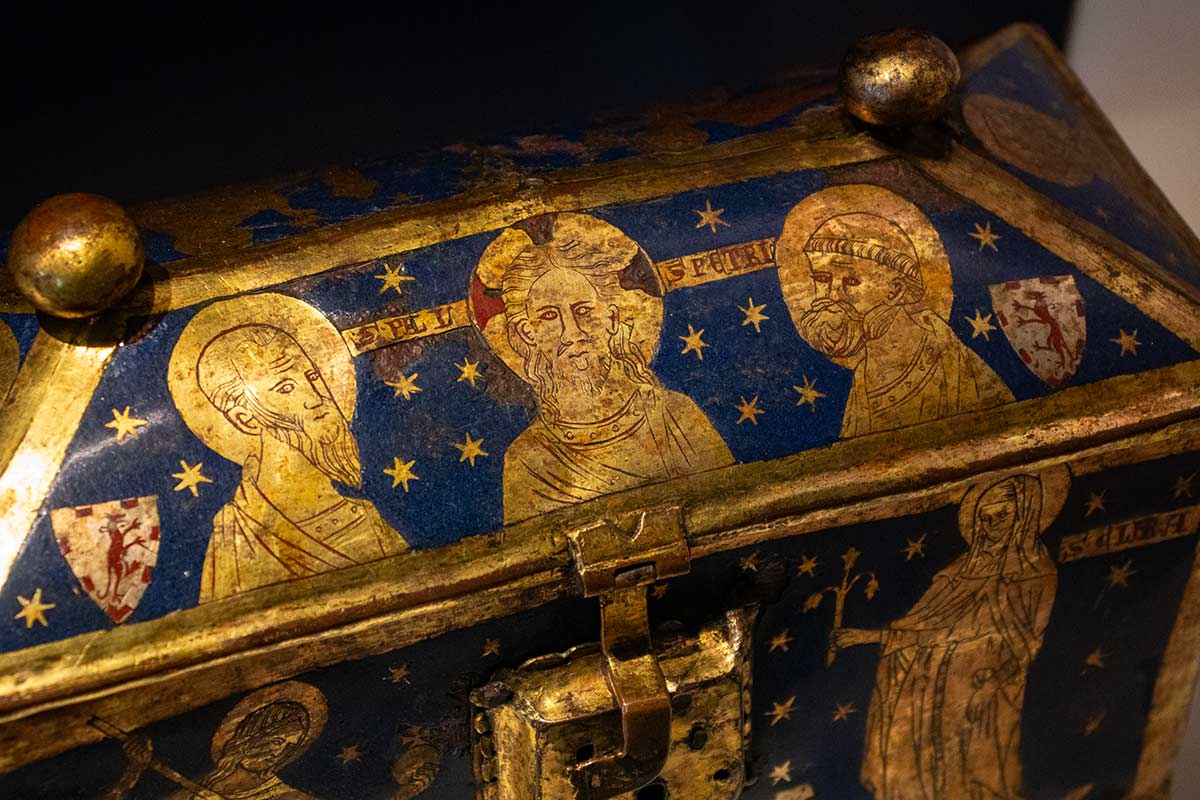
Holy relics played an enormous part in religious life in the Middle Ages. Pilgrimages to the shrines of saints became a spiritual tradition, a journey to fulfilment and also a search for a miraculous cure for ailments. But not all relics were genuine.
Such is the case with some of the reliquaries and shrines on display. Some of the relics may have been real, but the Holy Umbilical Cord of Christ? It sounds like something out of Monty Python and the Holy Grail to go alongside the Holy Hand Grenade of Antioch. And, spoiler alert, it turns out that the Holy Umbilical Cord was not the real thing.
The caskets and reliquaries crafted to house these relics may not have held what they were supposed to, but they are often astounding works of craftsmanship, from the reliquary of St Mabille (an early martyr) to the Shrine of the Magi.
Despite repeated efforts I am unable to enlighten you with information on the casket shown in the image above. It depicts St Paul and St Peter on the visible side of the lid, and other Apostles around the rest of it. However, information on it is, at present lacking. But I think it’s highly likely that it was made with the purpose of holding some saintly relics, genuine or otherwise….
Jouvenel des Ursins Painting (1445-49, Paris)
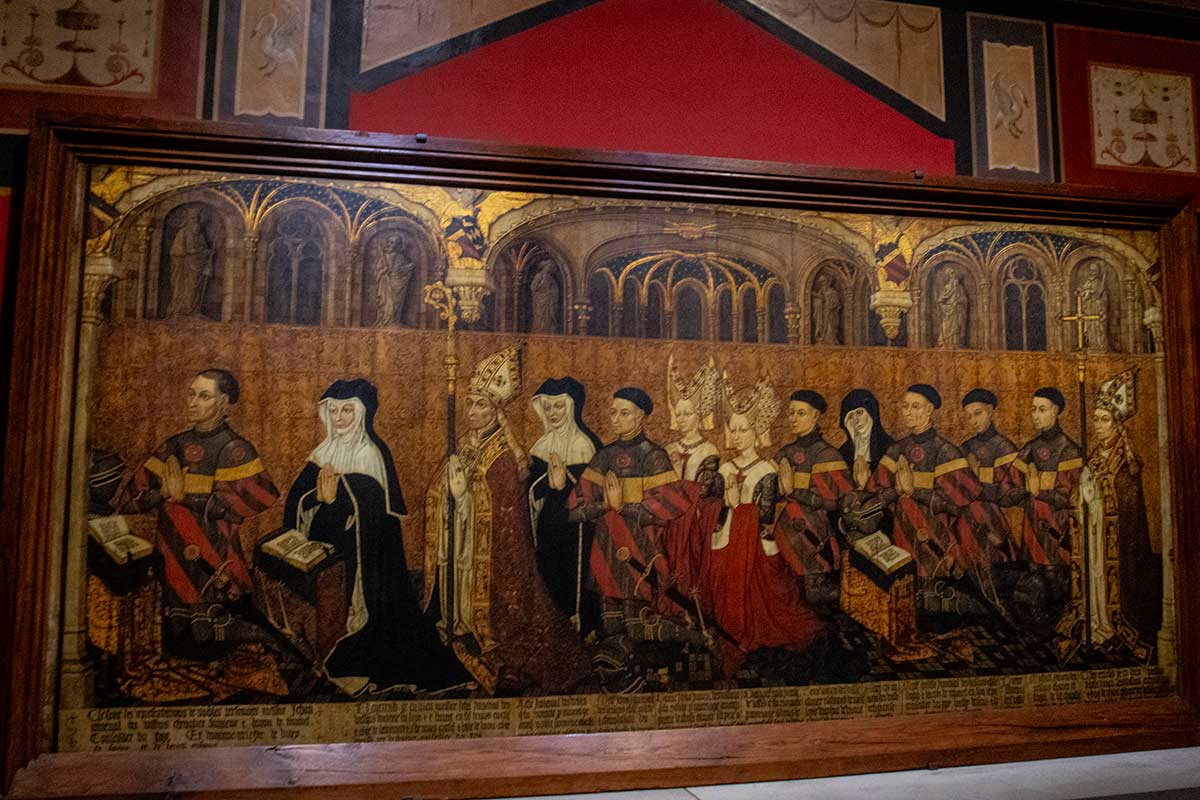
This painting from the 1440 shows a wealthy Parisian family at prayer, in the company of two bishops, a royal chancellor and two other senior French hommes politiques.
Artworks from Paris from this period are relatively rare, largely because of the fighting close by during the Hundred Years War.
This painting is all about showing off the family’s status, and indeed their piety. The gold brocade background underlines this as do the senior church and political figures. It’s likely that two of the nuns depicted were members of the family, again showing their Christian credentials.
The painting was held by the Louvre from 1829 to 1985, when it was donated to the Cluny Museum.
It’s on display in Room 15 of the Museum.
Heads of the Kings of Judah (from Notre Dame de Paris)
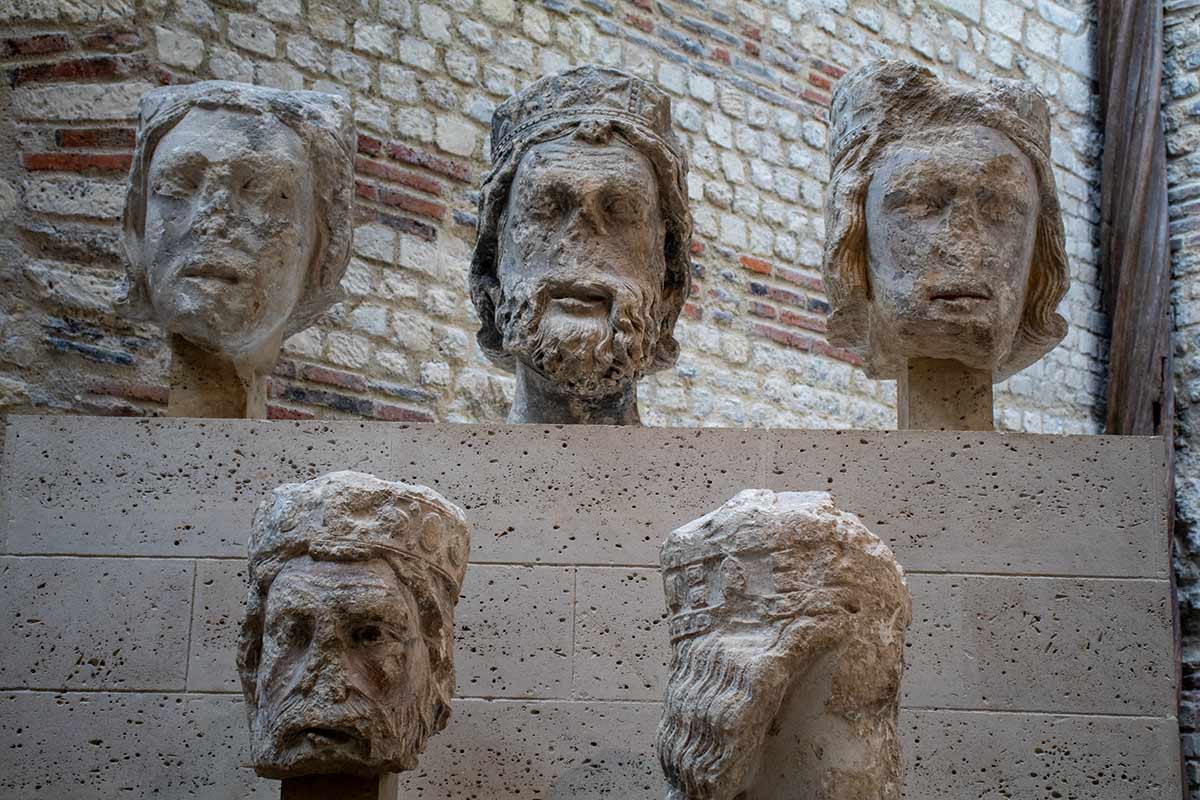
The Revolutionaries of the early 1790s were to France what Henry VIII and later the Roundheads and Puritans were to England (and the Taliban to modern Afghanistan, for that matter). They all went on wrecking sprees, destroying centuries of priceless religious art, for a mixture of political and religious reasons.
In one particularly in famous episode, a Revolutionary mob decapitated a series of statues on the façade of Notre Dame de Paris. As well as being an act of grotesque vandalism, they didn’t even know what they were destroying. They assumed that the statues were of previous French kings, but they were depictions of ancient Kings of Judah.
Some (21 of the 28) of the bodies and heads of the 13th-century statues were discovered during excavations in 1977, in the courtyard of a Parisian townhouse. They are one of the most important things to see in the Cluny Museum. The heads and torsos remain separated, but you can at least see them in the same room – room 5.
Medieval Stained Glass From Sainte-Chapelle
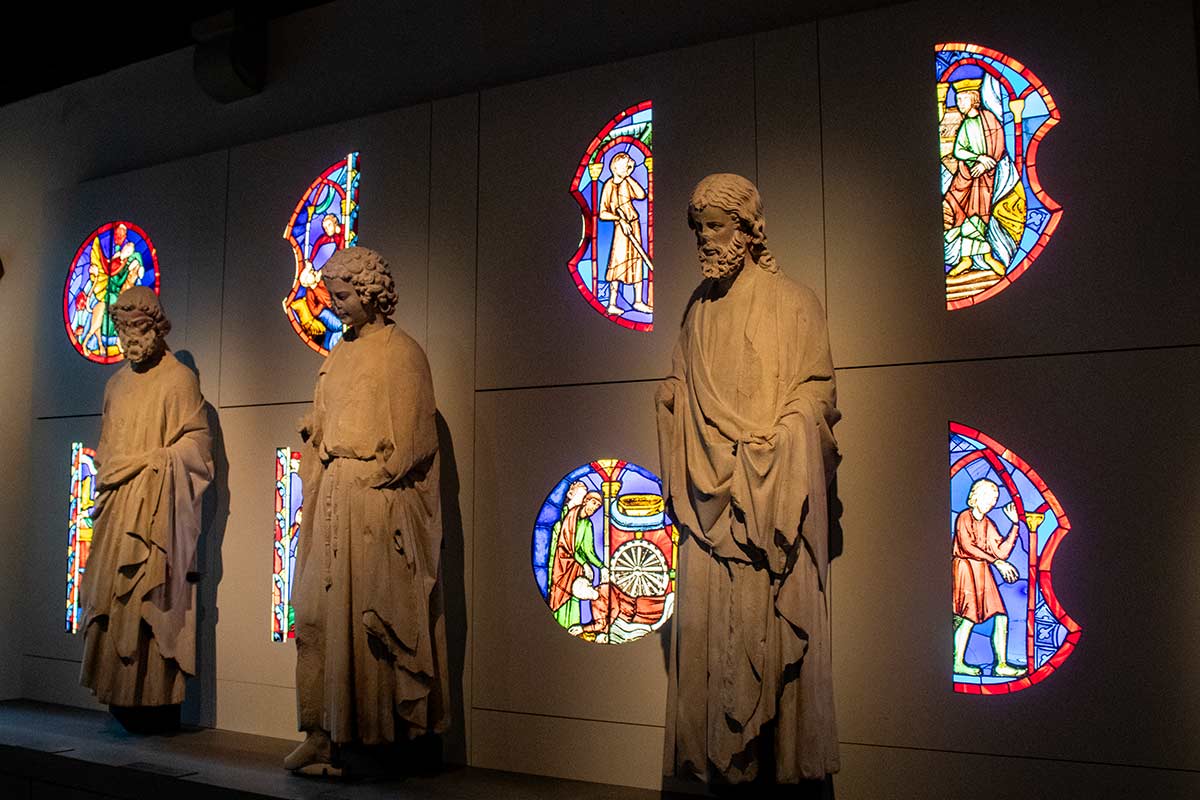
The Cluny Museum holds an extensive collection of medieval stained glass, and only a selection of it is usually on display at any one time.
The earliest examples date from the 12th century and are from the Basilica of St Denis in northern Paris. The largest collection is from nearby Sainte-Chapelle, with over 25 panels.
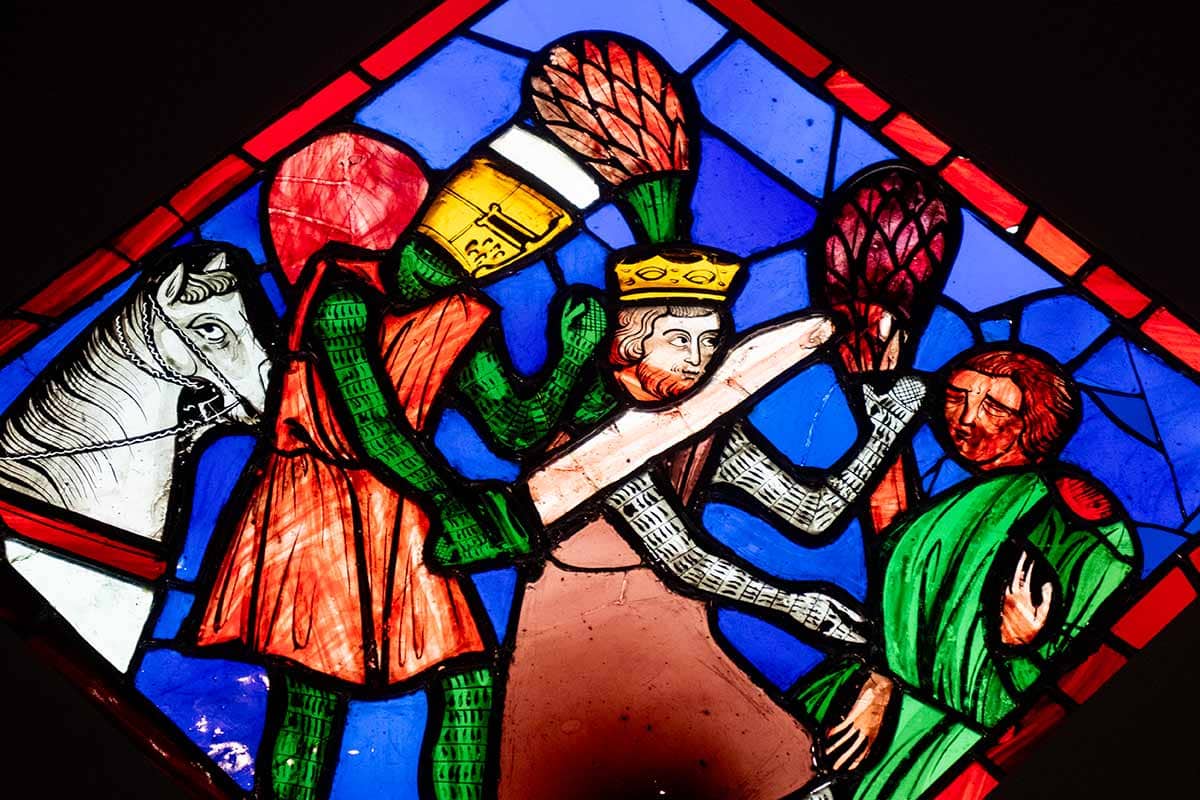
The panel I photographed (above) has a dose of gruesomeness not uncommon in 13th-century religious art. It depicts a knight (wearing a helmet not unlike the marvellous British parliamentary election candidate, Count Binface) killing a crowned king with a sword. I don’t know who either of these figures is meant to be, and if I do find out I will update the article accordingly.
If you enjoy the stained-glass collection at the Cluny Museum, absolutely do not miss the sense-overloading walls of 13th-century stained glass at the stunning Sainte-Chapelle just across the Seine on the Île de la Cité. This combined Sainte-Chapelle and Conciergerie ticket also includes the former prison and courthouse next door.
Holy Sacrament Altarpiece, Flanders
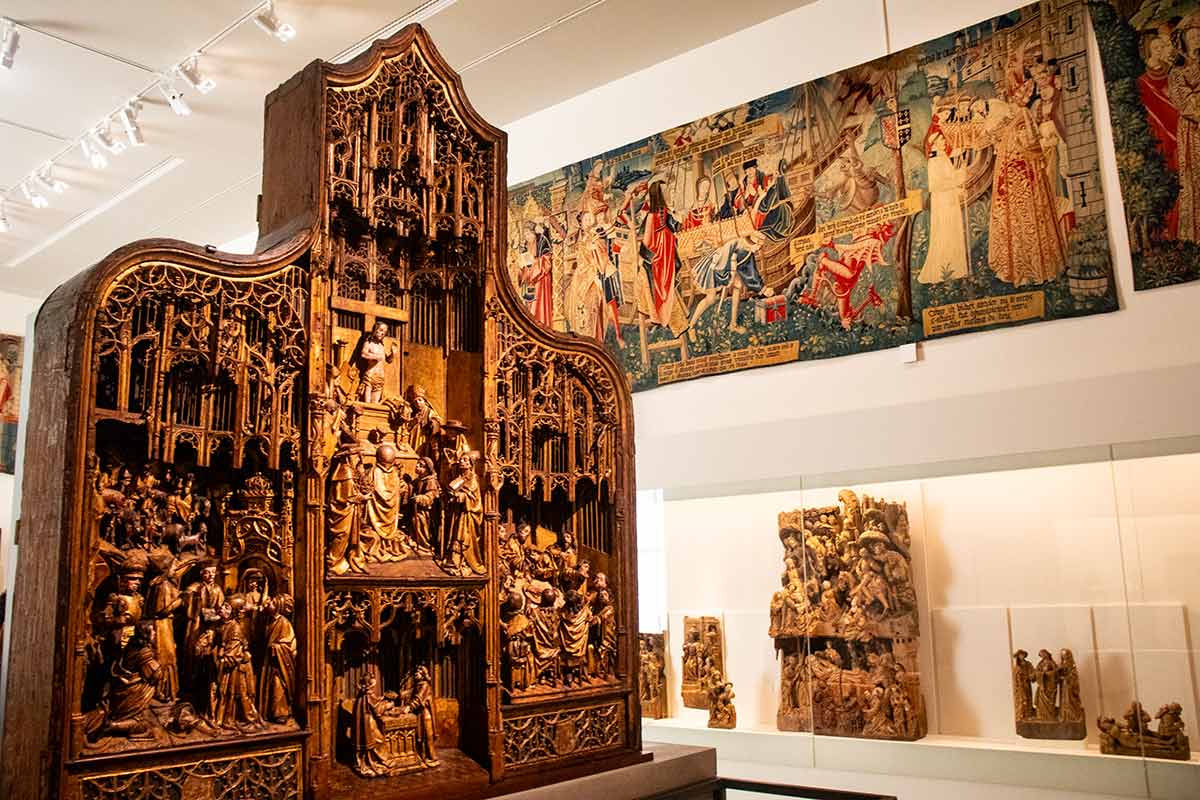
This is one of several outstanding altarpieces in the Cluny Museum. It’s from the Abbey of Averbode, near Antwerp in Flanders, and is believed to date from around 1514.
Surprisingly it wasn’t used for much of the ecclesiastical year, being brought out at Easter when it was placed on the high altar at Averbode.
It’s an extraordinary and elaborate work, with three events depicted – the Last Supper, the celebration of a Mass and the blessing of the prophet Abraham.
It can be found in room 21 of the Museum.
Saint-Romain-de-Blaye Altarpiece, Saint-Denis Abbey
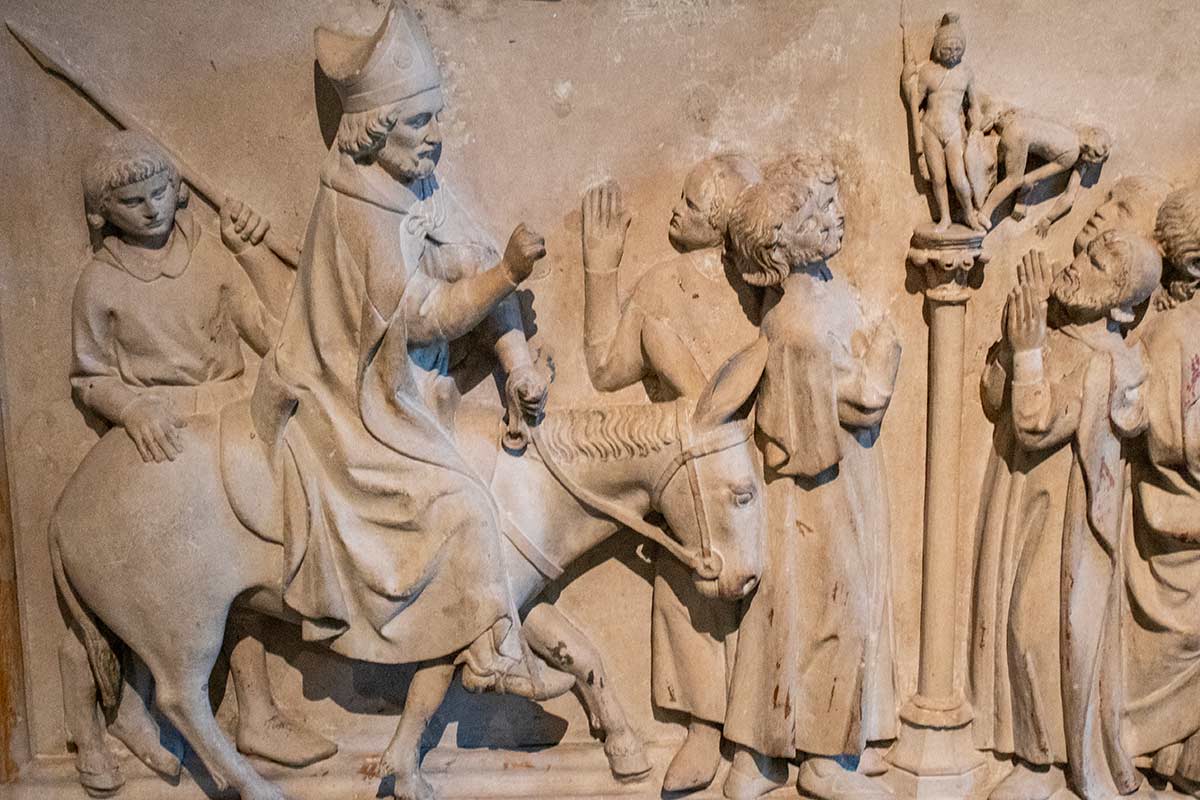
This 13th-century stone altarpiece came from a side chapel at the Basilica of Saint-Denis, the birthplace of Gothic architecture in the northern suburbs of Paris. St Romain was a 4th-century priest and early missionary active in the Aquitaine region in southwest France.
My image above only shows the first, left-hand scene of three. It shows St Martin of Tours sitting on a donkey, hearing the plea of St Romain to help remove the idols (of what were called ‘false gods’).
The central scene of the altarpiece shows the baptism of Christ, and the final scene shows St Martin blessing Romain on his deathbed.
This altarpiece is on display in room 9 of the Cluny Museum.
Auvergne Crucified Christ
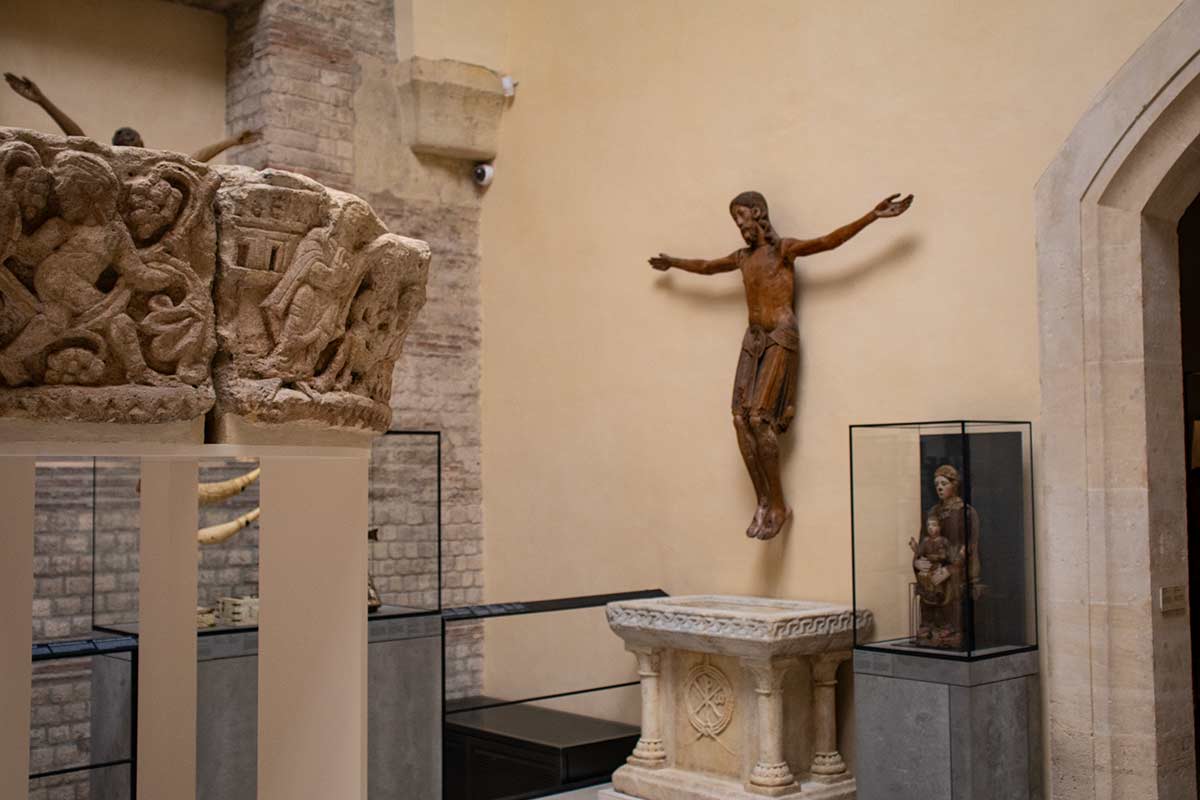
The Auvergne region – in the southern part of the Massif Central mountains – is renowned for its Romanesque religious sculptures from the 12th and 13th centuries. Many sculptures – particularly of the Madonna and Child – can be seen in churches across the region, but this Crucified Christ is a very rare survival from the region and period.
The life-size sculpture is on display in Room 3 of the Museum, close to some of the beautifully preserved stone pillar capitals rescued from around France. The Christ figure has been separated from the Cross, and doesn’t appear to be in any great pain, considering the agonising ordeal which he would have just endured.
This is because he is shown to be triumphant over death and pain. If you disregard the nail wounds in his hands and feet, without the cross he seems to be stretching out his hands as if leading a congregation in prayer, in a gesture of strength and compassion. It’s a magnificent sculpture, and it’s unfortunate that the name of the author of this work – like many others in the Museum – isn’t preserved for posterity.
Saint-Sulpice du Tarn Triptych
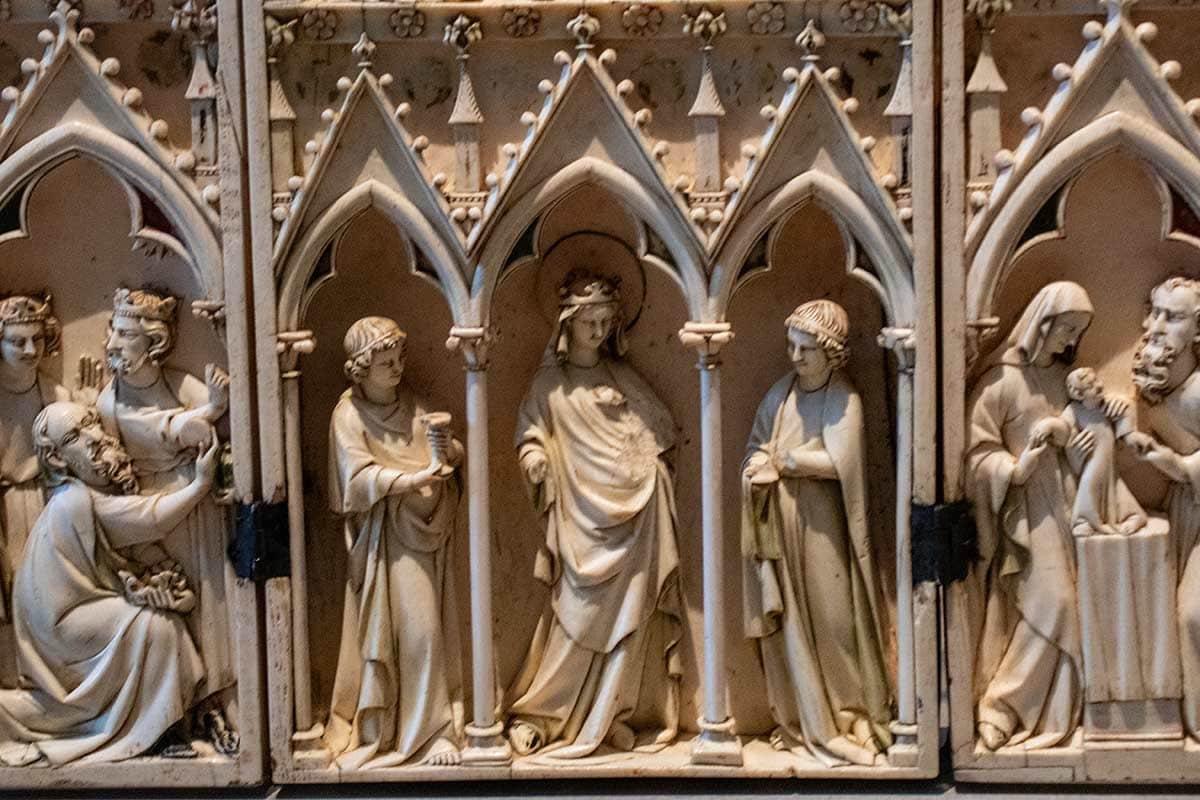
This tiny triptych (a series of sculptures in three panels) is one of the most remarkable exhibits in the Cluny Museum, Paris. It’s little more than 32 cm tall, and two layers of intricate ivory sculpture are elegantly crammed into this confined space.
It’s probably so small because of the material used, which would have been in limited supply in 14th-century Paris, where it was most likely produced. The upper section (not shown in my image, above) depicts the Crucifixion of Christ and Descent from the Cross. The lower section shown in my image shows two scenes from Christ’s childhood, with the figure of the Virgin Mary flanked by two angels.
The triptych was acquired in the 19th century from the fascinating church of what is now known as Saint-Sulpice-la-Pointe, between Toulouse and Albi, in the Occitanie region of southwest France. If you’re ever in the vicinity, it’s an intriguing fortress church (nearby Albi Cathedral would likely have been an influence). It resembles a castle rather than a church, so don’t be deceived!
The Triptych can be seen in Room 10 of the exhibition.
Stavelot Altarpiece
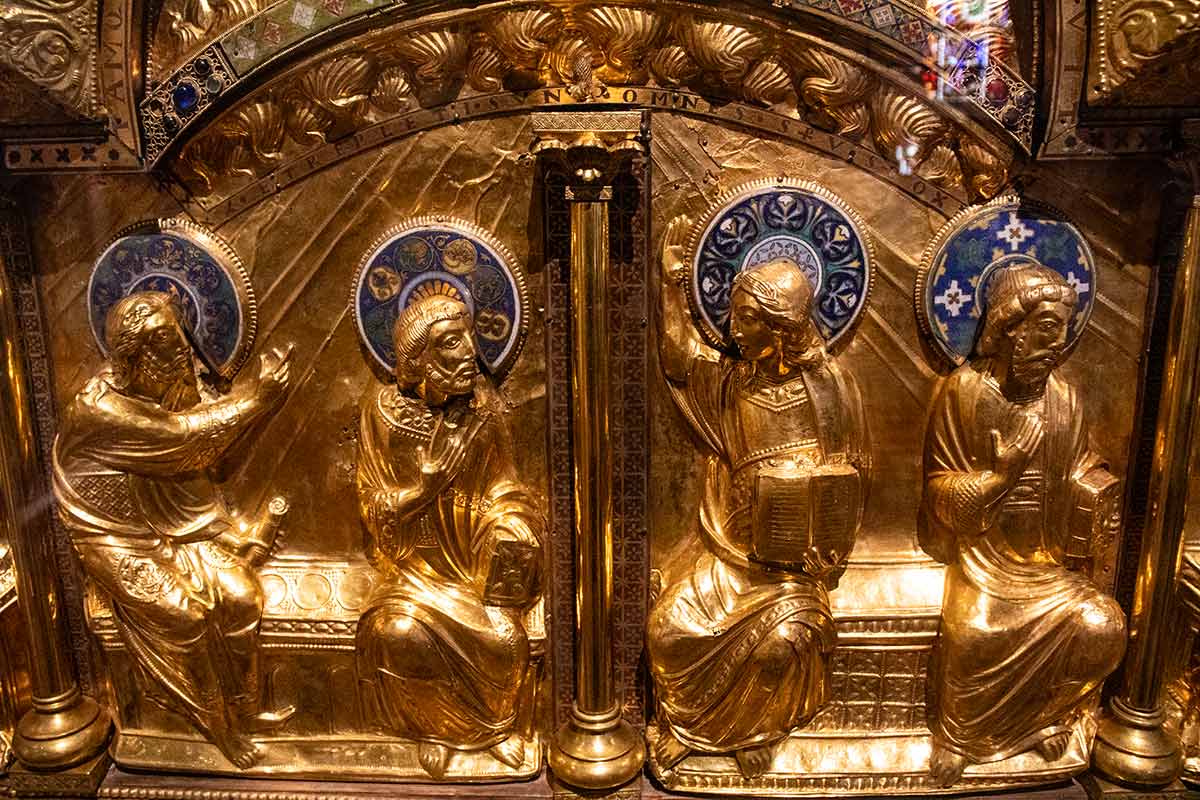
This exceptional 12th-century gilded altarpiece is from an Abbey in the Meuse region of northeastern Belgium. It’s a depiction of Pentecost, with Christ returning to earth with the twelve Apostles in attendance.
The twelve Apostle figures are amazingly lifelike, a very difficult thing to achieve in such a medium. They all bear different reactions to the Visitation, in one of the finest works in the Cluny Museum.
The Altarpiece can be seen in Room 7 of the Museum.
16th-Century Mechanical Clock
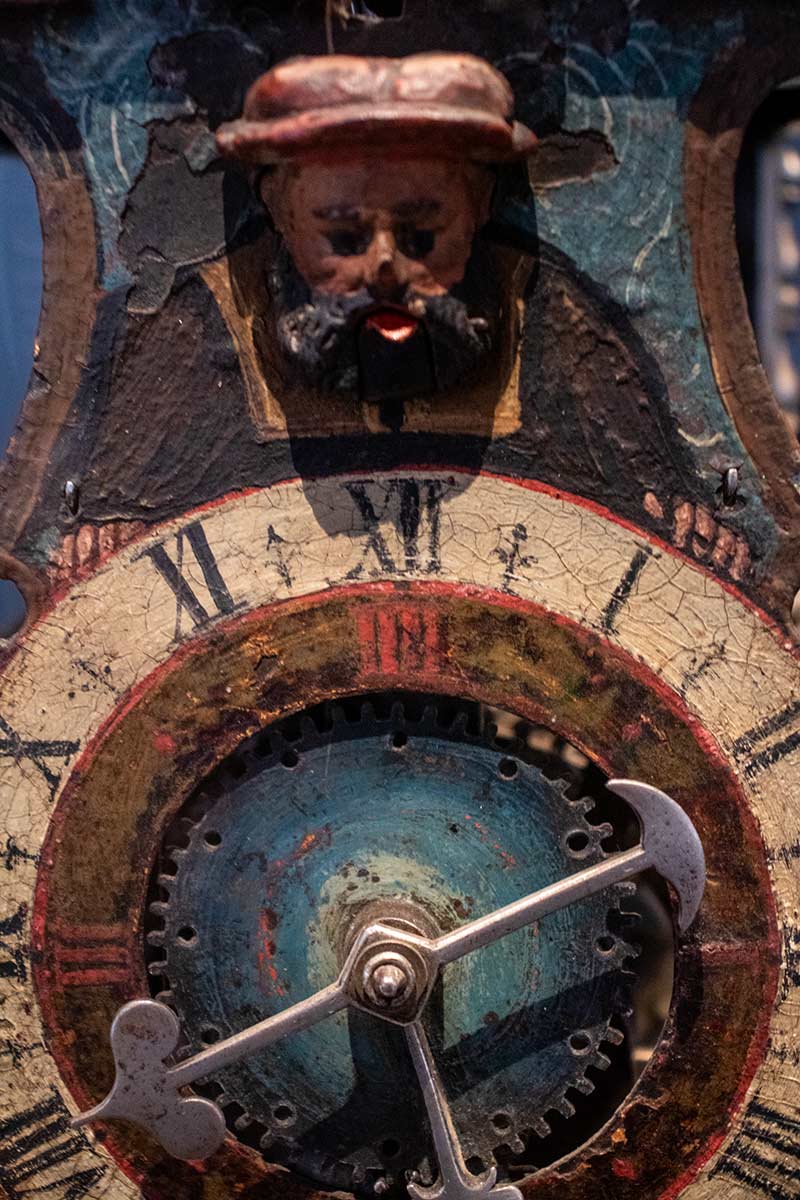
This 16th-century clock, acquired from an art market in Paris in the 1850s, is a rare find. It differs from astronomical clocks in that it operates with a weight falling every hour, thereby triggering the rest of the mechanism.
I didn’t see it in action, but the clock chimes on the hour. Behind the clock face and bearded man figure, you can see the complex, intricate machinery that makes this extraordinary ‘Gothic clock’ work 500 years after it was created.
Beauvais Misericords
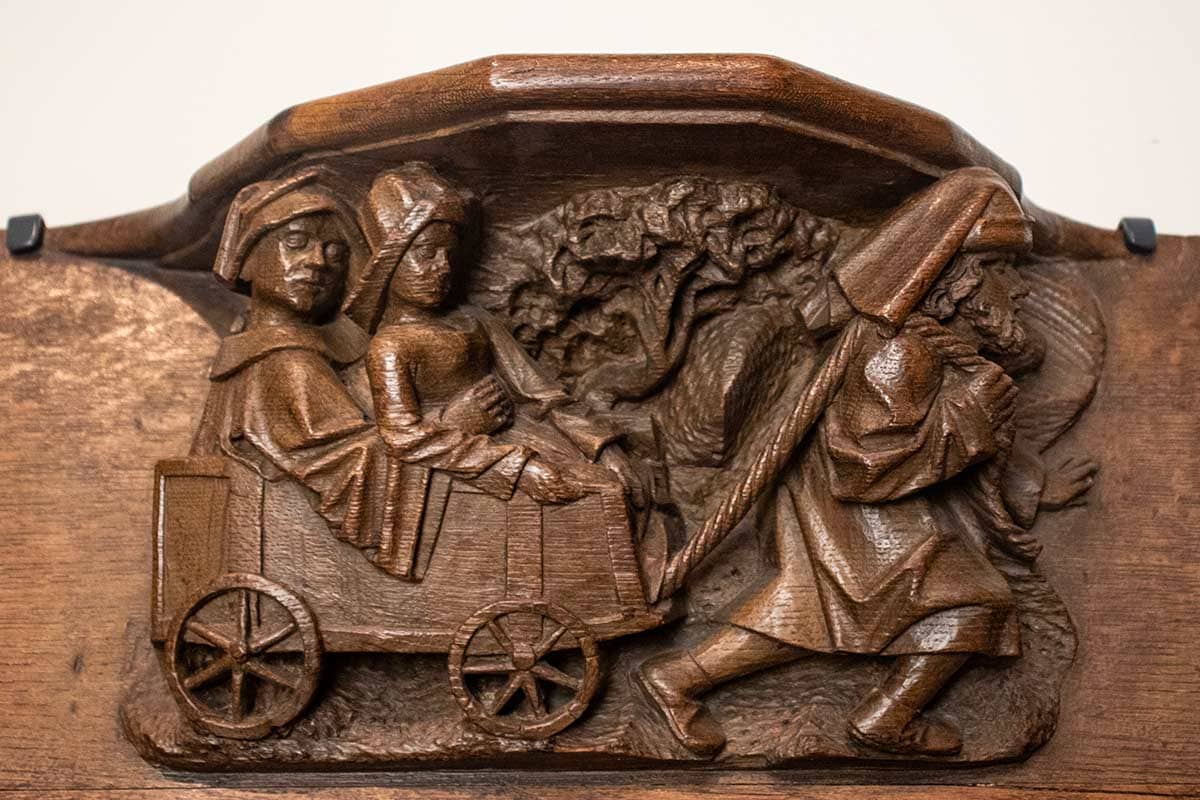
Misericords were a form of ‘mercy seat’ for priests required to stand for long periods during what would have seemed interminable rites and services.
They had to be folded down to be sat on, and when folded upwards, the underside had a helpful ledge on which the tired priest could lean back and prop himself up.
Wooden carvings would adorn the underside of the seat below the ledge. The misericords in the Cluny Museum date from 1492 and possibly the years immediately afterwards. The series was commissioned for the Abbey of Saint-Lucien-de-Beauvais, little of which now remains.
The misericord that I’ve photographed is of some poor soul seemingly pulling a cart (laden with two people) using a towing contraption attached to his head. Others in the series show animals playing church organs. Misericords could often be bawdy, humorous and downright irreverent, and are always worth seeing when visiting churches. Chester Cathedralin northern England has one of the best collections that I’ve seen.
The Beauvais misericords can be seen in Room 21 of the exhibition.
Abbot’s Chapel Fan Vault
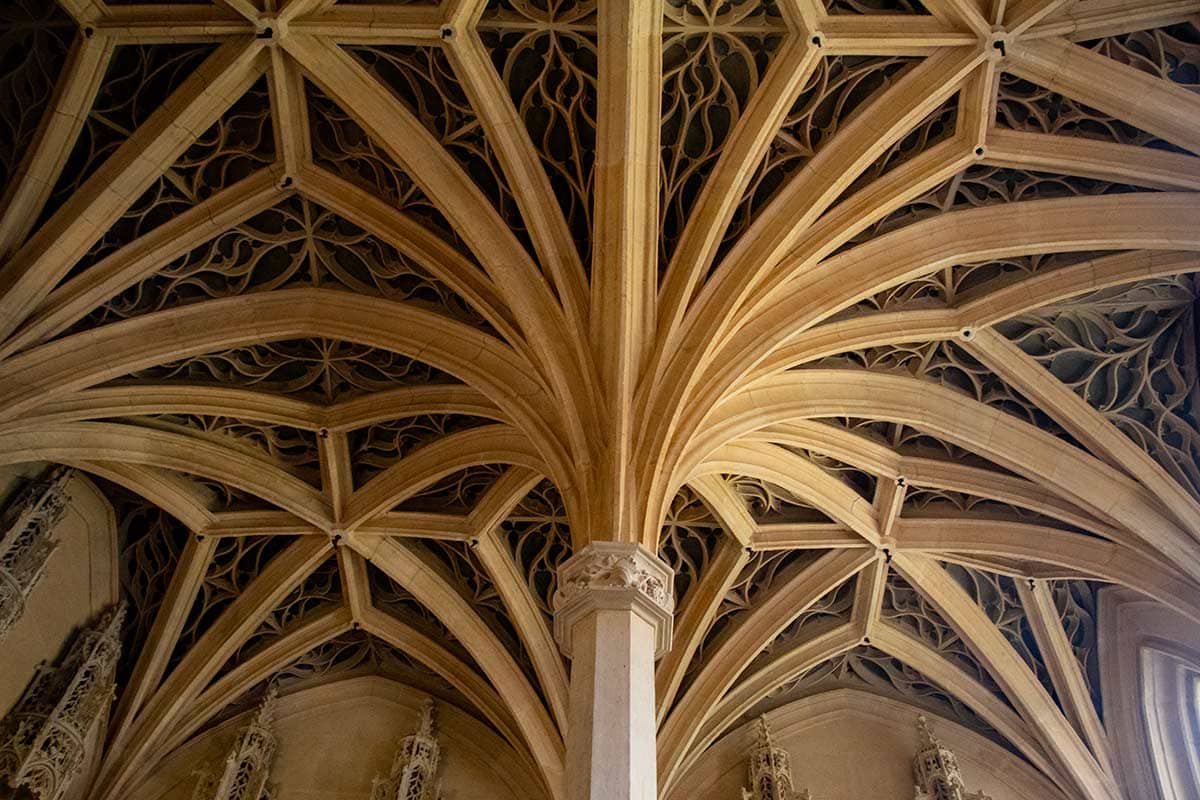
The Cluny Museum incorporates the ancient Roman Baths of Lutetia and the Hôtel des Abbés de Cluny, a late 15th-century mansion residence for the burgundy-based Abbots of Cluny, one of the largest and most powerful monastic orders of the Middle Ages.
It’s one of the earliest buildings of its kind in Paris, and towards the back of the building, the Abbot’s Chapel is the most striking space in the entire Museum. I was particularly impressed by the stunning fan-vaulted ceiling of the Chapel, supported by a single central pillar, and intricately carved with a leaf motif.
The walls are also decorated with stone niches with elaborate canopies – these would have likely held paintings of the Twelve Apostles.
Where Is The Cluny Museum – And How to Get There
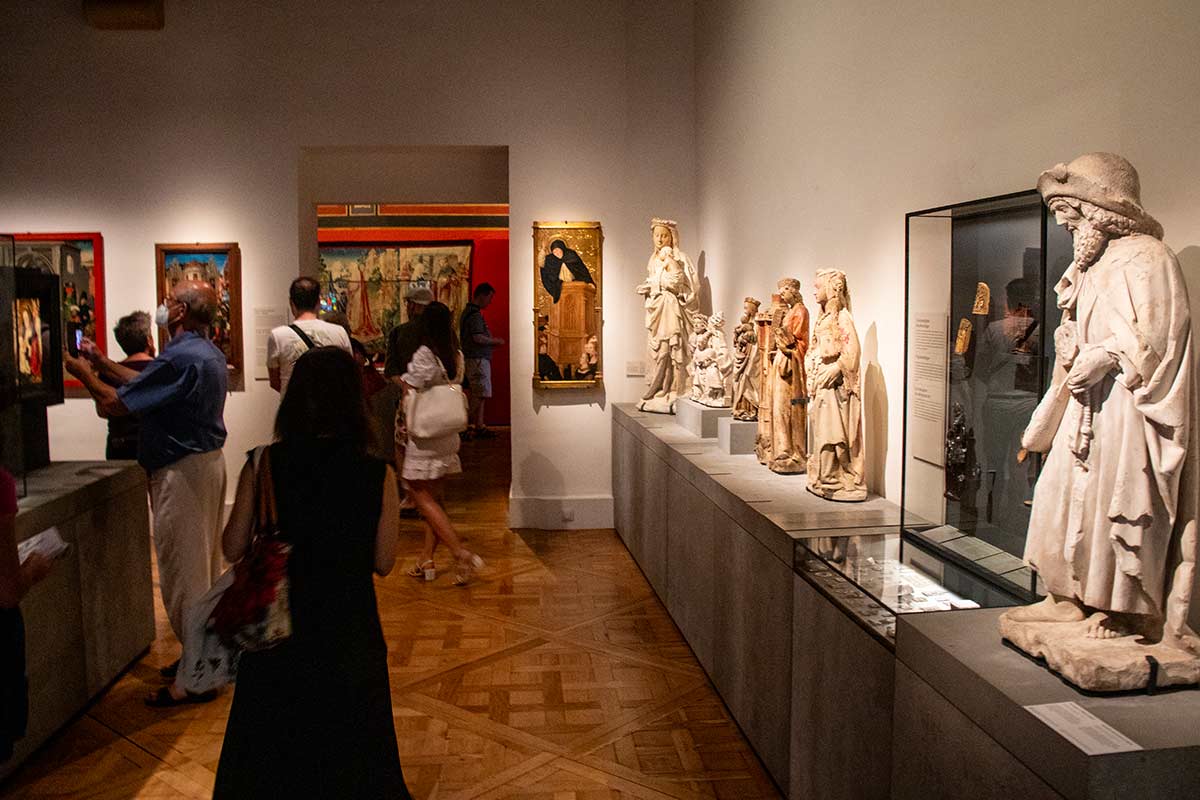
The Cluny Museum is in the heart of the Latin Quarter, close to the Sorbonne and a five-minute walk from the Left Bank (rive gauche) of the River Seine.
Its address is 28 Rue Du Sommerard 75005 Paris.
The nearest Metro station is Cluny – La Sorbonne, which is on line 10.
Visiting the Cluny Museum Paris – Final Thoughts
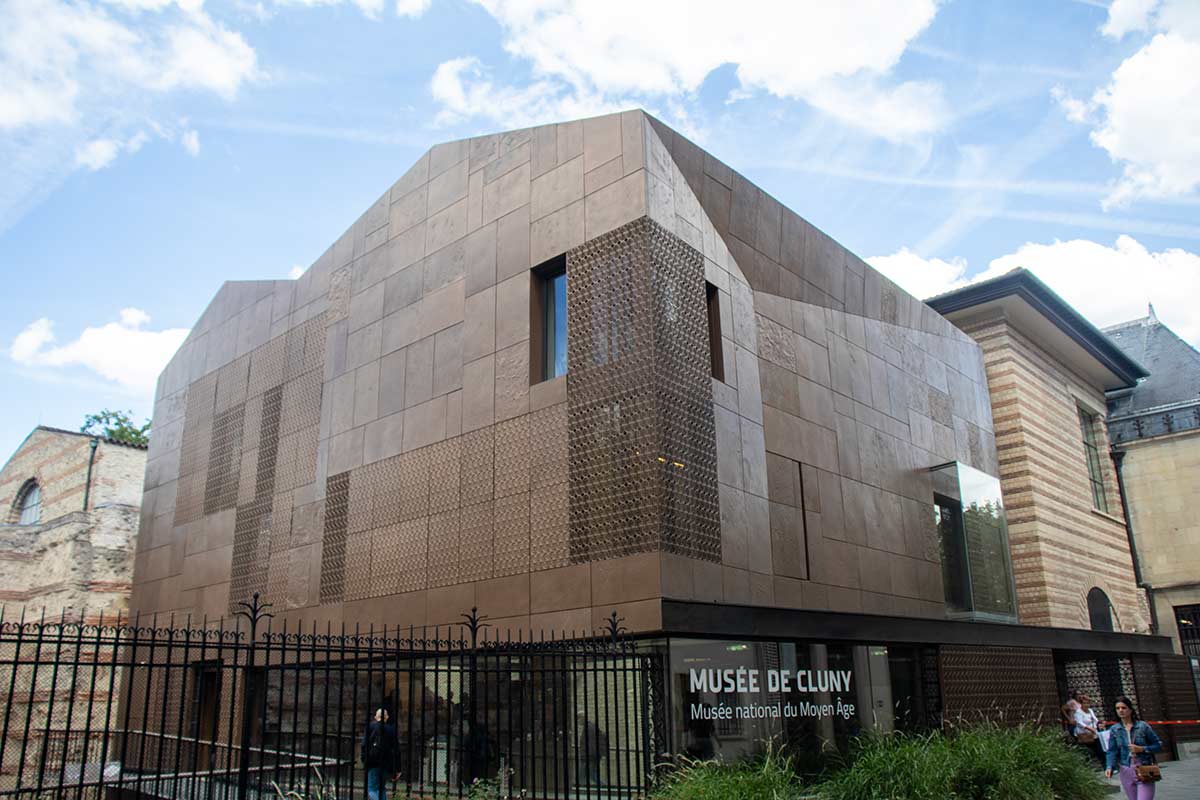
I hope that you have enjoyed this article and that it has opened your eyes to the many treasures to see in the Cluny Museum. If you’re intrigued, I recommend my Famous Churches in Paris article as a starting point for exploring more medieval art in Paris.
For further Paris inspiration, check out more of my articles on the French capital here:
General Paris Articles
Best Eiffel Tower Views – over 20 superb vantage points of the most famous landmark in Paris
Sunset in Paris – the best 15 places to see one
Visiting the Arc de Triomphe Paris – all you need to know before you visit one of the great monuments of Paris
Art Nouveau Paris – 12 magnificent sights not to be missed
Paris Carousels – the best merry-go-rounds in Paris
Statue of Liberty in Paris – seek out the replicas of Lady Liberty across the French capital
Bridges in Paris
Famous Paris Bridges – 15 of the most beautiful bridges on the Seine
Pont Alexandre III Paris – the most flamboyant, ornate bridge in Paris
Bir-Hakeim Bridge Paris – stunning double-decker bridge near the Eiffel Tower
Pont des Arts Paris – elegant iron bridge connecting the Louvre and Institut de France
Pont Neuf Paris – the venerable oldest bridge in Paris, and sometime art installation subject
Churches In Paris
22 Famous Churches in Paris – 22 ecclesiastical wonders
La Sainte Chapelle Paris – one of the wonders of the Gothic Age
Basilica of St Denis Paris – the birthplace of Gothic architecture
Saint Germain des Pres – landmark ancient Left Bank church
Saint Etienne du Mont – stunning Latin Quarter church
Saint Sulpice Church Paris – vast Neoclassical church dominating the Latin Quarter skyline
Pantheon Paris – the resting place of many famous French luminaries
Saint-Séverin Church Paris – Left Bank Gothic wonder
St Julien Le Pauvre – humble ancient church within sight of Notre Dame
Montmartre
Abbesses Metro Station Paris – one of the most beautiful Metro stations in Paris
Rue de l’Abreuvoir – one of the most picturesque streets in Paris
Rue St Rustique Paris – ancient Parisian street in the heart of Montmartre
Sacré Coeur Basilica Paris – the white-domed symbol of Montmartre
Parks in Paris
Square du Vert Galant Paris – the most romantic garden in Paris
Jardin du Luxembourg – one of the most beautiful gardens in Paris
Tuileries Garden Paris – amazing garden near the Louvre
Parc Monceau Paris – gorgeous folly-filled park near the Arc de Triomphe