

About the author: David Angel is a British photographer, writer and historian with 30+years experience exploring Europe. His work regularly appears in global media including the BBC, Condé Nast Traveler, and The Guardian.
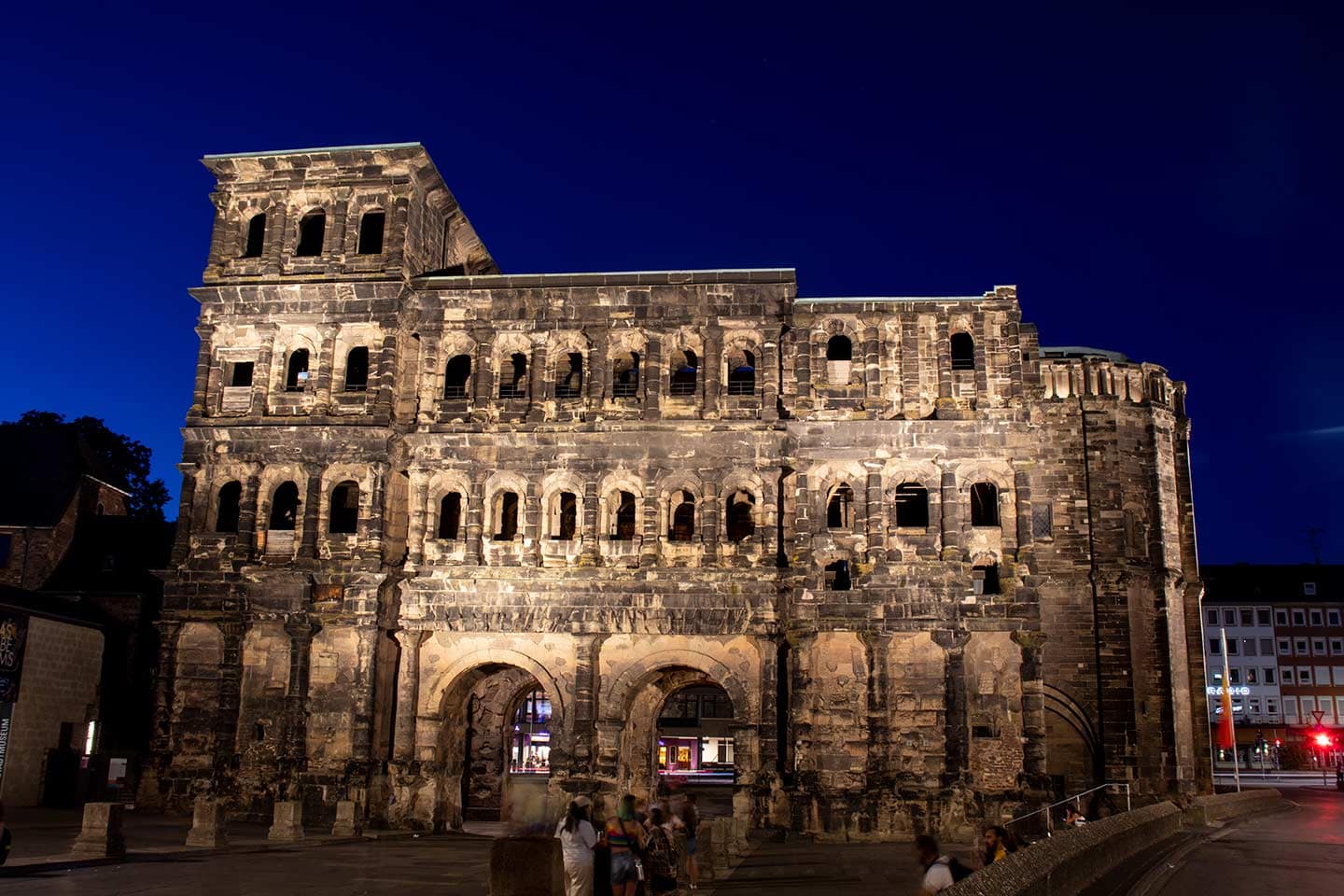
Porta Nigra Trier is one of the most astonishing buildings from ancient times. It’s around 1,850 years old, a vast and imposing Roman city gate that had a fascinating after-life as a pilgrimage church.
My Porta Nigra guide delves into this history, and shows you in detail the wealth of things you see when you visit.
I also show you the best ticket options, and advise on how to get to Trier and Porta Nigra, while advising you on the best things to do in Trier.
At the end of the article I also suggest other places to visit near Trier, including the stunning Mosel Valley, the unexplored Saar and the wonderful Grand Duchy of Luxembourg. I hope you enjoy it.
Interesting Facts About Porta Nigra Trier


Porta Nigra – the Black Gate – is one of the greatest Roman monuments in Europe. It’s an incredible feat of Roman engineering, consisting of thousands of vast stone blocks held together by metal clamps.
Porta Nigra is the most famous of the Roman monuments in Trier, which, as Augusta Treverorum, was the most important Roman city north of the Alps and capital of the province of Gaul.
The Porta Nigra Trier was much more than a city gate – it also served as a double church for centuries, and was the residence of the hermit St Simeon for many years.
Porta Nigra Trier History


What is now the city of Trier was founded in the 4th century by the Celtic Treveri people, and they were eventually conquered and subjugated by forces of the Roman Empire around 16 BC.
The Romans named the settlement Augusta Treverorum – the city of (then Emperor) Augustus among the Treveri – and it became one of the most important and powerful cities in the Roman Empire.
It became capital of the province of Gallia Belgica, part of Roman Gaul, and later capital of the Western Roman Empire, which brought much prosperity to the city.


The Romans built Porta Nigra – the Black Gate – around 170 AD (170 CE), as one of four city gates.
We don’t know the Romans’ name for the gate – the name ‘Porta Nigra’ originates from centuries after the end of the Roman Empire.
Poppo, Archbishop of Trier, met a Greek hermit, Simeon, on a pilgrimage to Jerusalem in 1028, and Simeon accompanied him on his return journey to Trier.
Poppo gave permission to Simeon to live as a hermit in a cell in one of the upper storeys of the Porta Nigra, and after his death in 1035, miracles began to be reported at his tomb within the Porta.

He was canonized as St Simeon of Trier by Pope Clement II in 1047, and accounts of miracles brought more and more pilgrims to his tomb.
The Monastery of St Simeon (Simeonstift) was founded next to the Porta Nigra, and the gateway was turned into a double church. The upper level was for the use of the monks, and the lower one was for members of the public and pilgrims.
The church was dismantled by forces of Napoleon Bonaparte, who had a tendency to destroy Catholic churches and shrines. He aimed to return the Porta Nigra to its late Roman appearance, without the church tower and additions to the original edifice.
What To See At Porta Nigra Trier


Before entering the ticketed section of Porta Nigra, take a walk away from the gateway to appreciate its immense scale, then walk below one of the central archways (this part is open and free to visit) and look up at the ancient stonework, an awesome feat of Roman engineering.

After entering via the ticket office, you climb a set of stairs to the first floor, which served as the lower church from the 11th to early 19th centuries.
The apse at the east end of this church has been preserved, kept simple and austere with three clear arched windows.

Just outside the apse you’ll see the scale model of the Porta Nigra double church before Bonaparte’s intervention. It’s an amazing sight, and only the apse really gives a hint of its past use as a church.
I had intended to visit Trier for decades, but wasn’t aware of this part of the Porta Nigra’s history until visiting the city.


Most of the Porta Nigra dates from Roman times, but there are also some later adornments, in the form of several Baroque bas-reliefs from the time the gateway served as two churches.
There is also a scale model of Augusta Treverorum – ancient Trier – and you can enjoy superb views over the city, including the Cathedral and its many towers and spires.
Where Is Porta Nigra Trier

The city of Trier is in the far west of Germany, on the Mosel (Moselle) river close to the border with Luxembourg. It’s in the Rhineland-Palatinate (Rheinland-Pfalz) state.
Porta Nigra is at the northern edge of Trier city centre on Porta Nigra Platz, at the end of Simeonstrasse, one of the main shopping streets in the city. Another main street, Christophstrasse, runs along the north side of the gateway.
How To Get To Porta Nigra Trier

Porta Nigra is easy to reach, as it’s in the centre of a well-connected city.
I travelled to Trier by train, which is on a busy regional line connecting Saarbrucken with the Mosel Valley and Koblenz. You can also reach Trier by train from Luxembourg.
As for airports near Trier, the nearest is Frankfurt-Hahn Airport, one of the main hubs used by budget carriers Ryanair and Wizzair. The airport is close to Traben-Trarbach and Bernkastel-Kues, two picturesque towns in the Mosel Valley, and is around an hour’s drive from Trier.
Porta Nigra Trier Tickets

Adult tickets to Porta Nigra cost 4 euros, with concession adults paying 3 euros. Kids aged 6-18 pay 2.50 euro each, and under 6s can visit for free.
The family tickets are a bargain – one adult and up to four children pay 4 euros, the same as a single adult ticket. Likewise, a family ticket for two adults and up to four kids costs 8 euros, the same as for two adults.
The Porta Nigra ticket office is next to the gateway, on the left-hand side as you view the gate from Simeonstrasse.
More Things To See In Trier

The Roman sites, Cathedral and Our Lady church in Trier comprise one of the most impressive UNESCO World Heritage Sites in Germany. Most of the sites are close to the city centre, and could be seen in a 5-6 km (3 to 4 mile) walk.
Take a walk down Simeonstrasse to the Marktplatz, the beautiful main square of Trier, and from there turn left to the awesome Trier Cathedral, one of the finest churches in Germany with a strong claim to being the oldest in the country.
Its neighbour immediately to its right, the Liebfrauenkirche (Church of Our Lady) is one of the earliest Gothic churches in Germany, reminiscent of some of the great French Gothic cathedrals.
The wealth of Trier Roman sites includes the Aula Palatina, the immense throne room of Emperor Constantine the Great, and the nearby Kaiserthermen (Imperial Baths) and Barbarathermen (Barbara Baths).
The Trier Roman Amphitheatre, below vineyards on the edge of the city, is also well worth the short uphill walk from the Kaiserthermen.
See Also: 26 Wonderful Things to Do In Trier
Places To Visit Near Trier

Trier is on the Mosel river, and is something of a gateway to this beautiful part of Germany, whether you’re travelling by train, bus, car or boat.
It’s also close to the confluence of the Saar and Mosel rivers, and the train line from Trier follows the Saar through some beautiful, seldom-explored countryside way off the beaten track.
The Mosel is one of the most beautiful rivers in Germany, the valley dotted with picturesque wine villages, steep vineyards and hilltop castles, and you could easily spend at least a week following the long, slow meanders of the valley.


Cochem is the most popular town on the Mosel, with a medieval heart and the fairytale Reichsburg Castle on a hill above. It’s a good base for exploring this part of the valley, especially the picture-perfect village of Beilstein, 11 km (7 miles) upstream.
It’s also within an hour of the stunning Burg Eltz Castle, which you can reach by bus or car from . It’s also possible to reach the romantic Rhine Valley from Trier, with Koblenz as little as an hour away.
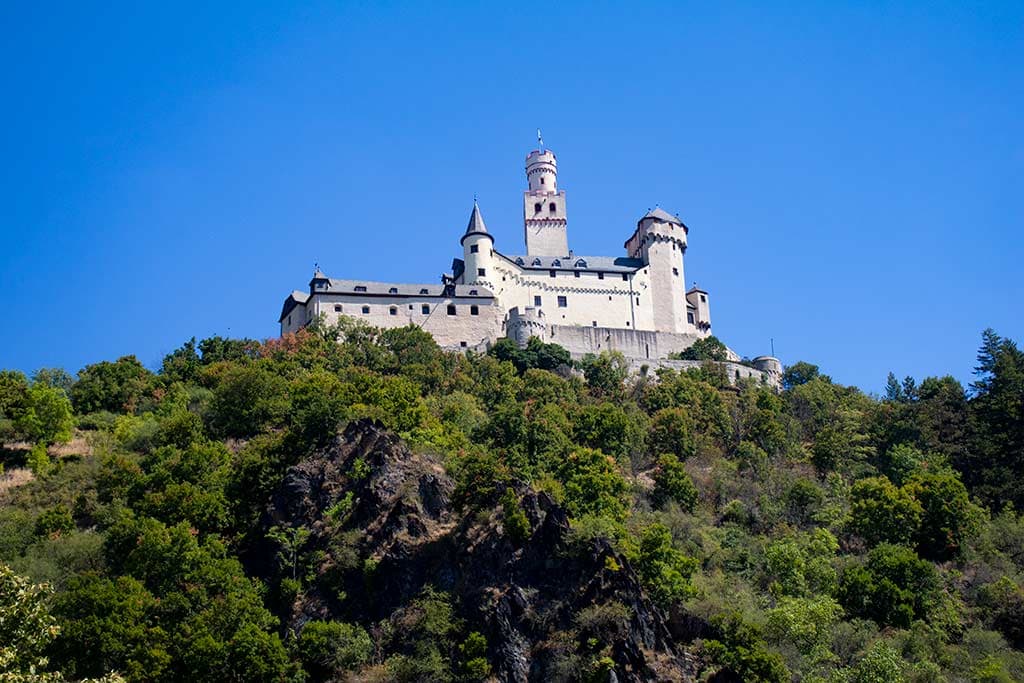
One of the best Rhine River Castles, just above the gorgeous town of Braubach, is Marksburg Castle, which is rare in that it’s fully intact, having never been captured.

Heading south from Trier, the Roscheider Hof Open Air Museum is one of our favourite discoveries of 2022. It’s a fascinating place to discover more about this corner of western Germany, with many recreated historic shops (19th and 20th centuries) in the main building and a series of village houses and a chapel reconstructed on the hillside below.
Further to the south, the beautiful riverside town of Saarburg is near the top of our Germany must-visit list, and the Saar valley is one of the hidden gems of Germany, with long curving meanders and steep hillsides high above.

The train line and road eventually reaches the more industrial part of Saarland, including the astonishing Völklingen Ironworks, a fully intact ironworks which closed in the 1980s and is now a UNESCO World Heritage Site.
It’s not far from there to the capital of Saarland, and there are enough things to do in Saarbrücken for a day trip.
Porta Nigra Trier – Final Thoughts
Read more about amazing Germany here:
- Rheinfels Castle – explore the largest medieval castle on the romantic Rhine
- Burg Katz – one of the most famous and photogenic Castles on the Rhine
- Rheinstein Castle – possibly the original Romantic Rhine Castle
- 17 Best Places To Visit In Eastern Germany – Dresden, Leipzig and many more
- Frauenkirche Dresden – one of the great Baroque churches in Europe, rebuilt after destruction in World War Two
- 30 Best Places to Visit On The River Elbe – following the great river through the Czech Republic and Germany
- One Day In Nuremberg – 24 hours in the fascinating Imperrial City
- Photographing Berlin – capturing the many sides of Germany’s amazing capital
- Berlin Landmarks – 21 Top Places To See In Berlin

David Angel is a British photographer, writer and historian. He is a European travel expert with over 30 years’ experience exploring Europe. He has a degree in History from Manchester University, and his work is regularly featured in global media including the BBC, Condé Nast Traveler, The Guardian, The Times, and The Sunday Times. David is fluent in French and Welsh, and can also converse in Italian, German, Portuguese, Spanish, Czech and Polish.