


Welcome to my guide to Oberwesel Germany, one of the best towns to visit in the famous Rhine Valley. Oberwesel has always been a little overlooked. It’s never quite had the renown of Rüdesheim or the visual beauty of its near-neighbour Bacharach.
But it’s one mightily impressive town to explore, with one of the best circuits of town walls and towers anywhere in Europe. It also has two superb Gothic churches, and a fantastic castle that’s now a luxury hotel overlooking the town.
My Oberwesel guide shows you everything there is to see, and I offer advice on how to get there by air, road and train. I also suggest places to visit in the Rhine Valley in both directions from Oberwesel, including more romantic towns and castles. Enjoy!
Why visit Oberwesel Germany
Oberwesel, the Town of Towers and Wine, is one of the most impressive Rhine River towns to visit. It has a magnificent set of town walls and towers, and you can walk most of the wall circuit with superb views over the town and Rhine.
The Schönburg Castle above Oberwesel is one of the best castles to stay in Germany, a luxury hotel with awesome views over the Rhine. The town also has two exceptional churches, the Liebfrauenkirche and Martinskirche.
Oberwesel, which is just south of the midway point of the Rhine Gorge, also makes a great base for exploring the Valley.


Oberwesel history
Oberwesel’s origins pre-date the arrival of the Romans, who eventually set up their regional capital in nearby Trier. We don’t know for sure, but the Celts may well have settled there, as in Boppard. They may well have used the names Vosavia or Volsolvia.
The Romans later set up an outpost – possibly for changing horses – in Oberwesel.
Over the ensuing centuries it was acquired by the Franks and later the Archbishop of Magdeburg (further to the east, in Saxony-Anhalt). In 1220 it became a free imperial city by order of Holy Roman Emperor Frederick II.
Oberwesel became prosperous through trade, wine exports and fishing, and this was reflected in its magnificent town walls. These were begun in 1220, and finally completed over a century later.
The Electorate of Trier took over the town of Oberwesel in 1309, and controlled it for almost 500 years, until 1802. They were unable to prevent it being largely destroyed in 1689 during the Nine Years War, which is also known as the War of Palatine Succession.
In 1802 Oberwesel came under French control, and after the defeat of Napoleon Bonaparte 13 years later, it was taken over the Prussians. They held it until German Unification in 1871.
It is now part of the Land (state) of Rhineland Palatinate (Rheinland Pfalz).


Things to do in Oberwesel Germany
1. Walk around the Altstadt (Old Town)

The first thing to do in Oberwesel is to take an hour or so to explore the Altstadt. It doesn’t take long to walk around the old town centre. Yet there is plenty to see both around the Marktplatz (main square) and in the side streets leading up the hill from the river.
Oberwesel has many half-timbered medieval buildings with some wonderful architectural details. However, it’s not quite the chocolate box style beauty you find in Bacharach, Braubach or, to a lesser extent, Rüdesheim and Boppard. It doesn’t have lots of wonky red and white half-timbered houses like these.
Oberwesel leaves a more powerful impression with its churches, towers and Castle.
2. Visit the Liebfrauenkirche (Church of Our Lady)

This splendid Gothic church reflects just how prosperous Oberwesel had become by the 14th century. It’s the outstanding church in the Rhine Valley World Heritage Site (with a possible rival in the Basilica of St Kastor in Koblenz).
The spire of the church – across the street from the train station – dominates the town skyline. The interior is even more impressive, particularly the ornate gold altarpiece.
I was incredibly fortunate to visit the Liebfrauenkirche when a British vocal group, the Gesualdo Six, were rehearsing for a concert later that evening.


3. Explore the Oberwesel Town Walls

The town wall towers are one of the main things to see in Oberwesel. Sixteen of the 21 towers remain, mostly in an excellent state of repair – indeed one of them, the Kölner Tor (Cologne Tower, pictured) is still inhabited.
The walls were built over around 200 years. They were most likely begun during the 13th century, with expansion continuing into the 15th century.
You can walk stretches of the town wall walk, including the section above the railway and river. I also enjoyed the section above the town, towards the Martinskirche (see below).
The towers are a mightily impressive sight. Partly because they were built over a long period, there isn’t any uniformity of style (like other World Heritage Town Walls in Conwy, Wales). In a way this makes them more interesting. Some of the best examples are the riverside Ochselturm and Haagsturm, both pictured.


5. Walk up to Schönburg Oberwesel and visit the Tower Museum


The Schönburg Castle is a short, steep walk up the hill at the southern end of the town. It’s a luxury hotel but the grounds are free to explore, and it’s worth it just for the views over the town.
The Schönburg is believed to date back to the 10th century, and from the 12th century was owned by the Dukes of Schönburg. Unusually for the period, when one of the dukes died the inheritance was split between the heirs, rather than passing to a sole heir. This led to the Castle accommodating over 200 inhabitants.
The Castle was destroyed during the War of the Palatine Succession in 1689, and remained in a ruinous state for 200 years. It was eventually acquired and restored by the German-American Rhinelander family, who eventually passed the Castle on to the town of Oberwesel.
If you’re just visiting rather than staying, there is also a small Tower Museum with a slingshot simulation and the highest viewpoint in the Castle.
6. Visit the Meteorite Museum

I was not expecting to find a Meteorite Museum in Oberwesel! Sadly I didn’t visit, thinking I’d come back with my space-loving son, but we didn’t quite get around to it.
It’s a private collection with several samples of meteorites and tektites, set in galleries with space-themed artwork.
7. See the giant wine glass on Oberwesel Marktplatz

The Marktplatz is the busiest place in Oberwesel Germany. Several hotels and cafes are on the square, and it’s where you’ll also find some of the most attractive half-timbered buildings in the town.
There’s a very large wine glass on the corner of the square which is impossible to miss. It’s a bit of a magnet for photographers and visitors, with plenty of people posing for selfies when I visited.
The wine glass is a testament to the huge role that wine played in the history of Oberwesel. It contributed enormously to the growth of the town from small Roman outpost to one of the wealthiest – perhaps the wealthiest – of the Rhine river towns.
8. Discover another great Oberwesel church – The Martinskirche


Having one outstanding church in your town was a sign of major prestige in the Middle Ages. Having two was a demonstration that Oberwesel Germany was seriously prosperous.
The church is located on high ground just outside the town walls. It was built during the 14th century, and it’s known as the White Church because some of its exterior is painted this colour. The tower was modified after skirmishes in the town in 1390, so it’s effectively an extra town wall tower.
The interior has a wealth of things to see, including medieval frescoes, 15th-century sculptures and some beautiful painted vaults in the chancel.


9. Explore the vineyards and wineries around Oberwesel Germany


The soil around Oberwesel is especially advantageous for growing vines. Conditions are especially good on the Oelsberg, the hill immediately north of the town, overlooking the river.
There are several Riesling vineyards around the town, with some great views over the river along the way.
10. Enjoy a glass of wine at the Günderodehaus


The Günderodehaus is a 200-year-old farmhouse near the top of the Oelsberg, overlooking the vineyards, town and river.
It’s a picturesque partly-timbered house which was originally built in the village of Seibersbach, ten miles to the south of Oberwesel. It was erected on its present site and used as a film location for the Heimat 3 TV series.
The epic Heimat (meaning ‘homeland’) series, written by Edgar Reitz, spans over 150 years. It follows life in Germany from the perspective of a family in the Hunsrück region next to the left bank of the Rhine.
The house is now a restaurant, wine bar and small film museum.
11. Visit the Kulturhaus Oberwesel
The Kulturhaus is one of the best museums on the Rhine. It’s the one place that tells the story of the Rhine Valley really well, bringing together the distinct periods of its history. And telling the story simply and clearly.
It covers the early history of the region, and also the height of the town’s prosperity during the Middle Ages. It then covers the Rhine romantic period of the early 19th century, showing the other side of the coin with the appalling conditions some of the locals had to work in.
Where is Oberwesel Germany
Oberwesel is in the Upper Middle Rhine Valley World Heritage Site. This section of the Rhine Valley, also known as the Rhine Gorge, is in western Germany, between the major cities of Cologne and Frankfurt.
How to get to Oberwesel Germany

Oberwesel is especially easy to reach, especially by train. It’s on the line running along the left bank of the Rhine, so two, sometimes three, trains call there each hour. The two regular trains are the fast RE2 service and the slower RB26. The RE2 takes just 25 minutes to reach Koblenz, and the RB26 takes 31 minutes.
TIP The RB26 stops at all stations along the line but the RE2 doesn’t. It skips some notable smaller stops, including St Goar. Check the Deutsche Bahn website for up-to-date train information.
If you plan to drive to Oberwesel, it’s on the B9 road which runs between the river and the town. The A61 autobahn (motorway) also passes close by.
If you’re travelling from the opposite side of the river, the nearest ferry runs from Kaub to Engelsburg, one mile (1.5 km) south of Oberwesel. This is easy if you’re driving, but not very convenient if you’re a foot passenger.
If you’re flying long haul to Germany, Frankfurt is your best arrival point, with Cologne-Bonn a good alternative. You can get some direct trains (the RE2) direct from Frankfurt Airport to Oberwesel, which take around 1 hour 17 minutes. Connecrtions from Cologne-Bonn tend to take a little over two hours.
Alternatively, budget carriers including Ryanair and Wizzair use Frankfurt Hahn airport which is near Traben-Trarbach in the Mosel Valley.
TIP: If you’re not driving, take the bus from Frankfurt-Hahn to Bingen (final destination Mainz) and catch a train from there to Oberwesel.
Hotels in Oberwesel Germany


The most visible place to stay in Oberwesel is the Burghotel auf Schönburg, the hotel in the restored castle on the hill overlooking the town. There are a mixture of luxury rooms and sumptuous suites, including a romantic cottage in the castle grounds.
We looked into staying there during our two weeks on the Rhine – the only reason we didn’t book was that they only have double or single rooms. We’re a family of three, which would have meant us all squeezing into an extra-large double bed. However it would be an amazing place for a couple to enjoy a romantic break.
Another great option down in the centre of Oberwesel is the Hotel Weinhaus Weiler, one of the lovely half-timbered buildings on the Marktplatz. This is a fine 3-star hotel and the location is perfect, right in the middle of town and two minutes’ walk from the river.
Just down the hill from the Martinskirche, at the northern end of Oberwesel, the Goldener Pfropfenzieher is another great traditional hotel. Once again, it’s also a very short walk from the river, and it’s the closest of these hotels to the Gunderodehaus.
If you’re driving, another option is the Gasthaus Weingut Stahl in the village of Dellhofen, less than two miles up the hill from Oberwesel. They also have a restaurant serving local dishes
Places to visit Near Oberwesel Germany


Oberwesel is a brilliant base for exploring the Rhine Valley, and all of the other Rhine river towns are within easy reach. It’s also a great base for exploring the other Rhine river castles, with one of them within reach on foot. The region is one of the best places to visit in Germany, so you’re spoilt for choice.
It’s a 20-25 minute walk south upriver to one of the most famous Rhine castles, Pfalzgrafenstein Castle. The whitewashed castle, with baroque black turrets, is one of the most famous landmarks in Germany. It’s located on an island in the river, and was built to collect tolls along with Burg Gutenfels, another castle on the hill above.
The next stop on the train along the south bank of the Rhine is Bacharach Germany. We’re of the opinion that this is the most beautiful village on the Rhine, and one of the most beautiful villages in Europe for that matter.


Bacharach also has a fine set of walls and towers, and is a bit busier than Oberwesel. If you love the old half-timbered houses, you’ll be in paradise in Bacharach. There’s an area called Malerwinkel with several of them below the town walls, a tower and Burg Stahleck, the Bacharach castle that now serves as one of the most famous youth hostels in Germany.

South of Bacharach, there are several fine castles on the left bank of the river around the village of Trechtingshausen. As you travel south, Burg Sooneck is the first, followed by Reichenstein Castle, right next to the main road.
A little further south, Rheinstein Castle was restored in the 1820s by Friedrich Wilhelm of Prussia. It was one of the very first Rhine castles to be restored, as the notion of the romantic Rhine began to capture people’s imagination for the first time.
By this point you’re near the southern starting point of the Rhine Gorge World Heritage Site. Trains arrive at Bingen, but if you’re pushed for time I’d recommend catching the ferry across the river.

Rüdesheim Germany is the most famous of the Rhine towns. To find out why, take a walk along the Drosselgasse, its famous narrow lane crammed with half-timbered houses, bars and restaurants.
It’s an essential stop on any Rhine tour, with a range of things to do from two quirky mechanical music museums to a great cable car ride above the vineyards above the town.

Downstream from Oberwesel, it’s only a few miles to the famous Loreley cliff, one of the best-known Rhine landmarks.
The cliff overlooks a treacherous stretch of water, and it’s the focus of much Rhine mythology. Clemens Brentano introduced the Loreley to the world, a tragic figure who threw herself to her death after being betrayed in love.
She was said to have become a mermaid, luring passing sailors onto the rocks below to their own deaths.


The Loreley is just south of the twin villages of St Goar and St Goarshausen, both of which are worth a stop or even a stay. Two castles – Burg Katz and Rheinfels Castle – were once allies, and face each other across the river.
The villages are linked by a regular ferry, and you could see both of them in a day.
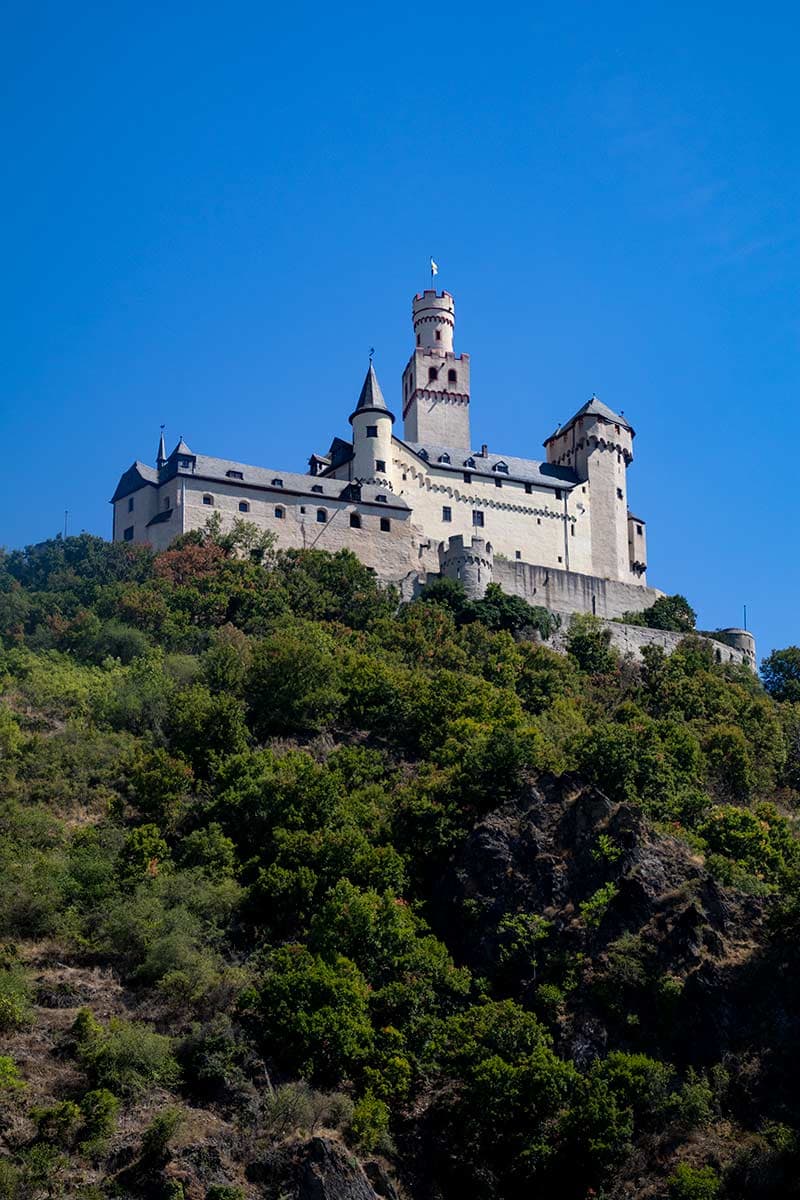
Further downstream, Boppard is another beautiful Rhine river town, one of the prettiest architecturally in the whole valley.
Beyond there, Marksburg Castle is probably the best castle on the Rhine to visit, and the village below, Braubach is gorgeous but very quiet.
Oberwesel Germany – Final Words

Oberwesel probably counts as something of a hidden gem despite being in the popular Rhine Valley. It gets a fraction of the crowds that Rüdesheim attracts, and isn’t quite as postcard-pretty as Bacharach, Boppard or Braubach.
That said, Oberwesel well and truly won me over. Its two churches are magnificent, the finest in the Rhine Valley, and its mighty towers point to a powerful past. Oberwesel is definitely worth a day of anyone’s time, and has some of the best hotels in the Rhine Valley too.
For more places to visit beyond the Rhine Valley in western Germany, here are some more articles for you to browse:
- Beilstein, Mosel Valley – discover this gorgeous Moselle wine village
- Things To Do In Cochem – fairytale castle and town, a great base for exploring the Mosel Valley
- Things To Do In Trier – 26 Things to Do In Germany’s Oldest City
- Trier Cathedral – the oldest cathedral in Germany and part of the Trier World Heritage Site
- Churches in Trier – the Cathedral, Liebfrauenkirche, Constantine’s Basilica and more
- Porta Nigra Trier – amazing ancient Roman gateway that survived thanks to becoming a church
- Roscheider Hof Museum Trier – one of the best folk museums in Europe
- Völklingen Ironworks – astounding industrial World Heritage Site near the French border
- Things To Do In Saarbrücken – discover the little-known capital of Saarland
And if you’re planning to explore further afield, here are some more of my articles on the rest of Germany:
Dresden Landmarks – 19 stunning sights in the ‘Florence on the Elbe’
Best Places To Visit On The River Elbe – following the great river from its source in the Czech Republic to the North Sea
One Day In Hamburg – 24 hours in Germany’s maritime melting pot
One Day In Nuremberg – 24 hours in Germany’s former Imperial City
Visiting Nuremberg Toy Museum – one of the best toy museums in the world, and one of the best museums in Germany
Best Places To Visit In Eastern Germany – the compelling best of the former GDR
Things To Do In Goslar – stunning World Heritage town made rich by the 1000-year-old Rammelsberg Mine
Things To Do In Quedlinburg – the World Heritage-listed half-timbered capital of Europe
Things To Do In Wernigerode – gorgeous half-timbered town, romantic castle and the gateway to the mystical Brocken mountain by steam train
Germany Half-Timbered Towns Itinerary – the stunning half-timbered towns of the Harz Mountains
One Day In Leipzig – 24 hours in the city of Bach and the Wende of 1989
Berlin World War 2 Sites – 15 fascinating places to visit around the German capital
Photographing Berlin – how to capture Germany’s fascinating capital on camera
Berlin Landmarks – 21 Top Sights To See In Berlin

David Angel is a British photographer, writer and historian. He is a European travel expert with over 30 years’ experience exploring Europe. He has a degree in History from Manchester University, and his work is regularly featured in global media including the BBC, Condé Nast Traveler, The Guardian, The Times, and The Sunday Times. David is fluent in French and Welsh, and can also converse in Italian, German, Portuguese, Spanish, Czech and Polish.