


About the author: David Angel is a British photographer, writer and historian with 30+years experience exploring Europe. His work regularly appears in global media including the BBC, Condé Nast Traveler, and The Guardian.
Beilstein is a tiny village that you could easily rush through in two hours or so, but I recommend lingering considerably longer, taking things as slow as a long meander on the Mosel river.
In my guide to the Beilstein Mosel village I suggest places to eat and try the local wine, as well as things to see, from the stunning traditional architecture to the imposing Castle overlooking the village.
I also advise you on how to get there, where to stay, and some great places you can visit nearby. Lets delve in.
Why Visit Beilstein Mosel Valley

Beilstein is one of the most beautiful villages in Germany and, indeed, Europe. It’s a picture-perfect German wine village, with a river, steep vineyards and medieval half-timbered houses huddled beneath a hilltop castle.
Beilstein is known as the ‘Sleeping Beauty of the Mosel’, and a couple of local brochures I read suggest it is like a much smaller Rothenburg ob der Tauber, one of the most famous and beautiful towns in Germany.


The main reason people visit Beilstein Mosel is to eat at one of the numerous restaurants and cafes, and to sample some of the local wine, in this gorgeous setting. It’s a place to linger, savouring the stunning Mosel landscape slowly, enjoying the food and wine and walking off the calories on the hills around.
The Klostertreppe – Monastery Steps – is one of the prettiest streets in Germany, climbing up past a row of restaurants and wineries in beautiful half-timbered houses.A walk up the steps and hill takes you to a wonderful Baroque church and, eventually, Burg Metternich, Beilstein’s Castle, which commands fantastic views of the Mosel valley.
Beilstein Mosel History


There has been some sort of settlement at Beilstein since around 800 AD, and Beilstein Castle – more commonly known as Burg Metternich or Burg Beilstein – is believed to date from around 1200.
The village was a fief under the Lords of Braunhorn, and Heinrich VII, Count of Luxembourg and King of Germany, granted Beilstein town status in 1309 and a Jewish community was established there.
The Electorate of Trier assumed ownership of Beilstein in 1488, and the Counts of Metternich took over the fief, taking the title of Lord of Winneburg and Beilstein.
Beilstein Mosel was taken over by Spanish Catholic forces in 1620, during the Thirty Years War. The Spanish brought with them a small painted wooden statue of the Black Madonna, and their peaceful takeover of Beilstein – compared to the violence elsewhere – was considered a miracle, which was attributed to the statue.


The Carmelite Monastery, including the prominent Church of St Joseph, was founded in 1636 to house the Black Madonna of Beilstein. It was finally completed in 1783, providing what was deemed a suitable home for the statue. It’s a grand church, especially for such a small village.
Burg Metternich was captured and destroyed by French forces (under King Louis XIV) in the early stages of the Nine Years War, in 1689. Many of the half-timbered houses in Beilstein were added in the 17th and early 18th centuries.
The Metternichs were removed by French forces in 1794, and the village came under the control of the Kingdom of Prussia in 1815.
Things To Do In Beilstein Mosel Valley


The most striking thing about Beilstein is its architecture. As you walk away from the river into the tiny village, you step a few hundred years back in time, surrounded by half-timbered houses. A few of the houses date from the 16th century, and most of them are from the 1700s, built in a similar style.
There is a concentration of centuries-old houses around the Klostertreppe, the steep flights of steps leading up from the village towards the former monastery church of St Joseph. It’s the most famous view in Beilstein, and one of the prettiest streets in Germany.


Beilstein is full of restaurants during the season, and the Klostertreppe is home to tone of the best in the village, the Winzerschenke, which serves a wide selection of local vintages.
The village is very small, and in summer there is a café or restaurant every few houses. The Altes Zollhaus (Old Customs House) is another good bet, especially if you can get a table on the first-floor terrace overlooking the Mosel river.
The former Carmelite Monastery Church of St Josef is the most prominent building in Beilstein after the Castle. It was built over almost 150 years to house the Black Madonna of Beilstein, a small Spanish figure of the Virgin Mary believed to date from the 12th or 13th century.
It was left behind by occupying Spanish forces and was believed to have had miraculous powers because the conquest of Beilstein was not violent. The church is a Baroque beauty, light and airy with a wonderful painted vault (pictured) in the nave.
The short, steep walk up to Beilstein Castle (also known as Beilstein Burg) is worth it for the views over the Mosel valley, especially from the top of the keep tower. There is a 3 euro entry fee for the Castle, and a popular restaurant in the courtyard below the main tower.
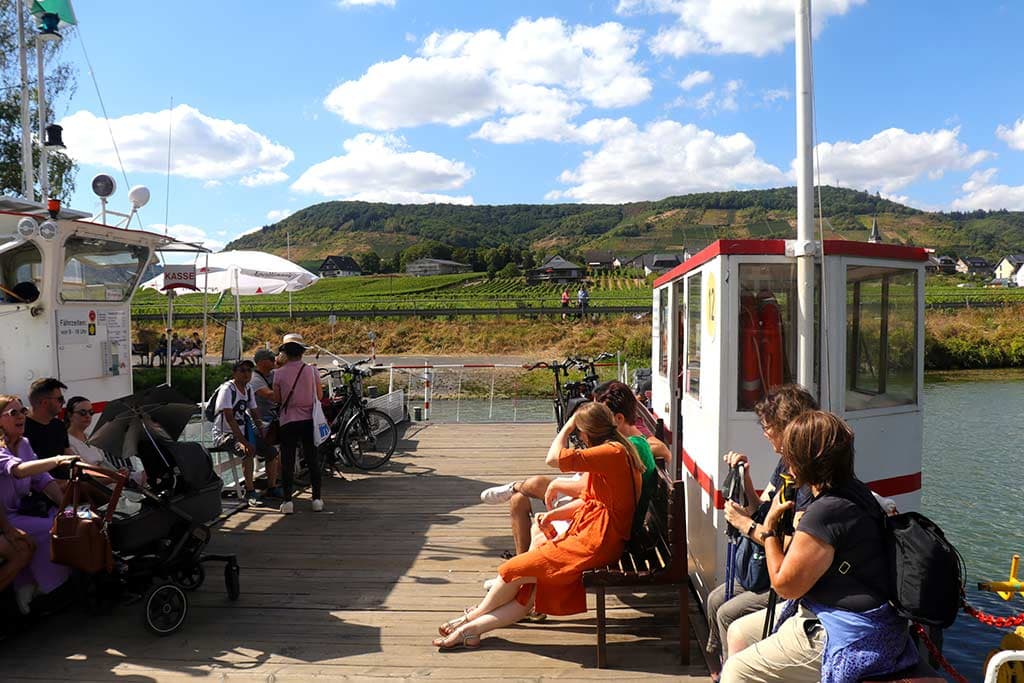

The Beilstein ferry (Fähre St Josef) is very popular with visitors, and even if you don’t intend to explore the village of Ellenz on the other side, it’s worth taking the short journey across the Mosel to take in the great view back to Beilstein from there.
The ferry runs daily from Easter to October, usually from 1000 to 1800 with an hour’s lunch break between 1200 and 1300.
The Beilstein Mosel area is also ideal for cycling. Long sections by the riverside are flat, and there are occasional short climbs to reach bridges, so it’s largely quite easy terrain.
I spoke to a few cyclists who were on a very slow ‘wine crawl’ along the river to Cochem, and it seemed like an excellent idea to me.

Beilstein is also a great starting point for a Mosel hike. The Moselsteig is a long-distance trail (365 km in total) from Koblenz to the border with Luxembourg and France.
You can follow it or other trails from Beilstein, taking paths up through vineyards and views over more Mosel meanders and gorgeous wine villages. It’s definitely one for my personal Europe bucket list at some point.
Where Is Beilstein Mosel Valley


Beilstein is on the Mosel river (Moselle in French), 11 km (7 miles) from the popular town of Cochem and around 90 km from the ancient Roman city of Trier. Even on public transport it’s little more than an hour from Koblenz, where the Mosel flows into the river Rhine.
Don’t confuse Beilstein Mosel valley with the Beilstein in Baden-Wurttemberg. It happens to be another picturesque wine village with (you guessed it) a castle on a hill above. However, it’s 240 km (150 miles) to the south-east, in countryside between Heilbronn and Stuttgart.
How To Get To Beilstein, Mosel Valley

Beilstein Mosel is easy to reach by car, public transport or boat.
If you’re driving, it’s on the L98 road, which runs along the Mosel river for much of the 11 km from Cochem. You can reach Cochem on the main B49 road which forms part of the E40 and runs from Koblenz to Trier and the Luxembourg border.
Getting to Beilstein is straightforward by public transport. Trains between Trier and Koblenz (the RE1 and RE11) stop at Cochem. The railway station is 500 metres away, a right turn down the street, and some of the buses that stop at Cochem station call at the bus interchange on Endertplatz.
From there, catch the regular 711 service to Beilstein – note that the final destination listed on the front of the bus is usually Senheim, which is two villages upriver from Beilstein.
A slower way of getting to Beilstein Mosel is on one of the river boats from Cochem. They take longer – up to an hour and a half – and cost much more than the bus (usually around 14 euros) but it’s a wonderful way to experience one of the most scenic sections of the Mosel Valley. These cruises run between May and October.
Beilstein Hotels


One of the advantages of staying in Beilstein is that you get to spend quality time in a wonderful atmospheric setting, and often have much of it to yourself. We’ve stayed in other tiny villages in Europe (see the links at the end of the article) and staying after most visitors have gone can be an incredible experience, one you’ll never forget.
Hotel Klapperburg is a few steps back from the river and main square, in a gorgeous half-timbered house. It has a sun terrace with stunning views and a popular restaurant serving traditional German classics.

Another great Beilstein hotel option is Hotel Burgfrieden, which is a 3-star establishment up the hill from the river, and just behind Burg Metternich Beilstein Castle.
There are also several fewo (pronounced ‘fayvoe’ – ferienwohnung – holiday lets) available in Beilstein, including several run by Beilsteiner Ferienwohnungen.
Places To Visit Near Beilstein

The most obvious place to visit near Beilstein is Cochem, which many use as a base to explore the Mosel (we did too). It’s a small town either side of the Mosel, dominated by the fairytale Reichsburg Castle on the hill above. There are plenty of things to do in Cochem, which also has a small, beautiful old town area below the Reichsburg, full of classic half-timbered houses.
You can also enjoy a return cruise from Cochem to Beilstein, with a visit to a winery and liqueur tasting included.
Another of the most famous castles in Germany is also within reach of Beilstein, especially if you’re driving. Burg Eltz is a spectacular castle that has been lived in by the same family for an astonishing 900 years. It’s a few miles north of the Mosel river, but not visible from it, and access is via minor roads from Moselkern or Hatzenport.
It’s only a few miles from there to Koblenz and the confluence of the Mosel and Rhine rivers. Koblenz has several things to see, including a couple of sturdy fortresses, a great Romanesque basilica and the lovely Schloss Stolzenfels, and its main virtue is its location, an ideal transport hub if you’re thinking about exploring the Rhine, Mosel and Lahn valleys.


Koblenz is one of the two gateways to the Upper Middle Rhine Valley World Heritage Site. There are an amazing 40 Rhine River Castles in just 65 km (40 miles), and one of the best of these, Marksburg Castle, is only 10 km (6 miles) south of Koblenz.
In the opposite direction from Beilstein, there are enough things to do in Trier, the ancient regional Roman capital, to entice you for a couple of days. Its numerous Roman monuments, including the awesome Porta Nigra city gate, together with Trier Cathedral and the neighbouring early Gothic Church of Our Lady comprise another World Heritage Site. Trier is less than an hour from Cochem by train. Don’t be deceived by the relatively small size of the city, there is a great deal to see there. This Trier Old Town guided walking tour gives you a great introduction.
Beilstein Mosel Valley – Final Thoughts

I visited Beilstein as part of an extensive summer trip around the Mosel and Rhine, an area I had explored and loved back in my teens. We were surprised to find the Mosel region is considerably more popular than the famous Rhine river towns, except Rüdesheim and possibly Bacharach.
Beautiful Rhine towns like Braubach and Oberwesel were surprisingly quiet – there wasn’t much gemütlichkeit – warmth and bonhomie – around simply because there weren’t many people.
Beilstein was completely different, bustling with most of its cafes and restaurants busy throughout the day I spent there. There was always a hum of chatter around the tables, and even a group of cyclists singing away before their ride back to Cochem fuelled by a few samples of the local Riesling.
I loved the place, and can’t wait to go back with my family.
Explore more of Germany:
- Rheinfels Castle – the largest Castle on the Rhine River
- St Goar Germany – perhaps the most convenient base for exploring the Rhineland
- Braubach, Germany – one of the most beautiful and romantic towns on the Rhine
- Burg Katz – one of the most photogenic of all Rhine Castles
- Rheinstein Castle – possibly the original Romantic Rhine Castle
- Roscheider Hof Museum Trier – brilliant open air museum of rural life in the far west of Germany
- Churches in Trier – the Cathedral, Liebfrauenkirche, Constantine’s Basilica and more
- Völklingen Ironworks – superb industrial World Heritage Site near the French border.
- Things To Do In Saarbrücken – the little-known capital of the Saarland
- Photographing Berlin – 15 Great Places To Photograph In Berlin
- Berlin Landmarks – 21 Top Sights To See In Berlin
Check out more of our articles on the most beautiful villages in Europe here:
- Monsaraz, Portugal – breathtaking hilltop time-capsule village overlooking the Spanish border and Alqueva lakes
- Things To Do In Burano – gorgeous colourful fishing village on the Venetian lagoon
- Holašovice – tiny, uniquely preserved ‘folk Baroque’ village in South Bohemia
- Things To Do in Portmeirion – the ultimate fantasy village, the Italian Riviera meets North Wales

David Angel is a British photographer, writer and historian. He is a European travel expert with over 30 years’ experience exploring Europe. He has a degree in History from Manchester University, and his work is regularly featured in global media including the BBC, Condé Nast Traveler, The Guardian, The Times, and The Sunday Times. David is fluent in French and Welsh, and can also converse in Italian, German, Portuguese, Spanish, Czech and Polish.