
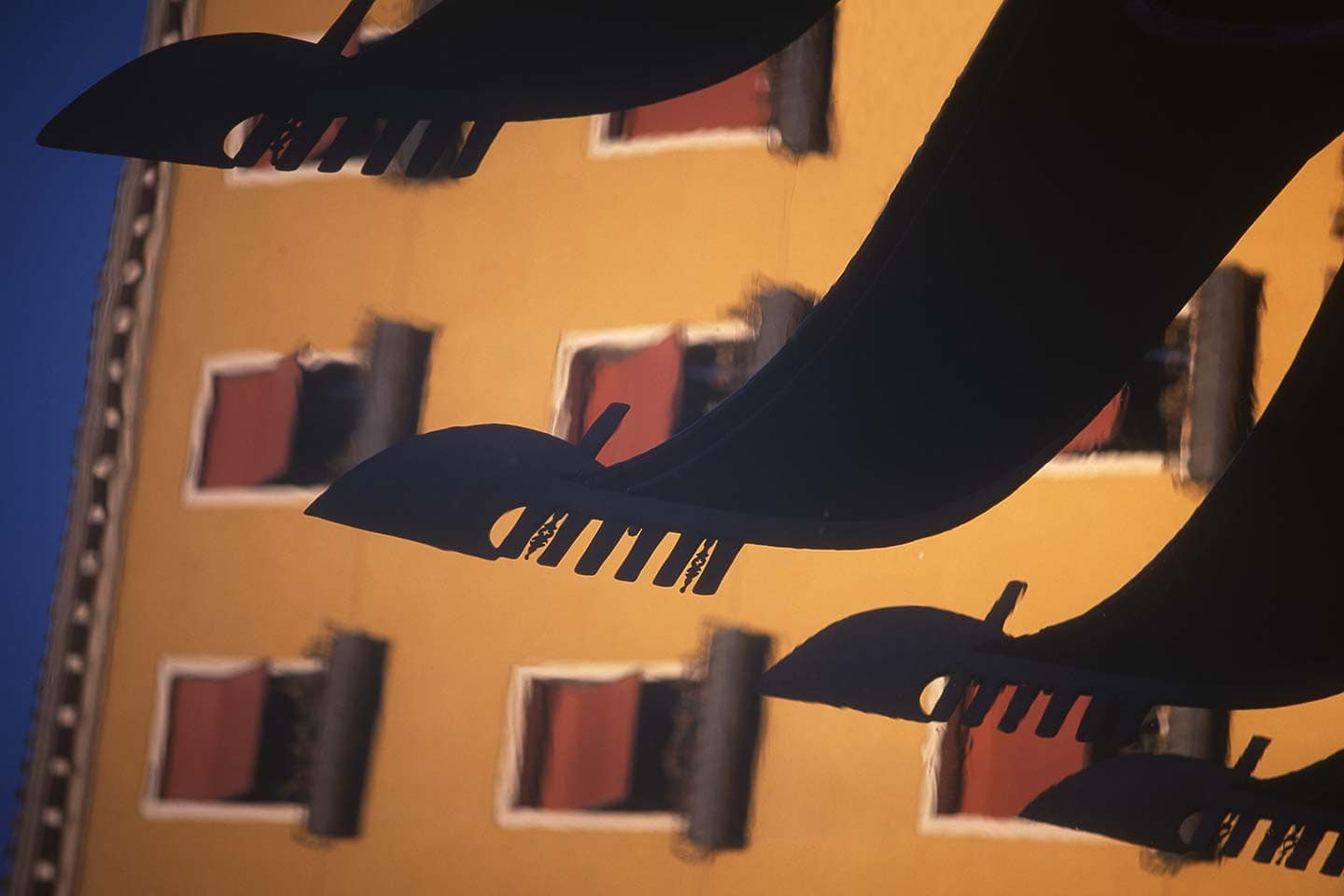
As it’s such a unique city, it’s perhaps not surprising that there are so many icons of Venice.
There may be cities with more canals, but nowhere on a par with Venice, on a series of a hundred or so muddy islands on which some of the most stunning buildings in the world were somehow raised.
Some of these buildings have become Venetian icons, but it’s often the everyday things that have become most recognisable, from the world-famous gondola to its colourful canal poles, and accessories like the Carnival mask that have become most widely known.
In this short article I show you the best of Venice’s icons, explaining their history, how and where to see them, and tours and places to stay where appropriate. I hope you find it enjoyable and helpful.
Icons of Venice
Gondola
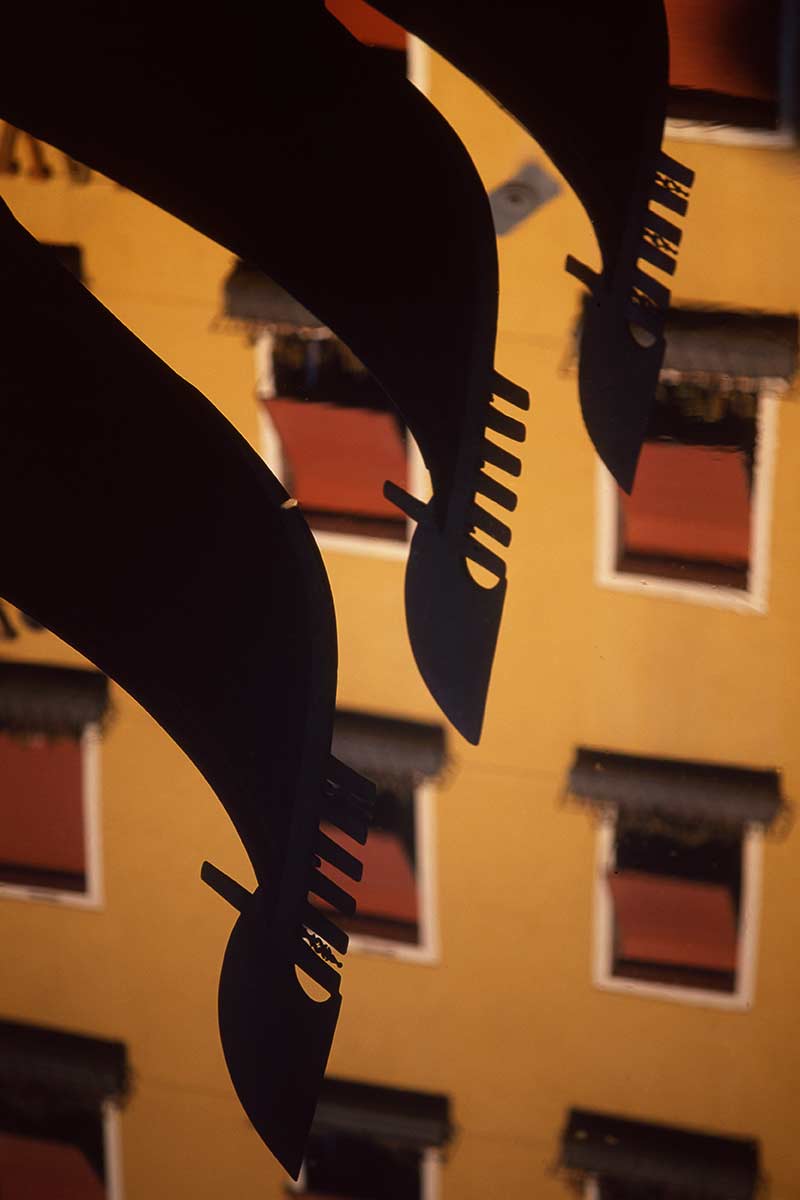
The gondola is perhaps the most widely recognised of all icons of Venice, the elegant long, sleek, narrow black boats unique to the Floating City, and a ride on one of them considered by many one of the most essential experiences in Venice.
Gondolas have been used on the canals of Venice for up to a thousand years. In medieval times they would have varied considerably in terms of size, standards of craftsmanship and colour. Other types of boat were also widely used. There were also far more of them – thousands – than there are nowadays. Only around 400 are still in use, each allocated to a licensed gondolier who has to undergo stringent training and pass exams.

The present version of the gondola is standardised precisely. They take several weeks to build, and are comprised of over 280 pieces of wood, including oak, mahogany, elm, cherry and lime. The boat has evolved over the centuries – some used to have canopies or shelters to protect passengers’ privacy.
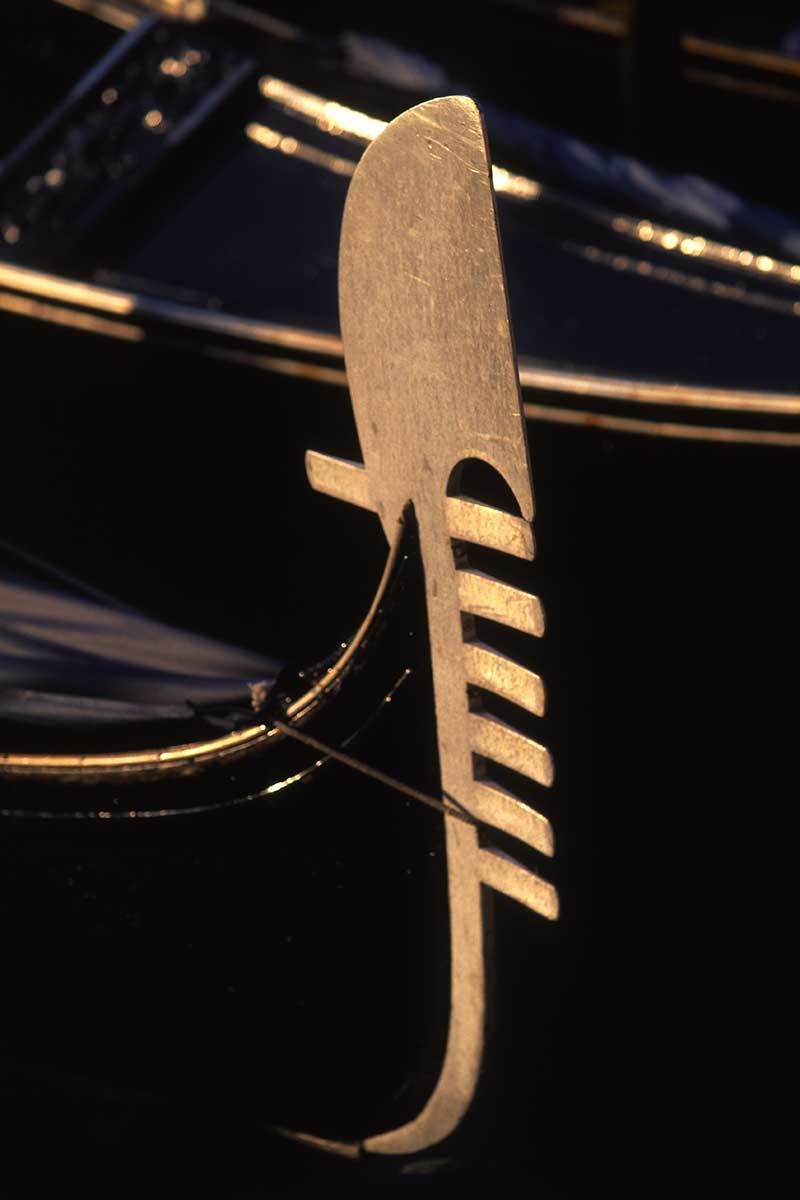
The heavy iron fero or ferro (prow) of the gondola is also meant to be standard. The six prongs supposedly symbolise the six sestieri (districts) of the city, and the backward-S shape is intended to represent the shape of the Grand Canal on maps.
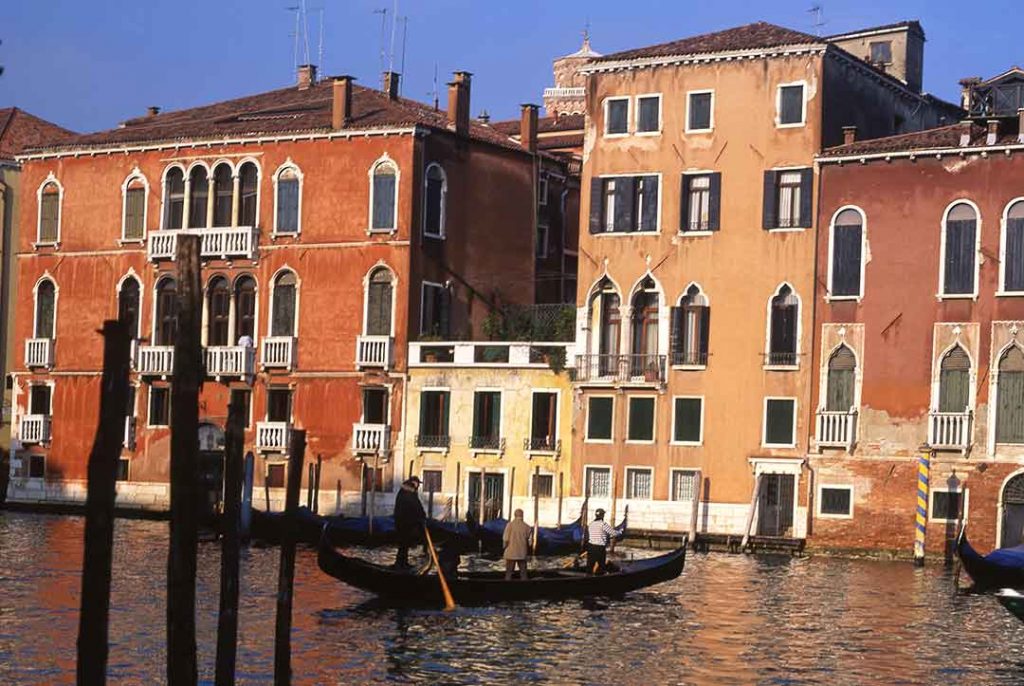
You can still cross the Grand Canal on a traghetto, a no-frills form of gondola that operates at five points along the Grand Canal, a fantastic way of making a shortcut on a thoroughfare with just four footbridges along its three-mile (5 km) course. Tourists pay a flat fee of €2.00 to the gondolier, while locals pay €0.70. If it’s full you’re normally expected to stand, while if it isn’t busy, you may be asked to sit.
Alternatively, you can of course ride a gondola. Routes vary and are subject to negotiation. We found one in the Castello sestiere and I suggested a sort of backstreet route to him, which he followed.
Gondolas carry up to six passengers for the flat fee of €80. If you want a singer blasting out a serenade, it’ll cost you extra. You can find them all over the city, especially at busy spots along the canals and near main sights. There are also gondola service spots in some of the quieter parts of the city, and a gondola ride along some of the most beautiful canals in Venice is one of the best ways yo experience the city.
You can book your Grand Canal gondola ride here.
Gondoliers
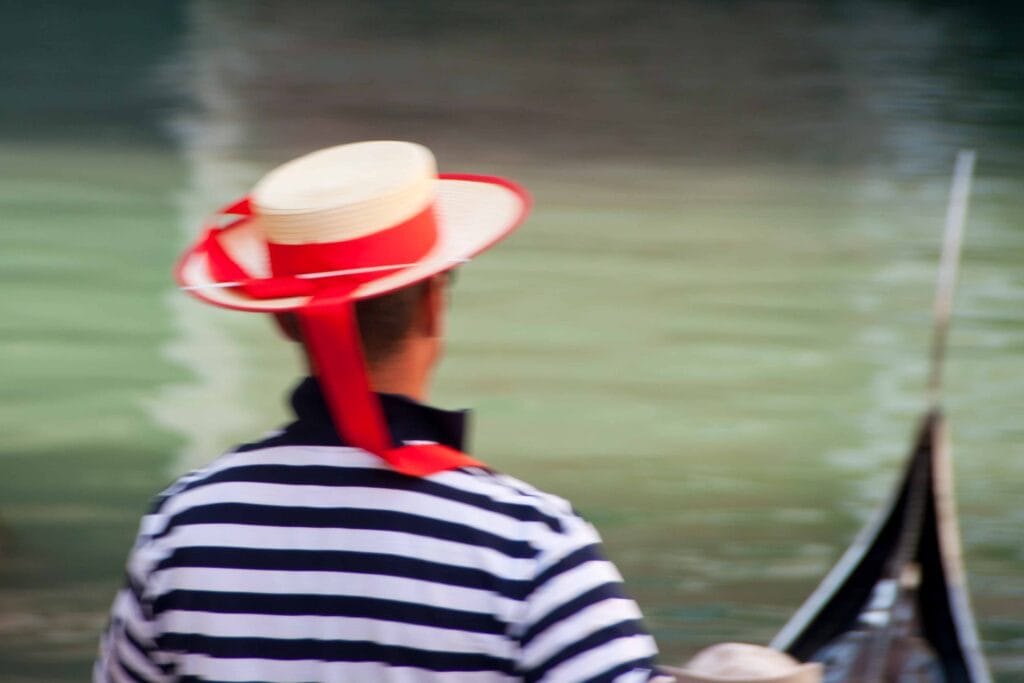
Gondoliers are also something of a Venetian icon in themselves. This is partly because they wear something akin to a uniform, albeit with flexible variations between individuals.
A Venetian gondolier has to become a member of a guild, with around 400 members in total. Like a learning car driver, a prospective gondolier has to clock up a set number of hours (400) rowing the canals of Venice, from the Grand Canal to off the beaten track rii.
They are assessed on their boatmanship, their knowledge of Venice (not just directions, but also their historical knowledge to pass on to visitors) and their proficiency in foreign languages.
Their uniforms usually consist of a striped top (usually red and white or navy blue and white), a straw hat, black or navy trousers and a red neckerchief.
Grand Canal
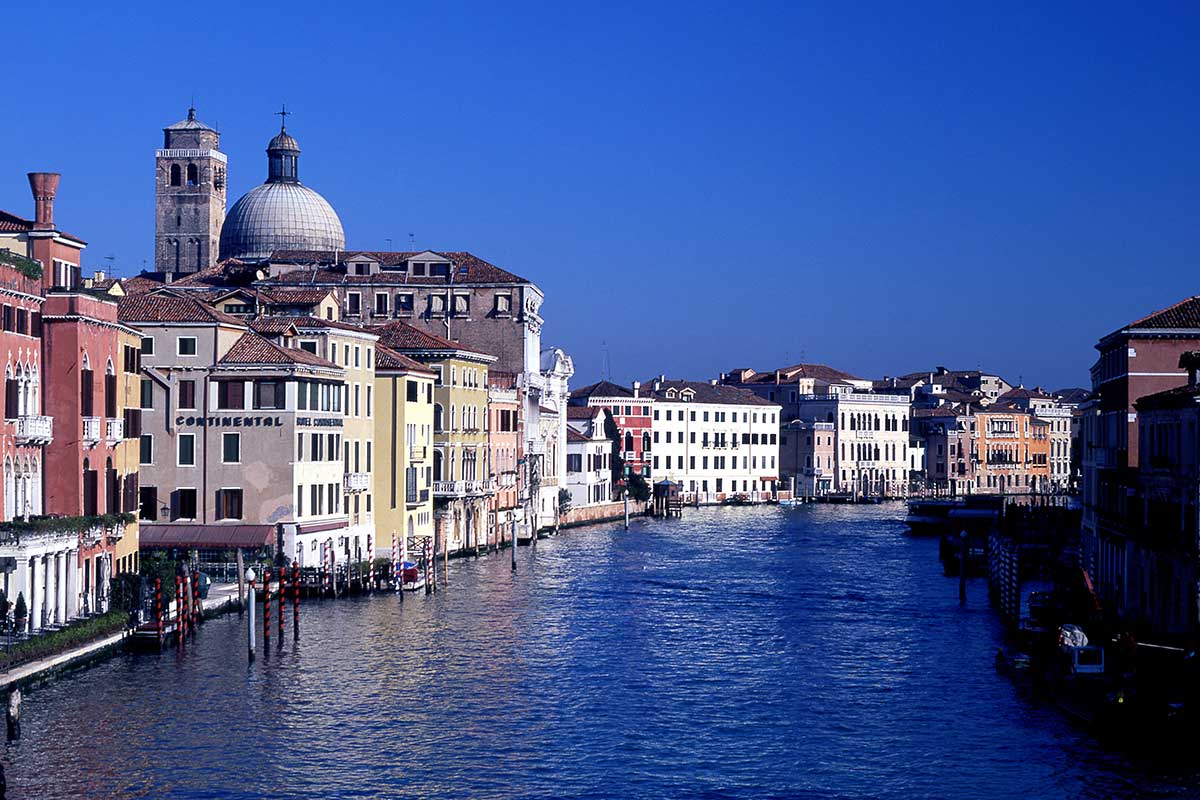

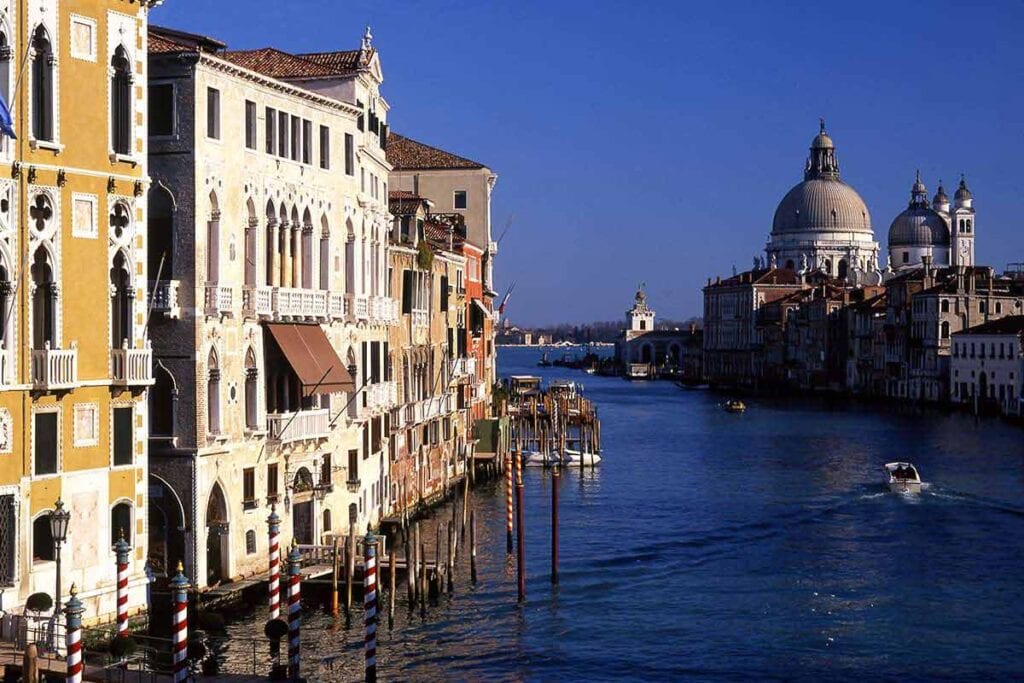
The Grand Canal is one of the most beautiful streets in Europe, indeed the world. It’s the first sight many visitors get of Venice, and even at the less attractive Piazzale Roma and Ferrovia (train station) end you will be wowed by the sight of the many boats on the Canal, the sight of the green dome of San Simeone Piccolo church and the many palazzi lining either side of the waterway.
For Venetians, the Grand Canal was the prime address in the city, where many of the wealthiest citizens and families spent their vast wealth on some of the most sumptuous palaces on the planet. And it’s the views of the palaces and churches along the Grand Canal that often make the strongest impression on visitors to Venice.
There are so many sights along the Grand Canal, from the exotic splendour of Ca d‘Oro to the bustling Rialto markets, and the Gothic Ca’ Foscari to the Baroque Basilica of Santa Maria della Salute.
Some of the best hotels in Venice are sited along the Grand Canal, including the exceptional Monaco & Grand Canal a minute’s walk from St Mark’s Square, and the de luxe, palatial Al Ponte Antico, within sight of our next icon of Venice, the Rialto Bridge.
Rialto Bridge
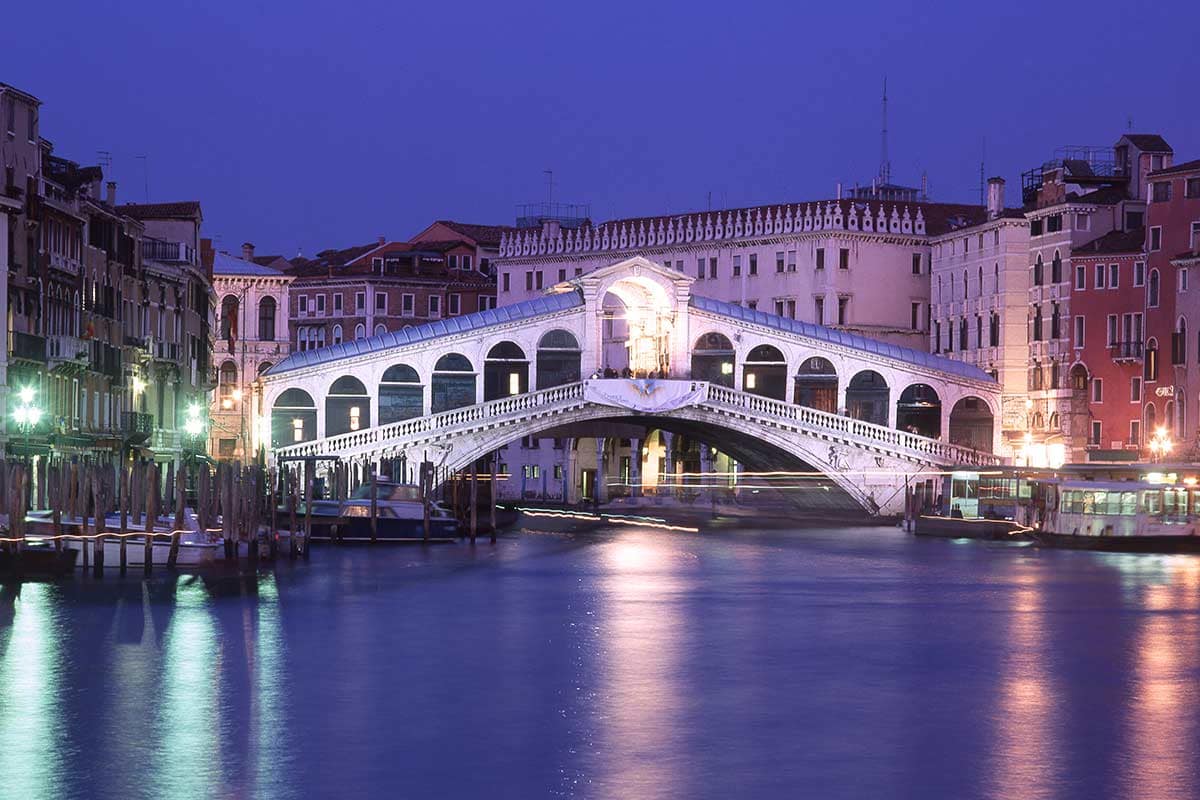
The Ponte di Rialto is one of the most famous, iconic and beautiful bridges in Europe. It was the first stone bridge across the Grand Canal, completed in 1591, linking the sestieri of San Polo to the west with that of San Marco to the east. Prior to that, a single-arched wooden bridge had been used to cross the Grand Canal.
The Rialto Bridge has become one of the most popular icons of Venice because its design is so distinctive. Staircases from each bank of the Canal climb to the apex of the single stone arch, meeting in the middle. The bridge was then lined with shops on each side, a simple, instantly recognisable symbol created in the 16th century but an ideal 21st century icon.
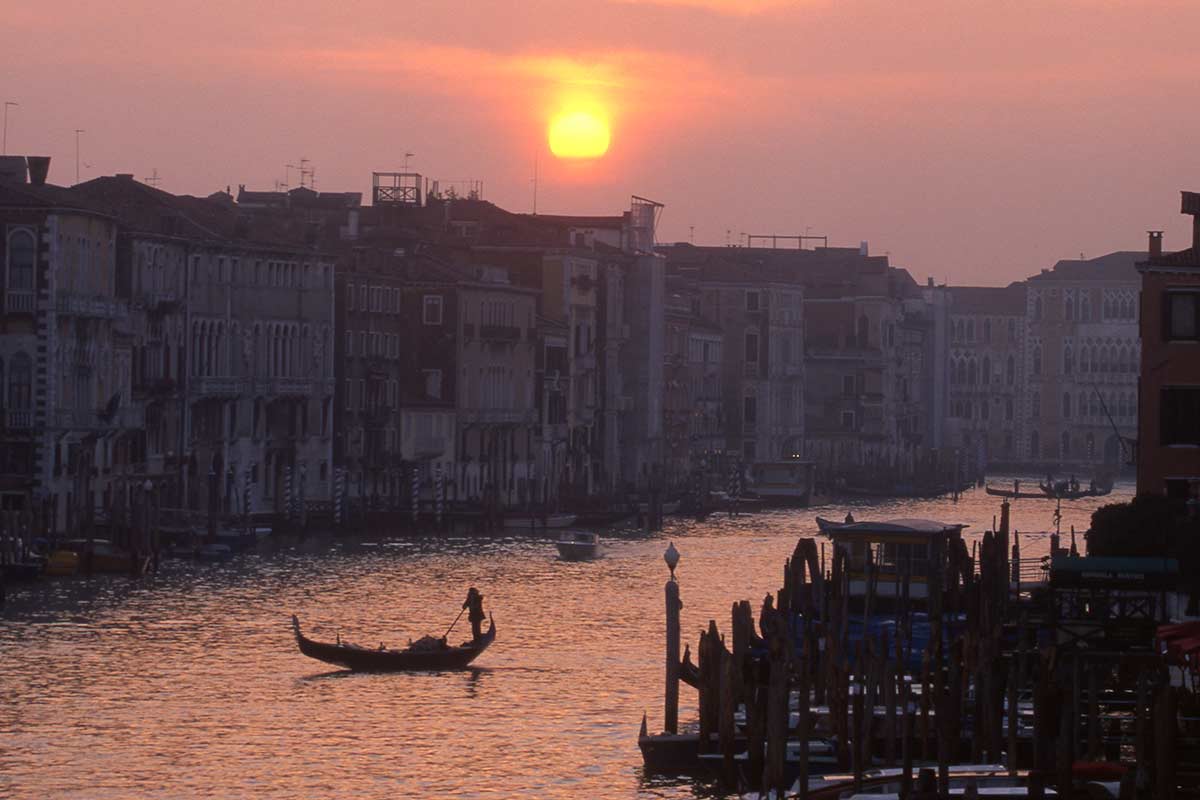
As well as being so recognisable, it’s also one of the best viewpoints in Venice. The views from either side of the Bridge are superb, but it’s in winter that it really comes into its own. At this time of year it’s one of the best places to watch sunset in Venice, facing southwest down the Grand Canal, the gondolas and many marker poles in silhouette as the sun sinks behind the palazzi at its far end. An unforgettable sight.
Where To Stay – Palazzo Barocci Venice – magnificent 18th-century palace next to the Sant’Angelo vaporetto stop, a 5-minute walk from and with views of Rialto.
Carnival Masks
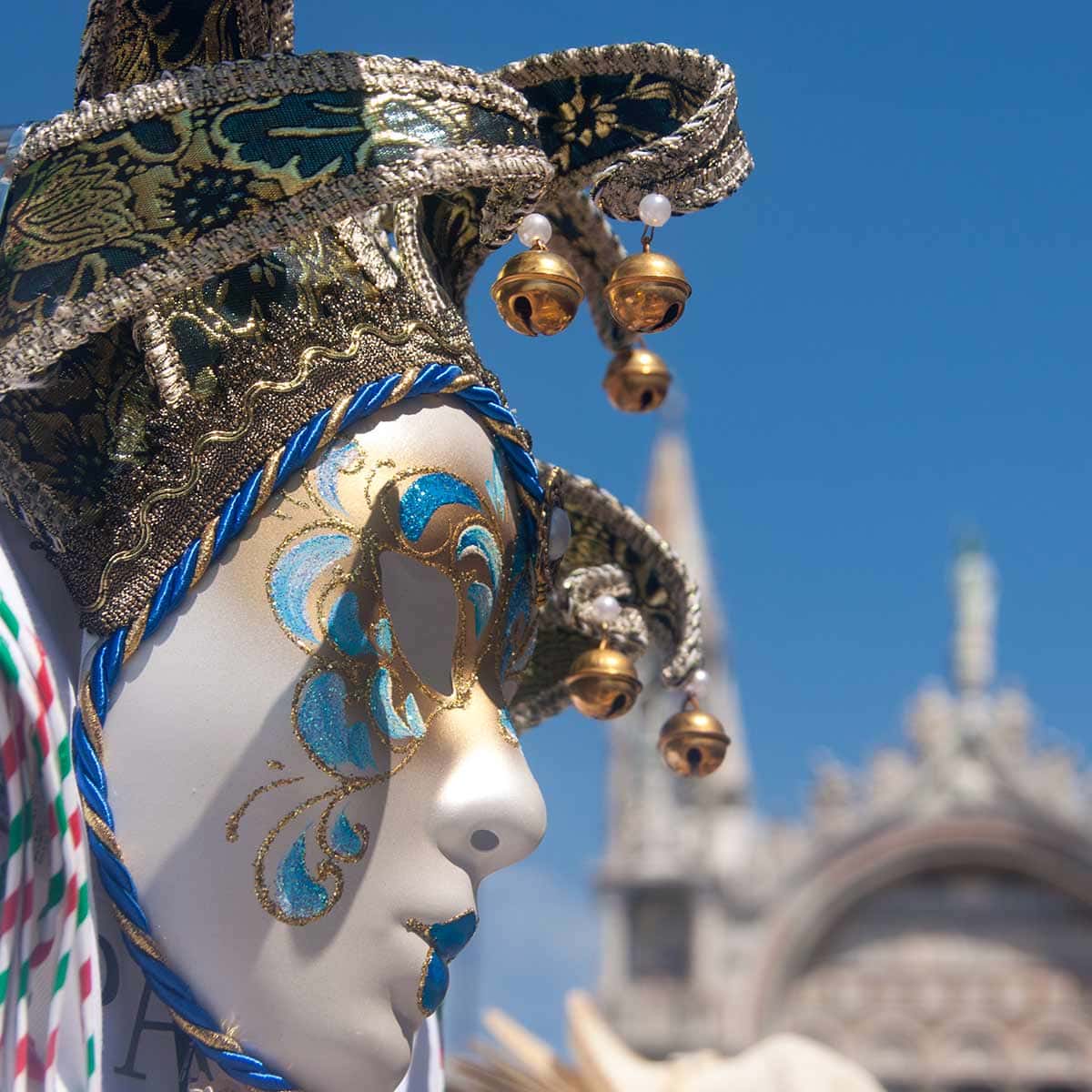
Venetian Carnival masks are among the most famous icons of Venice. The tradition of wearing them at Carnevale goes back around 800 years, to the 13th century, And there are also several different types of Carnival mask, some intended to be worn by women, others by men.
Carnival is a widespread tradition across parts of Europe, celebrated in Catholic regions and countries. Depending on the location, Carnival season varies from a long weekend to ten days in Venice, and it finishes on Shrove Tuesday, the day before Ash Wednesday, the beginning of the fasting period of Lent. Carnival may also have had links to ancient festivals celebrating the coming of spring, and with Lent coming, it was a chance to let one’s hair down and have some fun.
In Venice, the class structure of society was very rigid, and masks gave people the cover of anonymity to mingle with others with whom they would normally be unable to associate with. Men could pretend to be women (they would wear a gnaga mask, cat-like in appearance), likewise women could pretend to be men. People could also get away with things wearing a mask that otherwise may have got them into trouble.
Some of the characters on which the masks were based are derived from figures in early Italian theatre, the commedia dell’arte. These include the arlecchino (pictured above) or harlequin, a jester-like character, the colombina (dove, and often the love interest of the arlecchino). The plague doctor mask, with the long nose, was actually worn by physicians to protect themselves from disease!
Carnival masks in Venice are made from papier mache and painted with a mixture called gesso, and gold leaf and other decoration is then added as a final touch.
At one time Carnival masks could be worn for much of the year, but this was eventually restricted to the December 26th(St Stephen’s Day) to Shrove Tuesday. It was abolished under Napoleon Bonaparte’s rule in 1797, and only revived in 1979 by city authorities.
TIP: Expect peak season prices in Carnevale, and peak crowds with it.
St Mark’s Campanile
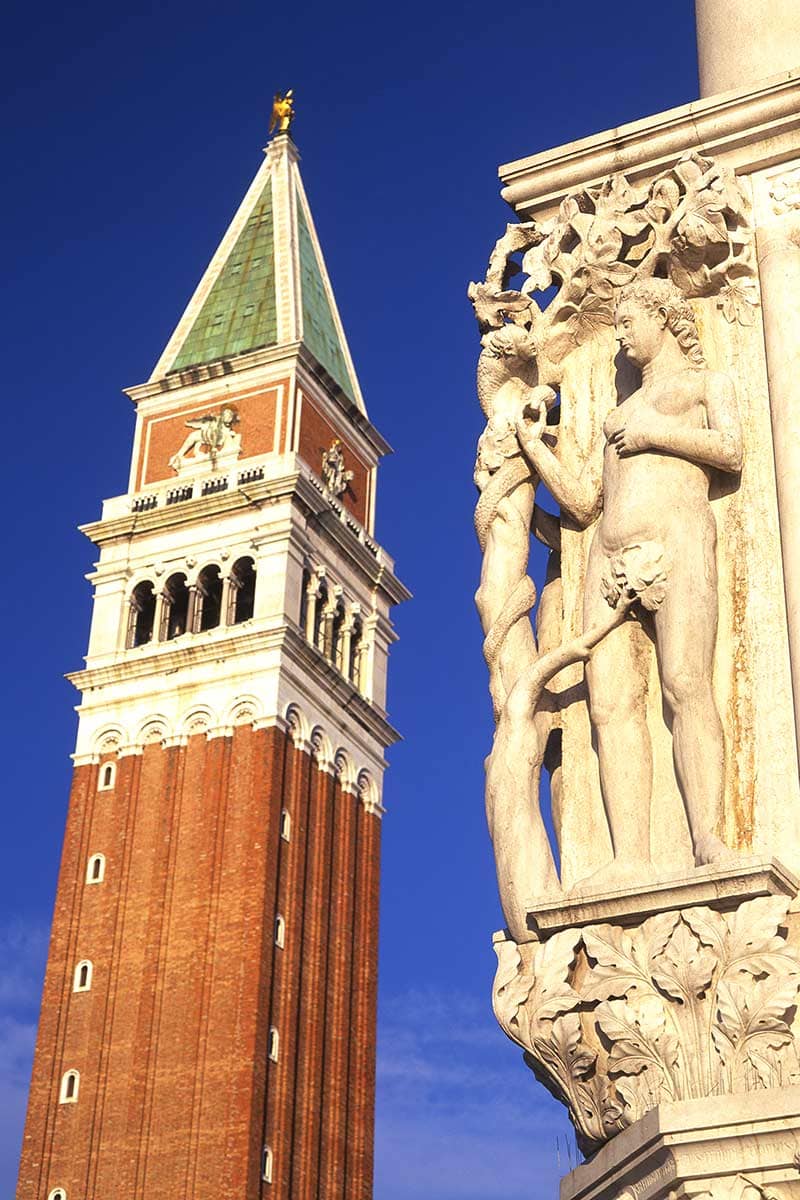
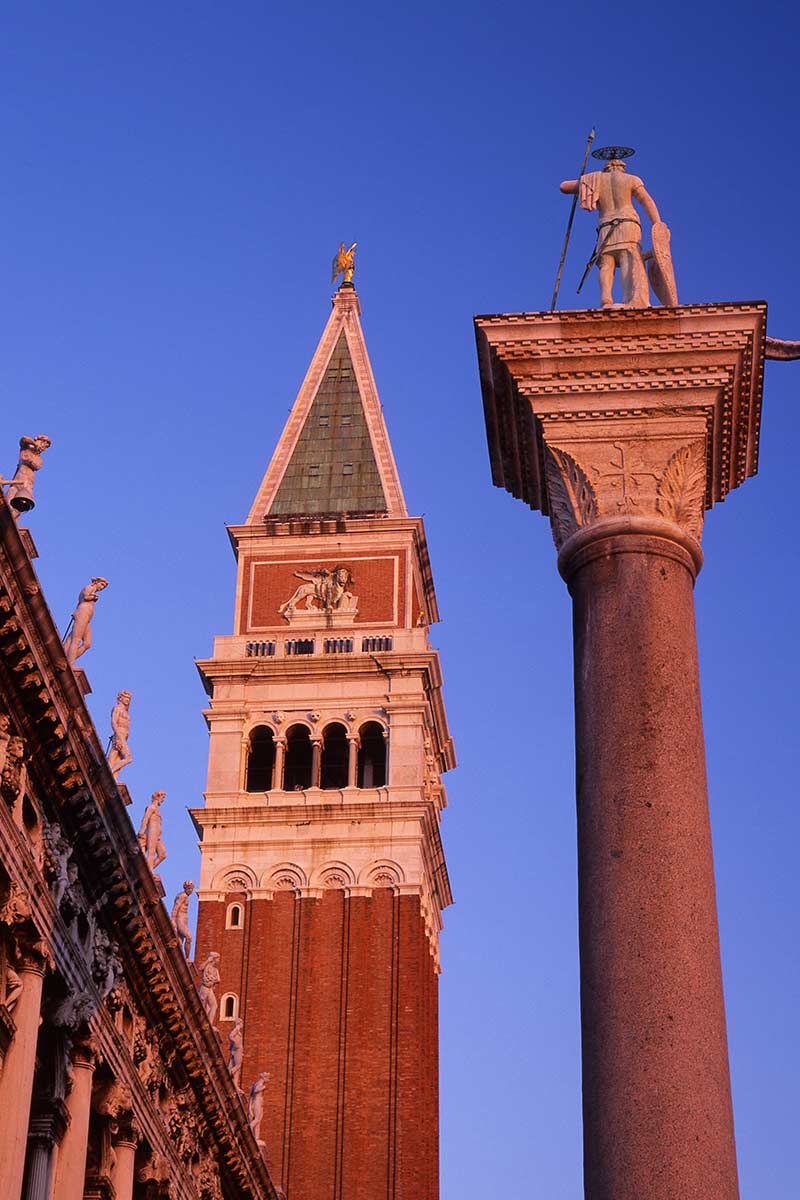
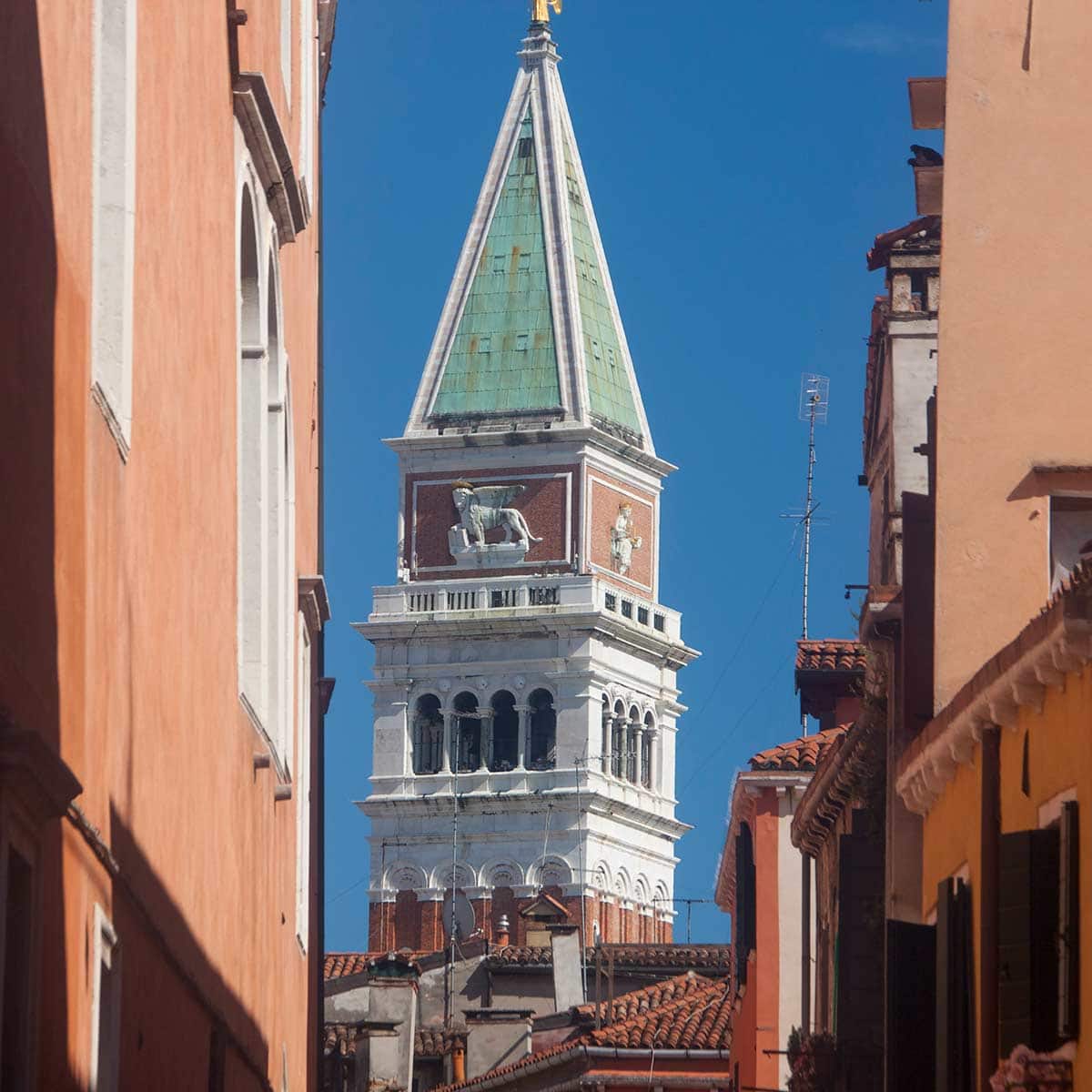
The belltower of the Basilica of San Marco (St Mark) is one of the most familiar landmarks and icons of Venice. At 323 feet (98 metres) it’s by far the tallest building in the city, and it’s also one of the best vantage points in Venice. The views across the lagoon, over the Grand Canal, the domes of San Marco and the city’s other belltowers are phenomenal, and worth seeing over and over again, as I have done.
The tower is disproportionately high compared to the Basilica with which it is connected. This is perhaps because it served as a watchtower, and also a beacon and landmark for vessels sailing into the city. The bells of San Marco were used to advertise service times but also served secular purposes, signifying the start and end of the working day, political gatherings, and other important events.
St Mark’s Campanile was completed in 1514, and over the course of the following century it was struck by lightning and damaged several times. Galileo Galilei also demonstrated the telescope to Venetian nobles in August 1609. The instrument was then presented to Doge Leonardo Donato.
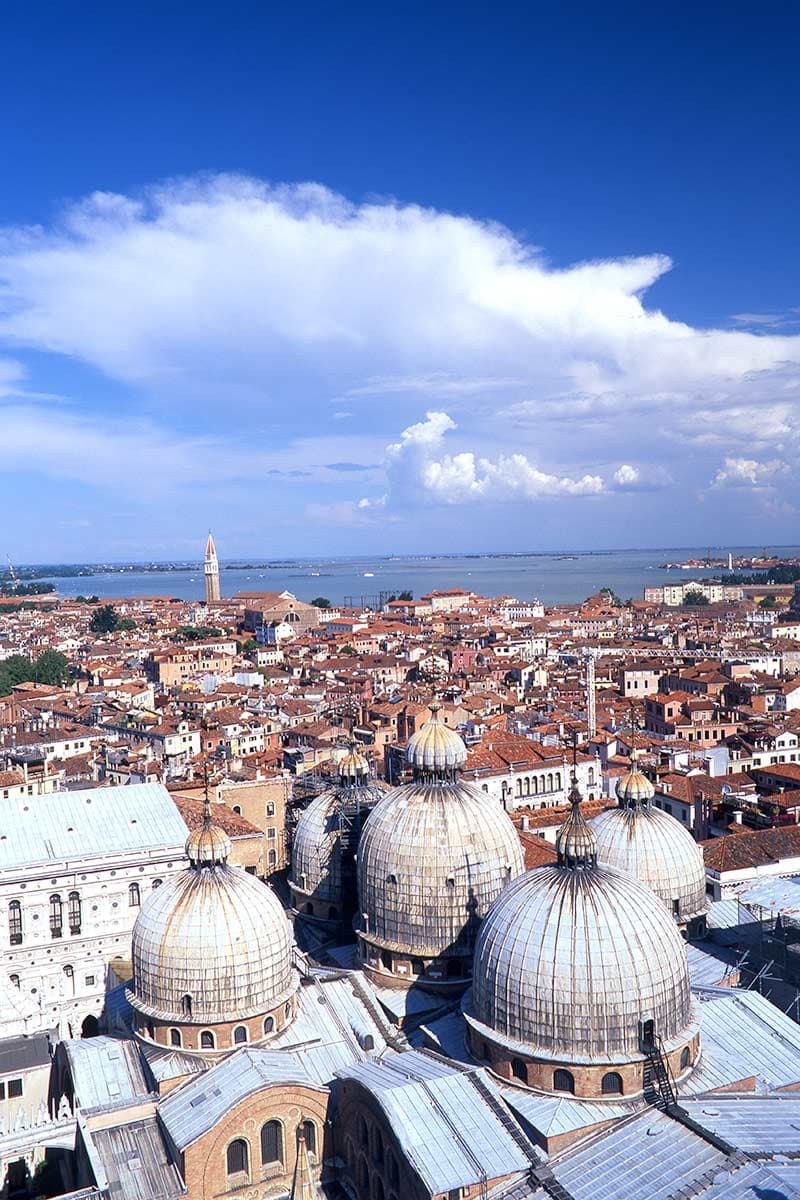
Severe structural problems were detected in 1902, and on 14th July of that year the Campanile collapsed in on itself. This was fortunate in that it caused little external damage, and there were no human casualties. Sadly, however, it was curtains for the custodian’s poor cat, who didn’t stand a chance.
The Campanile was then rebuilt by 1912. You can now visit the exhibition and aforementioned viewing gallery for €15 per adult. You can also book your Campanile tickets here.
San Giorgio Maggiore
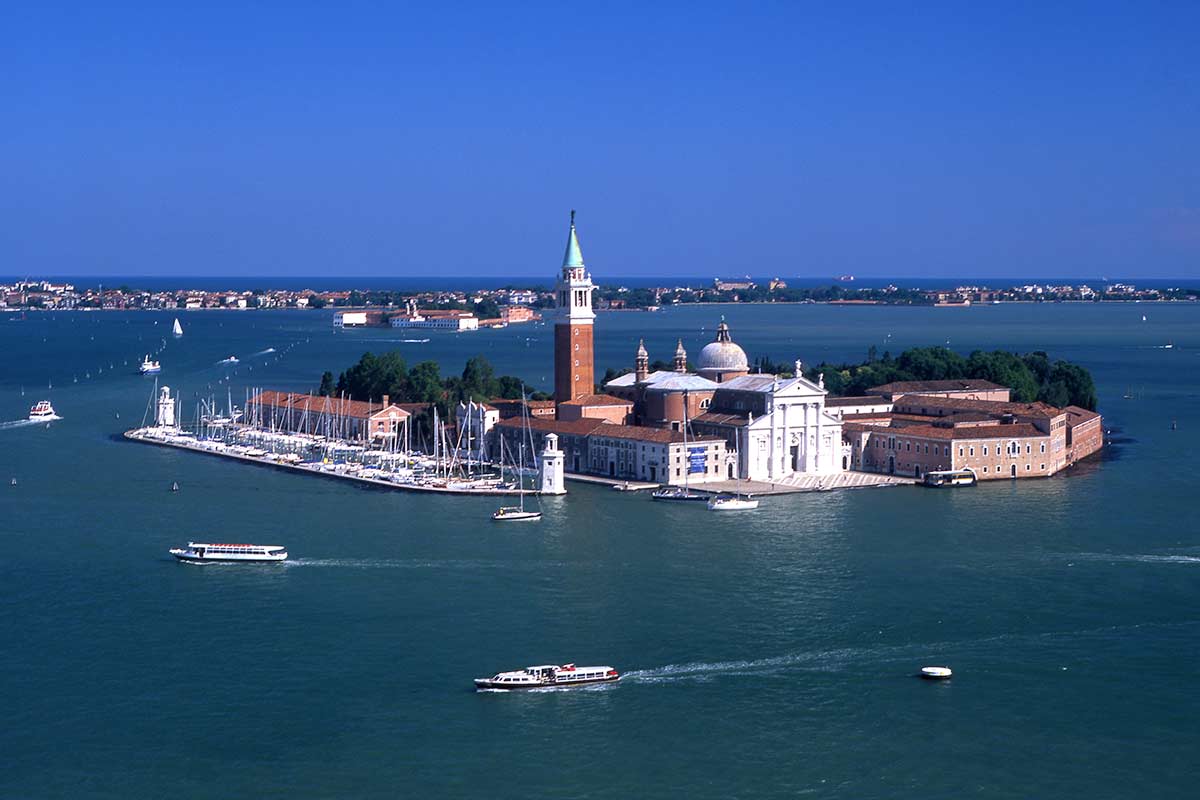
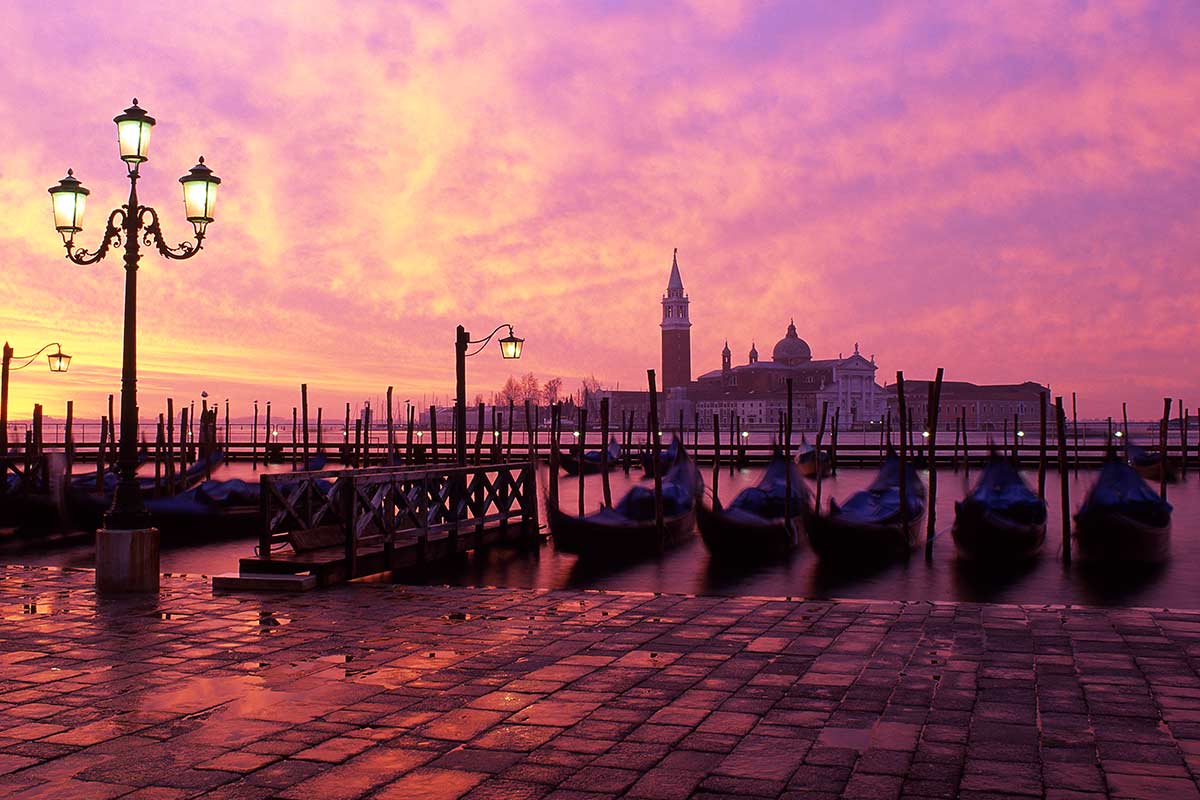
Andrea Palladio’s simple, serene Renaissance-era Basilica of San Giorgio Maggiore is one of the most beautiful churches in Venice.
This 16th-century masterpiece has the advantage of one of the best possible locations in Venice, on an island a short distance across the lagoon from the Molo, Venice’s stunning waterfront, and the adjoining Riva degli Schiavoni. It looks especially wonderful at sunrise or sunset from the Molo, with a row of gondolas usually in the foreground.
The church is also quite simple inside, but is adorned by some of the finest works of Jacopo Tintoretto, including his Last Supper and Entombment of Christ.
If you enjoy high level views, I can’t recommend the short elevator ride of San Giorgio Maggiore’s campanile enough. The views – particularly across the Bacino di San Marco to Santa Maria della Salute and the Doge’s Palace and San Marco (on a clear day you can also see the Dolomites in the distance) – will likely be among the highlights of your trip to Venice.
Bridge of Sighs
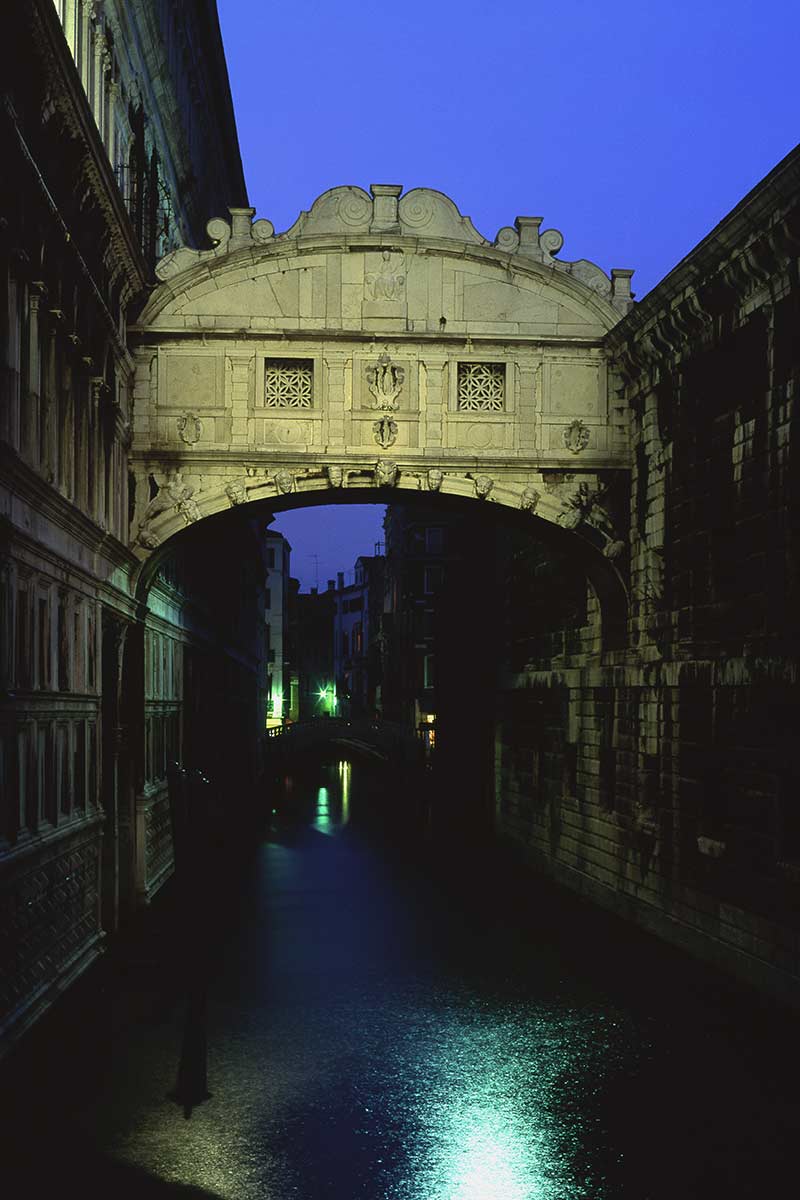
The Bridge of Sighs (Ponte dei Sospiri) is one of the most evocative icons of Venice.
It’s the bridge linking the courts of the Palazzo Ducale (Doge’s Palace) with the Prigioni (Prisons) of the Venetian Republic next door. The sighs are the presumed reaction of the sentenced prisoners of the last glimpse of Venice (San Giorgio Maggiore and the lagoon) and freedom before serving their time in grim conditions. Lord Byron gave the Bridge its name in English early in the 19th century – a direct translation from the Italian.
The Bridge of Sighs was begun by Gianantonio Rusconi, who died before it was completed. He was succeeded by Antonio da Ponte, architect of the Rialto Bridge (see above, the principal designer, but he too died before construction was finished. It was eventually completed around 1603 by da Ponte’s nephew, Antonio Contin.

It has inspired other Bridges of Sighs around the world, most notably those at the Universities of Cambridge and Oxford in England.
You can visit Venice’s Bridge of Sighs as part of the standard Doge’s Palace Reserved Entry Ticket (which you can book by clicking on the link). The Bridge of Sighs is also included on longer tours, the Itinerari Segreti or Secret Itinerary, which includes extras such as Giacomo Casanova’s torture chamber. These aren’t included on the regular Doge’s Palace ticket and self-guided tour.
And you can also book a gondola ride beneath the Bridge of Sighs here.
Venetian Gothic
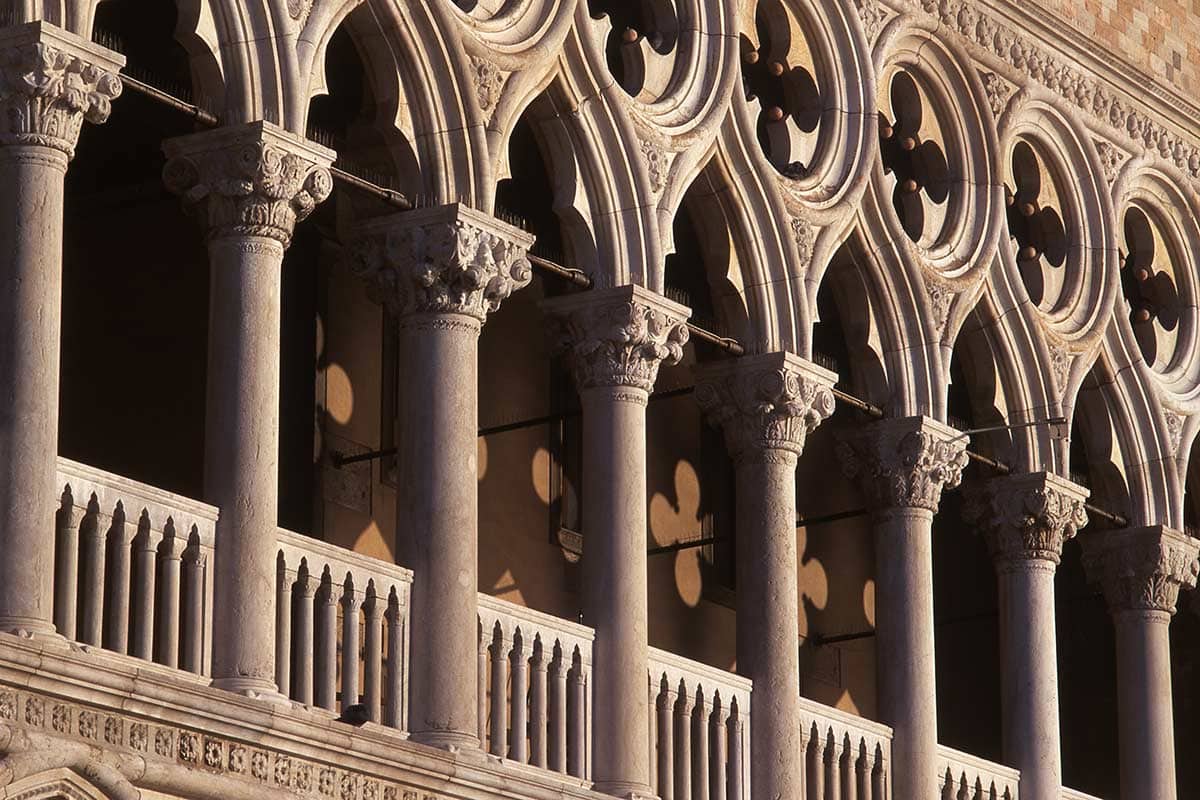

Venetian Gothic architecture is instantly recognisable, and quite different from contemporary Gothic architecture across Europe. You only tend to see Venetian Gothic buildings outside Venice if they are much later pastiches of the style.
You can find Venetian Gothic all around the city, but to narrow it down, I’ve singled out three buildings, two of which are very close to each other.
The Palazzo Ducale – Doge’s Palace – is the best-known of the three. It’s located on the corner of the Piazzetta di San Marco, the small square linking St Mark’s Square (Piazza San. Marco) with the Molo, Venice’s grand waterfront.
Its most prominent Venetian Gothic feature is the arcade running around two sides, with a series of narrow pillars supporting the structure above. There are decorative quatrefoils (shaped like flower with four petals) between each arch. The overall effect is similar to the shape of a Gothic stained-glass window without the glass.

A minute’s walk away, across the Ponte della Paglia (past the Bridge of Sighs) is the sumptuous Hotel Danieli. It was built in the late 14th century and known as the Palazzo Dandolo, and served as one of the most luxurious hotels in Venice since 1824. Stand outside to admire the façade, with some pointed windows showing some Islamic influence, a reflection of what Venetians would have encountered on their voyages and ventures to the east.
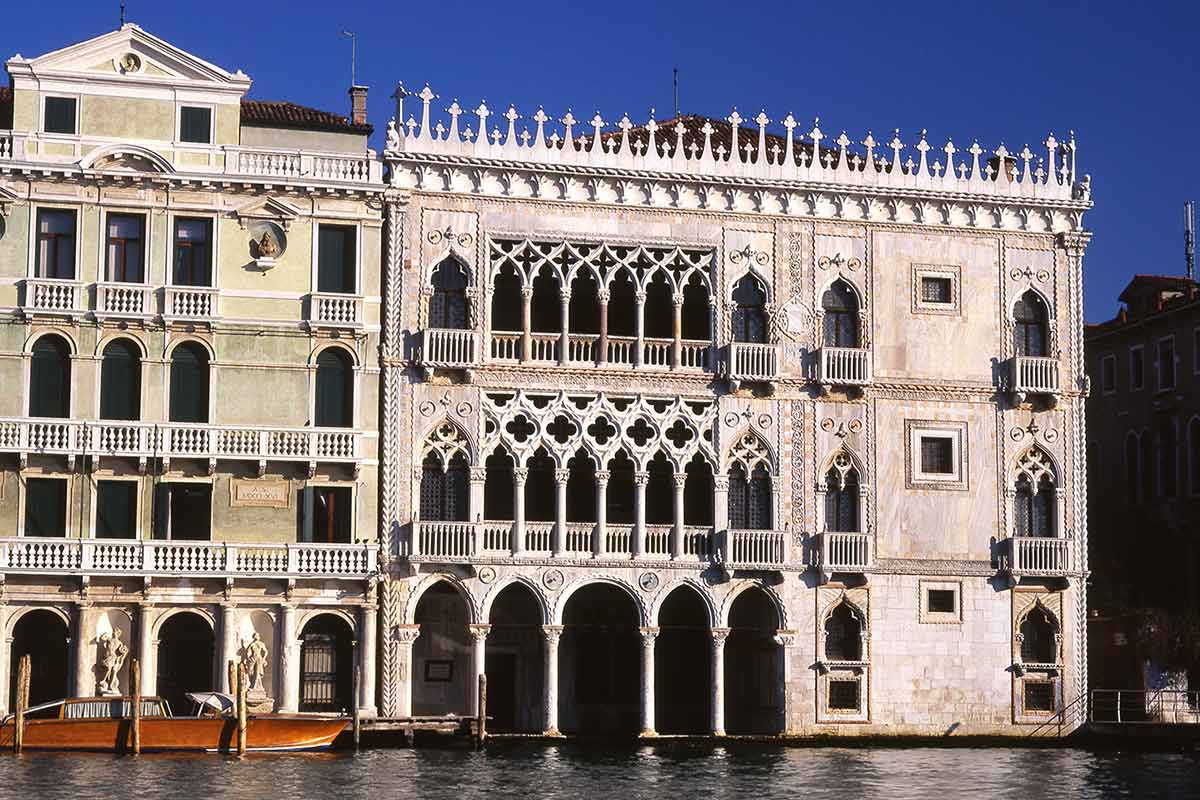
Over halfway back up the Grand Canal, Ca’ d’Oro (the Golden House) is one of the most lavish palazzi in Venice, even without the gold leaf decoration which adorned it. It was built during the 15th century, between 1421 and 1437, for Marino Contarini. He employed Giovanni and Bartolomeo Bon, and sculptor Matteo Raverti, to work on the ca’ d’Oro. He was a meticulous record-keeper, and all of these have survived, giving us an unparalleled insight into the planning and work involved in building it. The Ca’ d’Oro is now home to Galleria Giorgio Franchetti, one of the finest art galleries in Venice.
Where To Stay – the rebranded Danieli Venezia – A Four Seasons Hotel is one of the ultimate Venetian Gothic buildings and best hotels in Venice.
Canal Pole Markers
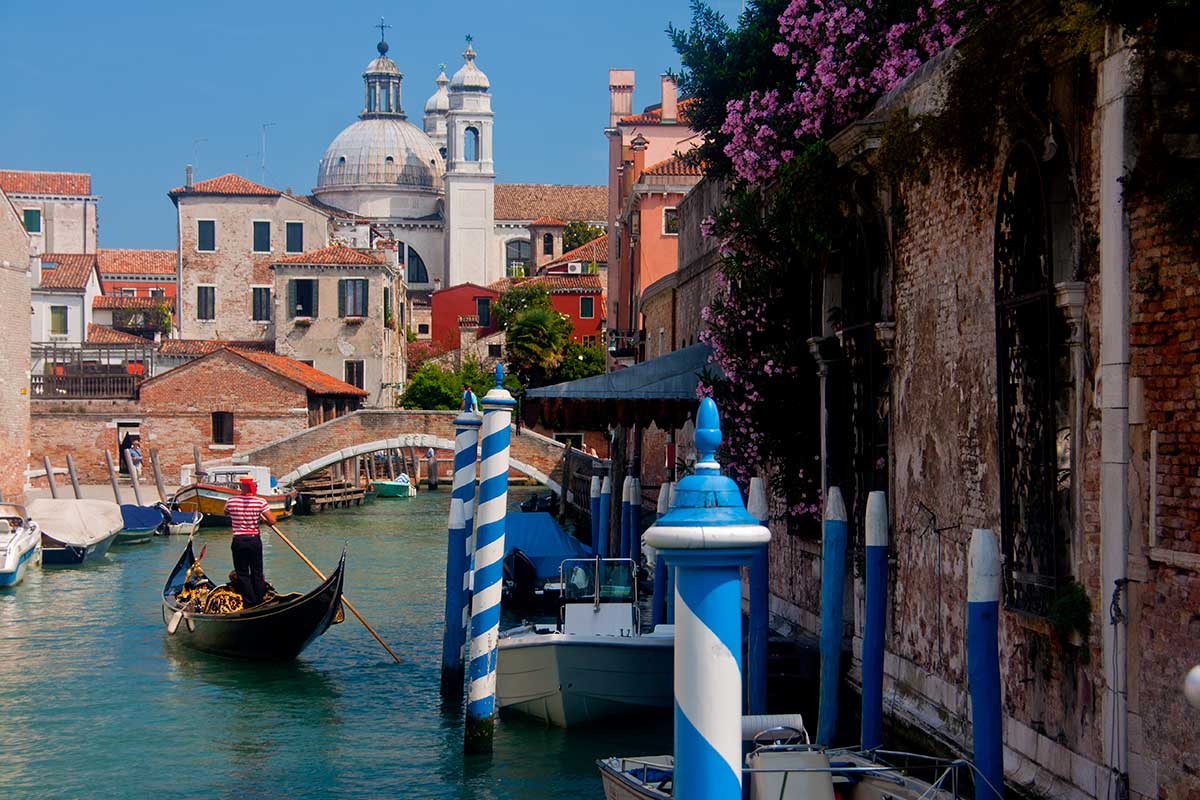

The spiral striped poles on the city’s canals are also icons of Venice, adding a dash of colour to the medieval canals.
Their Italian name is pali di casada – and they are vary in colour from building to building. Some aren’t even striped at all, rather a single colour, possibly with a small seal or decoration added.
They are used to indicate the location of a particular house or palazzo, and they also represent the colours of the resident family.
Traditional pali di casada are wooden, hand-crafted until they are perfectly round, and then meticulously painted using strips. These wooden posts last anything from 15 to 20 years before they need to be replaced. Some Venetians now use plastic or metal ones as a cheaper alternative.
Each palo is topped by a cappellozzo, which represents the oil lamps that used to stand on top of the poles in times gone by.
Icons of Venice – Final Thoughts
I hope that you’ve found this article useful. I’ve visited Venice many times written numerous other articles on the city. Here’s a selection of them – feel free to browse them at your leisure:
- Is Venice worth visiting?
- Sunrise In Venice – best places to watch the sunrise in Venice
- Sunset In Venice – the 10 best places to see it
- Grand Canal Venice – Visual Guide To The Most Beautiful Street In The World
- 14 Most Beautiful Churches in Venice
- 34 Wonderful Venice Landmarks – the unmissable sights of La Serenissima
- Bridges In Venice – from the Bridge of Sighs to lesser-known sights including the Bridge of Fists and the Bridge of Tits
- 14 Most Beautiful Canals In Venice
- Venice Off The Beaten Path – 18 Hidden Gems In Venice
- 17 Photos That Will Make You Want To Visit Venice
- 12 Most Beautiful Venice Squares – San Marco, Campo San Zanipolo and more
- Cannaregio Venice – the complete Area Guide
- Things To Do In Burano – the colourful fishing village in the Venetian lagoon
- Things To Do In Torcello Venice – where Venice began over 1,300 years ago
- Day Trip To Venice – what to do and where to go if a day is all you have
- Weekend in Venice – 48 hours in La Serenissima
- 3-Day Venice Itinerary – a slightly longer trip to Venice, what not to miss in 3 days
- 16 Best Day Trips From Venice – Burano, Verona, Padua and More
- Squares in Italy – 15 of the most beautiful squares in Italy