

The Villa Tugendhat Brno is one of the great private houses of the 20th century. Built by German architect Mies van der Rohe, it broke new ground in many ways.
A minimalist masterpiece, it soon became renowned as one of the finest buildings of the Functionalist 1920s and 1930s, and in 2001 it was made a UNESCO World Heritage Site.
In my guide to the Villa Tugendhat, I delve into the history of the building, its architectural importance and what to see on a tour of the house.
I also offer tips on the various tours and tickets on offer, and information on how to get to Villa Tugendhat from Brno city centre.
In addition, I put Villa Tugendhat in context, looking at other architecture in Brno from the same period and other places to visit in the city. I also suggest places to stay in Brno, a great city easily worth two or three days of your time – if not more.
Enjoy!
Why Visit Villa Tugendhat
Villa Tugendhat is one of the most significant buildings of the 1920s and 1930s, a unique functionalist family home for the ultra-wealthy textile-rich Tugendhats.
It is one of the most celebrated works of German architect Ludwig Mies van der Rohe, who went on to design several famous buildings in Chicago and the Martin Luther King Jr Memorial Library in Washington, DC.

Villa Tugendhat is groundbreaking in its innovative use of steel pillars to create a greater sense of space, its enormous windows and the impression that the external view was part of the living space and house.
The Villa was famous at the time it was built as it was the most expensive private house ever designed, and attracted a great deal of interest because of this.
Villa Tugendhat’s significance was recognized with its inscription on the UNESCO World Heritage list in 2001.
Vila Tugendhat Brno History
The hillside area 2 km (1.2 miles) northeast of Brno city centre became popular with wealthy landowners during the 19th century, and it became known as Belvedere – meaning ‘beautiful view’.
Several villas were built there, with some enjoying superb views over the skyline of the city of Brno.


A plot of land in the suburb was acquired by Greta and Fritz Tugendhat. Greta was a member of the wealthy Löw-Beer family, who had made their fortune in textiles. They also owned a large villa on the plot of land below Villa Tugendhat.
The chosen Villa Tugendhat architect was Berlin-based Ludwig Mies van der Rohe. He was also Head of Architecture – and later Director – of the Bauhaus School of Art and Design.

At first Mies was reluctant to accept the commission, but changed his mind after learning more about Brno’s rich contemporary architecture (see also the Hotel Avion).
The Villa Tugendhat was constructed between June 1929 and July 1930 at a cost of 1,000,000 Reichsmarks, or 8,000,000 Czechoslovak crowns.
Both the Tugendhats had previously been married, so the Villa was intended as home for them and their children from their first marriages.


The family only lived in Villa Tugendhat for eight years; they were Jewish, and fled to Switzerland in 1938, realizing the threat posed by the Nazis, who had taken over the whole of Czechoslovakia within a year.
Villa Tugendhat was requisitioned by the Gestapo and later the Red Army. Parts of the building were stripped out, and for some years it was used as a therapeutic centre for children.
Vila Tugendhat was the venue for talks between Czech Prime Minister Vaclav Klaus and his Slovak counterpart Vladimir Meciar. The two leaders reached agreement on what became known as the ‘Velvet Divorce’ – the division of Czechoslovakia into the Czech and Slovak Republics – in 1993.
Villa Tugendhat was partly rebuilt in the 1980s, then refurbished with the restoration of some original elements between 2010 and 2012. It was designated a UNESCO World Heritage Site in 2001.
Villa Tugendhat Architecture
Villa Tugendhat is often described as a work of Functionalist architecture. It’s also sometimes described as Bauhaus architecture, unsurprising given Mies van der Rohe’s connection to the School of Art and Design of the same name.
Functionalism was a major departure from decorative early 20th-century architecture. The ornamental elements were replaced by what Mies van der Rohe described as the bare ‘skin and bones’ of a building.


The building is supported by a series of reinforced steel pillars which take up minimal space inside the house. This – along with the high ceilings – adds to the sense of great spaciousness within the house.
Villa Tugendhat is very spacious and because of this seems quite sparsely furnished. However, the house wasn’t just about functional living. It was the most expensive house in the world at the time it was built, and this was partly down to the rare and expensive materials used.
These include the famous Moroccan onyx wall, and the Macassar ebony wood used in the dining room, zebrawood and Italian travertine.
What To See At Villa Tugendhat Brno
Exterior and Garden
If you follow the same route to Villa Tugendhat that I did, the house initially appears far smaller and more modest than it is. From the main gate on Černopolní, you only see the top storey of the house. The lower floors are built into the hillside below.

One of the first things you see on a guided tour of Villa Tugendhat is the view from the upper terrace over the garden and city beyond. Even when the trees are in full foliage in summertime, you have a clear view of the Cathedral, Spilberk Castle and church spires of Brno.
Upper Floor, Reception Area And Bedrooms
The Extended and Basic tours begin at street level, taking you into the main reception area. Visitors stand on a machine which wraps protective plastic ‘slippers’ around their shoes.


You are then taken through the reception area to the parents’ and children’s bedrooms. The sense of space – partly a result of the height of the ceilings – is immediately striking.
The rooms are furnished much as they would have been in the 1930s, the only period during which the house was ever lived in.
Piano nobile (living room) and dining room


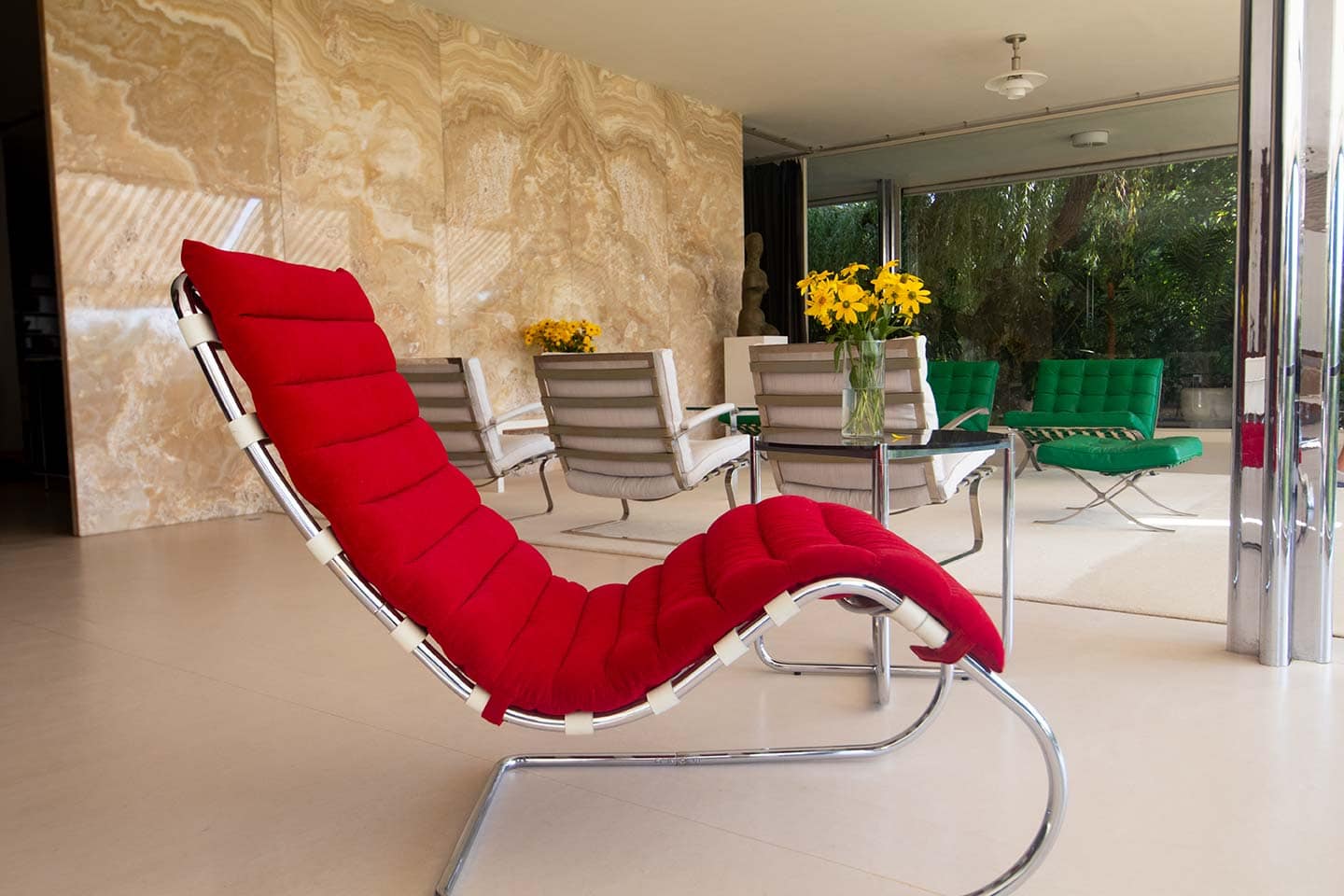
The vast main living room, or piano nobile, looks out onto the Garden and towards the city skyline. The large glass windows give the space a very open feel, as if you can reach and touch the trees and city beyond. This is very much what Mies van der Rohe intended.
He collaborated with designer Lilly Reich, who was responsible for the green Barcelona chairs and grey-white Tugendhat chairs, both of which are in production almost a century on.
The onyx wall (see below) separates the main living space from the area behind, where there is a library and reading area.
As you look out of the window of the piano nobile, the dining room is to the right. The Macassar ebony wall curves behind the round table, leaving the window view open to most diners.


Moroccan onyx wall

The Moroccan onyx wall that divides the main living area proved to be a surprise to both Mies van der Rohe and the Tugendhats. They didn’t realise the extraordinary properties of this remarkable piece of limestone, but the family soon became acquainted with them while living in the house.
The wall changes colour as the late winter sun shines on it. At this time of year the rays of the sun shine directly onto the wall, and this permeates through the wall to the other side. The wall turns a vivid, fiery red and orange. Simon Mawer, author of The Glass Room novel based on the Tugendhats’ story, shared this image on his Twitter account a few years ago – it’s an incredible transformation from its normal state.
Kitchen, technical area, air conditioning


The final part of the longer Villa Tugendhat tour takes you to the servants’ quarters and behind the scenes to where the staff worked.
You continue to the Villa Tugendhat kitchen, where staff would store food and prepare meals for the family.
You then get to see the air conditioning system, which regulated the flow of fresh air and also controlled the temperature within the house. For 1930 this was state-of-the-art high-end luxury.
Exhibition Space
There is also an extensive exhibition on the history of the house and family in the basement of the house. You can visit it at the end of the guided tour, or as part of the free visit to the Villa garden.
Villa Tugendhat Garden and views of house

If you’re on a Villa Tugendhat guided tour, the last stage of your visit is the short downhill walk to the Garden. There are superb views of the house from each side, particularly the right as you look back uphill.
From the Garden you can descend to the rear of the Löw-Beer Villa, the original family home of Greta Tugendhat.
Villa Tugendhat Tickets And Tours

If you want to visit the interior of Villa Tugendhat, plan ahead. Months ahead. There is limited capacity on tours of Villa Tugendhat, so you usually need to book a minimum of a month in advance. When I first looked into the possibility of visiting in 2019, no time slots were available for three months.
There are three types of guided tour of Villa Tugendhat. These are conducted in Czech, English and German:
A full tour of the house, including all three floors (residential and behind the scenes) lasting 90 minutes;
A tour of the two residential floors of the house lasting 60 minutes;
A tour of the exterior terraces, garden and exhibition area (40 minutes) on summer weekends.
There is also free entry to the Garden and exhibition space on the lower floor, which is often the only option if you want to visit at short notice.
You can only order your tickets for Villa Tugendhat through the Brno ID website.
And bear in mind that you can also visit Villa Tugendhat with the excellent Brnopas, which comes in one, two or three-day versions.
How To Get To The Tugendhat Villa Brno

The address of Villa Tugendhat is Černopolní 237/45, Brno-sever (Brno North).
The easiest way to reach it from the centre of Brno is by tram. Services 3,5 and 9 all stop at Dětská nemocnice (Children’s Hospital).
Alight there and head up Černopolní – it’s around an 8-minute gentle uphill walk. Villa Tugendhat is near the crown of the hill on your left, and is clearly signposted.
Brno Architecture – Other Things To See In Brno


Brno is endowed with some outstanding architecture, spanning around eight centuries. The iconic Brno Cathedral of St Peter and St Paul is perhaps the most striking Brno landmark, and even if you haven’t visited Brno you’ve almost certainly seen it. The Gothic Cathedral is on the 10 koruna (crown) coin in the Czech Republic, so take a look at the change in your pocket and you may well find it.
For more medieval Brno, I suggest exploring some of the Brno underground sights. The Brno Ossuary, below Baroque St James Church, houses the bones of around 50,000 souls. And a few minutes’ walk away, the Brno Capuchin Crypt is an even more confronting experience. Embalmed corpses in various states of decay lie in glass cases – a gruesome sight indeed.
The early 20th century gave Brno much of its architectural character, as the florid flourishes of Art Nouveau gave way to the sparse shapes and spaces of Functionalism. As well as the Villa Tugendhat, there are numerous other fine examples in Brno, including the Alfa building and Hotel Avion (see further information below).
Where To Stay In Brno


We stayed at the wonderful Hotel Avion, a unique design hotel by one of the prime movers of Brno functionalist architecture, Bohuslav Fuchs. We loved the many design features in the rooms and communal areas of the Hotel, and there’s also a small museum (free to guests).
It’s believed to be one of the narrowest hotels in the world, and the Museum part is the best place to appreciate Fuchs’ amazing use of such limited space. Check out our Hotel Avion Brno Review here.
If you’re looking for somewhere with older historic ambience, I recommend Grandhotel Brno, across the street from the train and bus stations. It was long the favourite of visiting dignitaries, with Habsburg Emperor Franz Josef I among its past guests.
Another of the best luxury hotels in Brno is Grandezza Hotel Luxury Palace on Zelny trh. This is one of the most beautiful squares in Brno, home to the Cabbage Market (and all other vegetables and more!) by day. At night, it commands outstanding views of Brno, especially the twin-spired Cathedral on Petrov Hill.
Villa Tugendhat – Final Words
Villa Tugendhat is one of the most fascinating places to visit in the Czech Republic, and I’m so glad I had the opportunity to see it for myself.
Many visitors follow the Prague Vienna Budapest trail across Central Europe, and I’ve always thought that Brno deserves to muscle in on this route too. Having finally seen Villa Tugendhat for myself, I’d say that anyone with an interest in modernist architecture should make every effort to see it.
Even if that entails travelling across the country from Prague to do so.
For more places to visit in Moravia, check out my article on the best day trips from Brno.
Explore more of our articles on Brno and Moravia here:
- Brno Ossuary – the resting place of 50,000 souls below the streets of Brno
- One Day In Brno – 24 Hours In The Czech Republic’s Superb Second City
- Brno Christmas Markets – atmospheric Christmas cheer in the Moravian capital
- Lednice Castle – magnificent World Heritage Castle, part of the Lednice-Valtice Cultural Landscape
- Valtice Castle – Baroque masterpiece and home to the Princes of Liechtenstein
- Mikulov -breathtaking historic border town a stone’s throw from Austria
Discover more Czech Republic World Heritage Sites in our articles here:
- Telč Czech Republic – gorgeous Moravian country town with one of the most beautiful squares in Europe
- Holašovice – gorgeous ‘folk Baroque’ rural village in South Bohemia
- Things To Do In Mariánské Lázně – one of the Great Spas of Europe
- Things To Do In Český Krumlov – time-capsule medieval town with one of the great Czech Castles
- Český Krumlov In Winter – off-season snowy magic in one of the most beautiful towns in Europe

David Angel is a British photographer, writer and historian. He is a European travel expert with over 30 years’ experience exploring Europe. He has a degree in History from Manchester University, and his work is regularly featured in global media including the BBC, Condé Nast Traveler, The Guardian, The Times, and The Sunday Times. David is fluent in French and Welsh, and can also converse in Italian, German, Portuguese, Spanish, Czech and Polish.