


It’s Germany’s oldest city, with some of the greatest Roman monuments in Europe and the country’s oldest Cathedral. Not to mention some stunning medieval houses.
And yet Trier somehow feels off the beaten path, well away from the crowds. One reason it’s relatively quiet is that Trier is a little out on a limb, in the far west of Germany close to the border with Luxembourg.
My guide to the best things to do in Trier covers all the city’s ancient sites and much more. It includes one of the best open-air museums in Europe just outside the city.
I suggest the best day trips from Trier; one up the Saar valley and the other down the Mosel towards the Rhine to witness some of the most stunning landscapes in Germany.

Why Visit Trier
- Trier is one of the best cities to visit in Germany. It is an ancient Roman capital with some of the finest Roman monuments in Europe to explore.
- It’s also one of the most beautiful cities in Germany, with some outstanding medieval architecture and one of the great cathedrals of Europe.
- Trier is also an excellent base for exploring the Mosel and Saar Valleys, as it’s close to the confluence of the two rivers.
- Other day trips from Trier include the short cross-border hop to the Grand Duchy of Luxembourg, one of the smallest and most beautiful countries in Europe.


Top Things To Do In Trier
1. Explore Porta Nigra


Porta Nigra Trier (Porta Nigra is Latin for black gate), is the symbol of the city, the sole surviving Roman gateway to Trier, which was built in the 2nd century AD. It’s a magnificent structure on the northern edge of the city centre, one of four gates to the city. The others were most likely dismantled by locals who used the materials for other buildings in Trier.
Porta Nigra is an amazing feat of ancient engineering, consisting of a series of large stone blocks held together by metal clamps. Similar methods were used to construct many of the other finest Roman monuments in Europe.
Porta Nigra ended up having something of an ‘afterlife’ in the 11th century when a Greek hermit accompanied the Archbishop of Trier to the city and set up a cell in the Porta Nigra. He died a few years later, and after miracles were reported at his tomb, he was canonized.
The Porta Nigra was then converted into a pilgrimage church on two levels, which ensured its survival. Interestingly, it was used as a church until the 18th century, and several Baroque bas-reliefs in the gateway are from this period.
Tickets: A single entry ticket costs €4 for adults, otherwise it can be visited as part of the Trier Antikencard. Discounts available for children, students, families etc.
Opening Hours:
November – February: daily 9 a.m. – 4 p.m.
March: daily 9 a.m. – 5 p.m.
April – September: daily 9 a.m. – 6 p.m.
October: daily 9 a.m. – 5 p.m.
Good to know: Last entry is 30 minutes before closing time.
Address: Porta Nigra, Simeonstraße 60, 54290 Trier


2. Visit the Cathedral of Trier


Trier Cathedral is stupendous. It’s one of the most magnificent churches in Germany, and one I had been looking forward to visiting for decades.
I must admit that seeing the amazing west front of the Cathedral for the first time, together with the Liebfrauenkirche next door, blew me away.
Trierer Dom – also known as the High Cathedral of St Peter in Trier – is the oldest cathedral in Germany. Christianity first came to the city by 270 AD, and the first church on the site was built by the early 4th century.
Opening Hours:
November 1 to March 31:
daily from 6:30 a.m. to 5:30 p.m.
April 1 to October 31
daily 6:30 a.m. to 6:00 p.m.
Good to know: Sightseeing is not possible during Mass.
Address: Liebfrauenstraße 12, 54290 Trier, Germany
3. Visit Liebfrauenkirche – Church Of Our Lady Trier


The Liebfrauenkirche is the finest of the churches in Trier after the Cathedral. The two share a magnificent cloister and garden, but the church was built after its neighbour, and was one of the earliest Gothic churches in Germany.
The church was built in French High Gothic style by French architects commissioned by the Archbishop of Trier, Theoderich von Wied.
An inscription inside the church states that it was constructed between 1227 and 1243, though the dates may not have been entirely correct.
The exterior, especially the western portal, is very impressive, but the interior is the highlight. The relatively short length of the church gives an impression of great height, and some of the painted vaults, especially that of the central tower, are breathtaking.
Address: Liebfrauenstraße 2, 54290 Trier, Germany


4. Discover the Hauptmarkt


One of the best things to do in Trier is to spend some time on the Hauptmarkt, its main square.
It’s one of the most beautiful squares in Germany, with views of three of the main Trier landmarks (Porta Nigra, the Cathedral and the church of St Gangolf) within sight.
It is surrounded by cafes and restaurants, and you also get a taste of traditional German architecture here with the gorgeous half-timbered houses from the late Middle Ages on one side of the square.
One of the most impressive buildings on Trier Hauptmarkt is Die Steipe, a 15th century tower-house on the corner of the square.
It has an impressive series of sculptures, including the four patron saints of the city, Peter, Paul, Helena and James the Elder. The ground floor now houses a restaurant, Zur Steipe.


5. Visit Trier Toy Museum

I didn’t get to visit the Trier Toy Museum over the course of my two visits to the city, though I’m sure I would have if my son had been with me!
The little red car on the corner of the Hauptmarkt helps you to find it, in one of the buildings just off the square.
They have a large collection of over 5,000 toys, and if their eyes are glazing over at the prospect of another ruined Roman thermal baths, it’s the number one fallback option for things to do in Trier with kids.
6. St Gangolf Church


St Gangolf’s Church is one of the main landmarks in Trier, towering above the houses on the south side of the Hauptmarkt. It’s one of the most significant churches in Trier, and I was disappointed to find it closed for renovations.
St Gangolf (or Gangulphus) was a French saint with one of the most unusual stories I’ve come across. He was a rich knight from the Burgundy region who renounced much of his wealth and became a hermit.
His wife was not supportive of this, and she eventually conducted an affair with a priest. She and her lover eventually killed Gangolf, and both died soon afterwards.
He is now the patron saint of unhappily married husbands.
7. Three Kings House – Dreikonigenhaus

The Dreikonigenhaus is another Trier tower house, probably dating from the early 13th century, around the time of the gradual crossover between Romanesque and Gothic architecture in Europe.
It’s located on busy Simeonstrasse, within sight of the Porta Nigra, and would have belonged to a family of considerable wealth. The most unusual aspect is its front door on the first floor – this would have been accessible by a wooden staircase or ladder.
8. Aula Palatina


The Aula Palatina, also known as the Basilica of Constantine, is one of the most impressive Roman buildings in Europe. It was completed in 310 AD, a brick basilica with the largest hall surviving from ancient times.
It is a vast building, 67 metres long and 33 metres high, with a superb wooden coffered ceiling. The Basilica later served as a residence for the Archbishops of Trier, and is now used by the Evangelical Church.
Don’t miss it, it’s one of the essential things to do in Trier.
9. Electoral Palace Trier


The Electorate of Trier was one of the most powerful parts of the Holy Roman Empire, and the Archbishop and Electors resided in a medieval fortress-palace and later a Renaissance palace.
The Palace extended beyond the adjacent Aula Palatina as far as the Red Tower, so much of the complex was lost over the centuries.
The southern part of the Palace was built in the mid-18th century in the Rococo style (essentially a more florid form of Baroque).
The façade and Gardens are among the most striking things to see in Trier, and there are a couple of great cafes close to the Gardens where you can stop by.
Unfortunately the Palace is usually closed to visitors, but you can see inside if you happen to be in town for one of the classical music concerts that are held there.
10. Trier Roman Amphitheatre

Like most major Roman cities, Trier had an amphitheatre, and it hosted events including gladiatorial contests and executions.
It’s the tenth largest surviving Roman amphitheatre, and had a capacity of around 20,000 spectators. It is still used for Roman re-enactments, and you can climb to the top of the seating area for superb views.
You can also descend into the cellar below the arena, where animals and prisoners would be kept.
The Amphitheatre is a few minutes’ walk up the hill from the Kaiserthermen, on the eastern side of the city below the Petrisberg vineyards.
11. Kaiserthermen – Trier Imperial Baths

The Kaiserthermen – Imperial Baths – are one of the most impressive things to see in Trier. I first glimpsed them from the train on my way into Trier, and was keen to see them up close.
They have a surprising story, as historians aren’t sure they were ever completed. They were begun in the 3rd century AD, then work recommenced a century later.
It’s a large complex, with underground tunnels and ruins of baths and a large pool that would have accommodated hundreds of bathers. The Kaiserthermen later served as a fortress and monastery.
The Kaiserthermen can also be visited with the Antikencard.
12. Barbarathermen


The Barbarathermen bath complex, a few minutes’ walk along Sudallee from the Kaiserthermen, was considerably larger than its near neighbour, and indeed is believed to be the second largest baths complex in the Roman Empire.
The extensive remains are a fraction of the size of the original complex, and it takes a fair leap of the imagination to picture the Barbara Baths as they were. Some of the baths were heated, and even lined with marble.
When pondering the famous question, ’What have the Romans ever done for us?’ the rebels in Monty Python’s The Life of Brian really should have mentioned wellness and thermal spa treatments as well.
13. Römerbrücke – Roman Bridge

The Roman Bridge – or Römerbrücke – over the Moselle River is the oldest bridge in Germany. Astonishingly it dates from the late 2nd century AD, and the nine pillars are all original.
It is part of the Trier World Heritage Site, along with the other Roman monuments in the city.
14. Zurlauben


One of the most enjoyable things to do in Trier that I found was the small Zurlauben riverside district just to the north of Trier city centre.
I visited on a hot summer’s day, so appreciated the opportunity to sit in the shade at a table at one of the pubs and enjoy a cool glass of Bitburger.
There are several pubs and restaurants along this short, picturesque street, and I recommend the outdoor tables during the warmer months for the great river views. Mosel river cruises also start from here.
15. St Matthias Abbey
St Matthias’ Abbey, in the south of Trier is unique in that it’s the only church north of the Alps to be the site of the tomb of one of the Twelve Apostles of Christ.
The relics were most likely donated by St Helena, mother of Emperor Constantine the Great, who was very supportive of the early Christian community in Trier. The church has attracted pilgrims since the 12th century, when the relics were rediscovered.
Interestingly, the west front of the church has influenced other buildings in the city, most obviously the Dreikonigenhaus. The church is from the late Romanesque period (late 12th century), and there’s an unusual smaller Baroque façade laid over the lower part of the west front.
16. Karl Marx Museum and Statue

19th century political philosopher Karl Marx was born in Trier in 1818 and spent his early years in the city before moving away to study at the University of Bonn.
We had seen his tomb in Highgate Cemetery when we lived nearby in North London some years ago, so I was curious to see where his life journey began.
Marx was a very influential and also divisive figure, one of the most significant of the last 200 years. His Communist Manifesto influenced many, who believed in workers of the world rising up and seizing power.
Some aspects of his legacy are strongly disputed, but some things done in the name of ‘Marxism’ or ‘Communism’, such as the Soviet Great Purge or the Gulag prison camp system – weren’t suggested or implied in his works.
There are two things to see in Trier related to Marx – his statue and the Museum dedicated to him in his birthplace. The statue, near the Porta Nigra, by Chinese sculptor Wu Weishan, was inaugurated in 1918.
The Karl Marx Museum is in his birthplace on Bruckengasse, to the south of the city centre. The ground floor of the Karl Marx house, which his family left when he was a toddler, is devoted to his personal life
(and includes the armchair on which it is believed that he died), while the upstairs part of the exhibition examines his works and legacy.


17. Simeonstift Museum

The Simeonstift is a monastery next to the Porta Nigra, and it’s now home to the City Museum. The double-level cloister is a wonderful setting, often used for concerts in the summer.
The Museum itself is well worth an hour of your time. It copers the history of Trier from pre-Roman times to the present, and also has an impressive art collection.
The Museum also hosts regular temporary exhibitions – for much of 2023, a retrospective of local avant-garde artist Hans Proppe will be running.
18. Rheinisches Landesmuseum
If you came to Trier to see the Roman ruins then you should absolutely not miss the Rheinisches Landesmuseum. It covers the rest of the Rheinland Pfalz state as well as Trier, and is one of the richest archaeological museums in Germany, indeed Europe.
Its permanent collection covers the history of the region from 200,000 years ago to the 18th century, and the oldest exhibits are early stone tools used by our very early ancestors.
The Museum is best known for its Roman-era treasures, including beautifully preserved mosaics and a vast hoard of gold coins discovered near Trier in 1993. Again, you can visit the Museum as part of the Trier Antikencard package.
19. Historic Trier River Cranes

There are two river cranes on the right bank of the Mosel river in Trier, which hint at its past as an important trading port.
The older of these dates from the 15th century, and the one pictured, a short walk from the Barbarathermen, was built in 1774. You can’t go inside either of them, but they’re worth a brief look.
20. Roscheider Hof Open Air Museum


If you stay in Trier, and have any interest in 19th and 20th century history, I strongly urge you to consider a half-day trip to Roscheider Hof Open Air Museum , a few miles from Trier.
I grew up near one of the best folk museums in Europe, St Fagans near Cardiff in Wales, and have to say that Roscheider Hof is of a similar standard – perhaps not for presentation, but certainly for content.
It covers the Hunsruck, Saar, Mosel and Luxembourg borderland region. There is a re-created village of houses and shops rebuilt piece by piece, and a vast collection of re-created shops and homes from the 19th and 20th centuries.
It’s one of the best museums of its kind, a wonderful find.
Best Day Trips From Trier

Trier is close to the ‘SaarLorLux’ region (Saarland in Germany, Lorraine in north-east France and Luxembourg), so it’s on the edge of a western European mini-melting pot, with a great many places to see nearby, many of which are off the beaten track.
It’s less than an hour away from the Luxembourg town of Schengen, where the European open borders treaty was signed.
One of the best places to visit on a day trip is the Mosel town of Cochem. It is within easy reach from Trier, as little as an hour away by train. Cochem is dominated by its fantasy Reichsburg Castle, on a hill high above the town.
But there are many more things to do in Cochem, with a gorgeous old town, hikes in the hills and boat trips along the Mosel.


Beilstein is a tiny village a few miles upriver from Cochem, one we think is up there with the most beautiful villages in Europe. Like many Moselle wine villages, it’s a cluster of half-timbered houses huddled between a ruined medieval castle and steep vineyards.
Burg Eltz is one of the most famous castles in Germany, a fairytale fortress-residence in the hills above the Mosel.
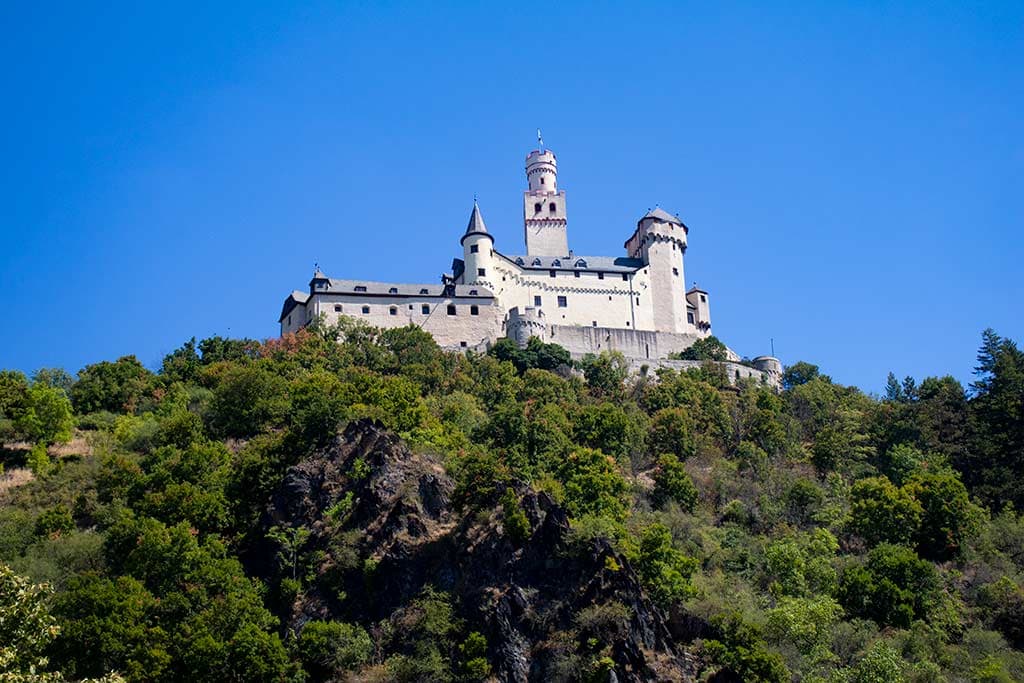

Trier is also within reach of Koblenz, the gateway to the Rhine Valley World Heritage Site. From Koblenz, you’re very close to Braubach, one of the most beautiful Rhine towns, which is below Marksburg Castle, one of the most impressive of all the Rhine River Castles.
See Also: Bacharach Germany – the most beautiful village on the Rhine

In the opposite direction, the Saar Valley is one of the least-explored areas of Germany, one to which we’d love to return. Top of our list is Saarburg, a gorgeous town with a waterfall running through its centre and a fine medieval castle overlooking the river.


We used the capital of Saarland, Saarbrücken, as our first base for our rail trip across Germany to Prague. There are enough things to do in Saarbrücken to keep you busy for a day or so, including one especially captivating Baroque church, the Ludwigskirche.

It’s one of the lesser-known World Heritage Sites in Germany, but I cannot recommend Völklingen Ironworks enough. It’s a completely preserved Ironworks which closed in the 1980s, an incredible place to visit.
Parts of it are used to exhibit art, others are part of the artwork. Some of it is left to nature, and you can climb a network of stairs to the top of the blast furnaces for amazing views over the complex.
What to do in Trier Germany in Winter
Visit Trier’s Christmas Market in the main market square, one of the oldest in Germany, and one of the most atmospheric. Don’t miss seeing the ancient Porta Nigra gate, beautifully lit up in the winter evenings.
A Brief History of Trier
To fully appreciate a visit, it is important to have some historical background information about Trier.


The Treveri Celtic people occupied the area that is now Trier some time in the last centuries before the birth of Christ and establishment of the Roman Empire.
Roman forces led by Julius Caesar subjugated the Treveri, and a settlement, Augusta Treverorum, was inaugurated around 16 BC. The name means ‘City of Augustus among the Treveri’ and the city is believed to be the oldest in Germany.
Trier grew in prominence during the 1st and 2nd centuries AD, becoming capital of the province of Belgica and, later, Gallia Belgica. Many of Trier’s best-known landmarks, including the Porta Nigra gateway, were added during this period.
Trier was the second city after Cologne, then Colonia Agrippina) of the short-lived breakaway Gallic Empire between 271-274 AD. It was also ransacked by the Alemanni soon afterwards.

It was then made a residence of the Western Roman Emperors in 293, a status that was maintained for over a century. This conferred great prestige on the city, and more grand buildings followed, including the Aula Palatina (Basilica of Constantine) and Kaiserthermen (Imperial Baths).

Trier was also the oldest Christian community in what is now Germany, dating back to as early as 270 AD. The first church on the site of Trier Cathedral was also built in the early 4th century AD.
St Helena, mother of the first Emperor to convert to Christianity, Constantine the Great, was an important patron of the Church in Trier, donating significant relics such as the Holy Robe, which would attract pilgrims to Trier centuries later.
As the Roman Empire gradually disintegrated, Trier came under more frequent attacks. The Franks sacked the city four times, and eventually took over until 843.
The city declined in importance, and its population fell from up to 80,000 citizens to around 5,000.

After being incorporated into the Kingdom of Lorraine and then the East Frankish Empire (which would eventually form part of modern Germany), Trier was ransacked by the Vikings in 882 AD.

Trier remained a significant ecclesiastical power, and the relics of the Apostle St Matthias were held in the Abbey dedicated to the saint in the south of the city.
The Archbishops of Trier were one of seven Electors of the Holy Roman Empire, and their interest spread to include territory and castles to the east (Including Burg Maus, in the Rhine Valley).
Baldwin of Luxembourg was one of the most important Archbishops of the Middle Ages, instrumental in the growth of power in the mid-14th century.
Trier was captured several times over the course of the 17th century, and again in 1794 when it was incorporated in to France.
The Prussians then took over in 1814, and four years later one of the most influential people of the following 200 years, a certain K. Marx, was born in the city.
Trier developed as a trading centre and port during the 19th century, and is now the fourth largest city in the Rhineland-Palatinate.

St Helena, mother of Constantine, the first Roman Emperor to convert to Christianity, was a patron of the church, and donated two significant relics, the Holy Robe (worn by Jesus during the crucifixion) and the Holy Nail used on either his feet or one of his hands to keep him on the cross.
The relics are still kept in the Cathedral, much of which dates from the 11th and 12th centuries. The west front, nave and crypt all date from this period.

Parts of Trier Cathedral date from the Baroque period, most notably the West Choir.
The Cathedral is part of the Trier UNESCO World Heritage Site along with the Liebfrauenkirche next door. And along with the Porta Nigra it’s unquestionably one of the best things to do in Trier.
Things to Do In Trier – Final Thoughts

Trier is one of the most underrated cities in Europe.
Trier is more off the beaten path than I expected. We travelled during the summer of 2022 when trains all over the country were packed solid with passengers taking advantage of the €9 monthly ticket. But the trains were less busy around Trier, which made things easier for us.
I had wanted to visit Trier since my school days, and was delighted to get the opportunity a few decades on. It didn’t disappoint in the slightest, and I rate it one of the best places to visit in Germany. As I managed to leave one or two stones unturned, I’ve got an excuse to go back one day.
Here are my complete guides to visiting the famous cathedral in Trier and the UNESCO listed Porta Nigra.
And more guides to help you explore this beautiful part of Germany.
- Beilstein Mosel our favourite village on the Mosel. It is a must see.
- If you like open-air museums, Roscheider Hof should be on your list. It’s amazing.
- Headed further south? We’ve also got tips for Saarbrücken and a unique UNESCO site, Völklingen Ironworks.
Trier is also one of the best border towns in Europe to visit – check out my guide to plenty more around the continent.
For more places to visit in Germany, browse our Germany travel guide

David Angel is a British photographer, writer and historian. He is a European travel expert with over 30 years’ experience exploring Europe. He has a degree in History from Manchester University, and his work is regularly featured in global media including the BBC, Condé Nast Traveler, The Guardian, The Times, and The Sunday Times. David is fluent in French and Welsh, and can also converse in Italian, German, Portuguese, Spanish, Czech and Polish.