


About the author: David Angel is a British photographer, writer and historian with 30+years experience exploring Europe. His work regularly appears in global media including the BBC, Condé Nast Traveler, and The Guardian.
Roscheider Hof is one of the best hidden gems in Germany. It’s an astonishing collection of recreated buildings, restored shops and relics from the region of western Germany around Trier, and nearby Luxembourg and the Lorraine region of North East France.
We rate Freilichtmuseum Roscheider Hof one of the best of its kind that we’ve ever visited.
The many exhibits and buildings help build up close to a complete picture of life in this rural region. If you ever wanted to step back in time 100-150 years, this is as close as you’re likely to get to it.
You’d most likely visit Roscheider Hof if you visit Trier, the German city best known for its many Roman monuments.
My guide to Roscheider Hof gives you a broad overview of the wealth of things to see there, practical information on how to get there, and things to see in the surrounding region.
Why Visit Roscheider Hof Open Air Museum


Roscheider Hof is a rich treasure trove of recent rural German history.
It has possibly the most complete coverage of a region (including western Germany, Luxembourg and the French region of Lorraine) and the widest range of artifacts we have ever seen in such a museum.
There is a beautiful reconstructed country village, with buildings from different places around the Hunsrück region between the Rhine Valley and nearby Trier.


Roscheider Hof also has a vast collection of reconstructed shops, from Trier and towns across the region, which make for a wonderful trip down yesteryear, a must for history lovers.
The Roscheider Hof museum is comparable with some of the best museums of its kind in Europe. These include the superb Ballenberg Swiss Open Air Museum, the wonderful Lychnostatis Open Air Museum in Crete and the St Fagans National Museum of History, near my home city of Cardiff, Wales.
What To See At Roscheider Hof Konz


The Roscheider Hof has two distinct sections – the indoor exhibitions and the reconstructed Hunsrück village a short walk down the hill.
The indoor exhibitions document life in the region in amazing detail. The first room you enter is a collection of vehicles, including the old vintage car (pictured) packed up for a drive somewhere on holiday.


You then continue through a small exhibition on industry and agriculture, which includes a fully recreated science laboratory and century-old farm equipment.
You then head upstairs to what we felt is the best part of the whole Roscheider Hof attraction. You walk along a virtual street of shops from the late 19th to mid-20th centuries, each painstakingly recreated in extraordinary detail.


We loved the exuberant display in the hat shop, and were just as captivated by the clockmaker’s shop and desk, and the 1940-1950s TV repair shop took me back to my childhood in Wales when my neighbour ran a similar shop.


There is also a wonderful old classroom and a kneipe (pub) full of old beer signs and adverts from a bygone age. You eventually reach the end of the indoor part of the exhibition, and head outside towards the village, which is a couple of minutes’ walk down the hill.
The first building you see is a half-timbered chapel in the middle of a field, then you arrive in the Hunsrück village, whose buildings come from various locations across the region.


These include a farmhouse, a general store and post office, a schoolroom, residential houses and a building used as a barracks by local recruits during the Second World War.

There is also a small collection of more industrial buildings, including a goods station from Konz and several outbuildings from elsewhere in the area.
Where Is Roscheider Hof Museum

Roscheider Hof is 3 km (2 miles) up the hill from the town of Konz, in the north-west of the Rhineland-Palatinate region of Germany. Konz is known as the location of the confluence of the Mosel and Saar rivers, and is 9km (6 miles) south-west of Trier.
Roscheider Hof is also just a few miles from the border of the Grand Duchy of Luxembourg.
How To Get To Roscheider Hof

If you’re travelling by public transport from Trier, you can catch the 9 or 89 buses from Trier main station (Trier Hbf).
If you’re travelling by public transport from elsewhere (e.g. Saarbrucken) you’ll need to take the train to Konz station (Konz Bahnhof). Up to three trains an hour – including the RE1 and RB71 – make the journey. It’s around an hour, sometimes more, from Saarbrucken, and less than ten minutes’ journey from Trier.
Buses 9 and 89 then depart from outside Konz station, climbing the hill towards Roscheid. You need to get off the bus at Konz-Seif-Wald-Ring, and Roscheider Hof is a 100-metre walk from there. Turn left at the roundabout just after the bus stop.
Roscheider Hof Tickets

- Adults pay 7 euros each.
- Students and concessions pay 6 euros each.
- Children 6-14 pay 3 euros each.
- Kids under 6 have free entry.
Restaurant At Roscheider Hof

The Wirtshaus Roscheider Hof is located in some of the buildings close to the entrance of the complex, and they also have tables outdoors during the warmer months.
We only had a drink there, but they also have a good selection of schnitzels and steaks and a range of vegetarian options.
Other Things To Do In Trier

There are enough things to do in Trier to warrant a two-day stay, and it makes a great base if you want to explore the ‘SaarLorLux’ (Saarland, Lorraine (France) and Luxembourg region.
Trier was once known as Augusta Treverorum, and was one of the most important cities in the Roman Empire, especially in the 3rd and 4th centuries AD.
A wide range of Roman monuments have survived, including the magnificent Porta Nigra gateway, an amphitheatre and the Kaiserthermen, or Imperial Baths.

Along with Trier Cathedral and the adjacent Church of Our Lady, Trier’s Roman sites comprise a UNESCO World Heritage Site, one of the most extensive in Germany.
There is plenty more to see in Trier, from its lovely main square, the Hauptmarkt, to the birthplace of its most famous son, Karl Marx, and the fine Baroque Abbey of St Matthias the Apostle to the south of the city. Check out my guide to the best churches in Trier for more information.
Places To Visit Near Roscheider Hof And Trier

Trier is the gateway to the Mosel Valley, and some of the picturesque wine towns and villages are within a short drive or train ride of the city.
Cochem is the most popular town on the Mosel, and is best-known for its fairytale Reichsburg Castle and the fascinating Bundesbunker, where a stash of 15 billion deutschmarks were stored during the Cold War in case of the outbreak of nuclear war.
The wine village of Beilstein on the Mosel is a short bus ride or drive from Cochem. It’s a picture-perfect little place, a cluster of half-timbered houses below a ruined medieval castle on the hill above.
It’s especially beautiful in summer when the houses are decorated with flower boxes, and the village is busy with all of its restaurants and wineries open.

Further down the Mosel, a short side trip takes you to the multi-turreted romantic Burg Eltz Castle, and Koblenz is the gateway to the Upper Middle Rhine Valley World Heritage Site.
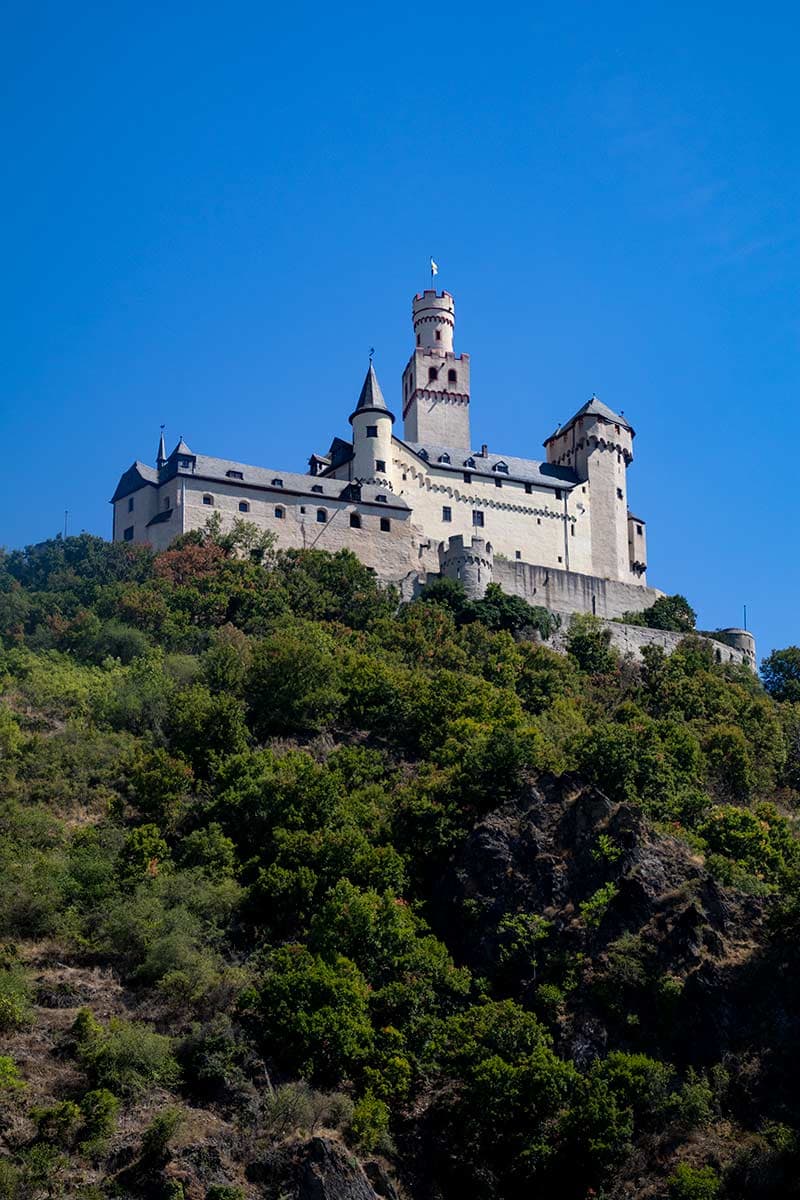
Some of the best Rhine River castles are within a short distance of Koblenz, including Marksburg Castle, which towers above the picturesque small town of Braubach.
If you head up the Saar Valley from Konz, you’ll discover one of the most underrated and unexplored parts of Germany.
The landscape is more forested than the Mosel, and there are some scenic stretches including the Saarschleife, a spectacular view of a U-shaped meander of the river.
The medieval town of Saarburg, a few miles upriver from Konz, is another hidden gem.

The area near the French border is more industrialised, and was once one of the biggest coalfields in Europe. Just before you reach the regional capital, Saarbrucken, you come to Volklingen Ironworks, the only 19th-20th century Ironworks to have survived intact.
It has been a UNESCO World Heritage Site since 1994, and is one of the best off-the-beaten-path World Heritage Sites in Europe.
Where To Stay In Trier
**** – Park Plaza Trier – as central as you can get – a two-minute walk from the Hauptmarkt, the city’s main square
*** – Hotel Aulmann – another great option in the historic centre of Trier, 5-10 minutes walk from most of the main sights
*** – ibis Styles Trier – ever-reliable chain, in beautiful former post office building in the heart of Old Town Trier
Visiting Roscheider Hof Open Air Museum – Final Thoughts
I hope you’ve enjoyed my guide to this extraordinary museum. It’s one of the best open-air museums in Europe, with one of the most exhaustive, complete collections you’re likely to find anywhere. You’ll never get a better glimpse of late 19th and early 20th-century life in rural Germany than this.
For more ideas on places to visit in Germany, take a look at some of the following articles:
- 27 Best Places To Visit In Germany – from Berlin to the Baltic to the Black Forest and much more
- Marksburg Castle – awesome World Heritage Castle on the River Rhine
- Braubach, Germany – one of the most beautiful and romantic towns on the Rhine
- Visiting Nuremberg Toy Museum – one of the best toy museums in the world, and one of the best museums in Germany
- Things To Do In Goslar – stunning World Heritage town made rich by the 1000-year-old Rammelsberg Mine
- Things To Do In Quedlinburg – the World Heritage-listed half-timbered capital of Europe
- Burg Katz – one of the most photogenic of all Rhine Castles
- Rheinstein Castle – perhaps the original Romantic Rhine Castle
- Rheinfels Castle – the largest and most imposing Castle on the Rhine
- Photographing Berlin – 15 Best Places To Photograph In Berlin
- Berlin Landmarks – 21 Top Attractions In Berlin
- Völklingen Ironworks – stunning industrial World Heritage Site near the French border
- One Day In Leipzig – 24 hours in the city of Bach and the Wende

David Angel is a British photographer, writer and historian. He is a European travel expert with over 30 years’ experience exploring Europe. He has a degree in History from Manchester University, and his work is regularly featured in global media including the BBC, Condé Nast Traveler, The Guardian, The Times, and The Sunday Times. David is fluent in French and Welsh, and can also converse in Italian, German, Portuguese, Spanish, Czech and Polish.