


The three main Gothic churches in Nuremberg Altstadt – the old city – are comparable to any in Germany, and indeed, much of Europe.
Nuremberg was the de facto capital of the Holy Roman Empire for over 300 years, and this brought vast wealth to the city.
Much of it is reflected in the rich architecture of Nuremberg Altstadt, its three main churches, and the Imperial Castle, or Kaiserburg.
My guide to the best churches in Nuremberg takes you to these three extraordinary churches, as well as the ancient Imperial Chapel in the Imperial Castle and one of the more recent Nuremberg churches.
I describe what to see inside and how to get to each by public transport – although they are all within walking distance of each other.
Churches in Nuremberg – An Introduction


Between the 13th and 16th centuries, Nuremberg grew in wealth, status and prestige as it was the unofficial capital of the Holy Roman Empire.
Nuremberg Castle, also known as the Kaiserburg, hosted Imperial Diets (a discussion body involving the Emperor and nobility) for over 300 years.
Some of this wealth was invested in local churches within what is now the Altstadt (Old City). You can walk between the three main Nuremberg churches – the Frauenkirche, Sebalduskirche and Lorenzkirche – within ten minutes.


The Gothic period (late 13th through to late 15th centuries) was the heyday for the construction of churches in Nuremberg, with all three major churches built during this period.
The Protestant Reformation quickly won support in Nuremberg, and by 1525 two of the three principal churches in Nuremberg, the Lorenzkirche and Sebalduskirche, had adopted the ideas of Martin Luther. The Frauenkirche remained a Roman Catholic Church.
There is no Nuremberg Cathedral, although the Lorenzkirche and Sebalduskirche are as large and impressive as many a Cathedral in Europe. They both have the status of Basilica and parish church.
See Also: One Day In Nuremberg – See The Best Of The Imperial City In A Day
The following are the best churches to visit in Nuremberg
1. Frauenkirche – Church of Our Lady Nuremberg
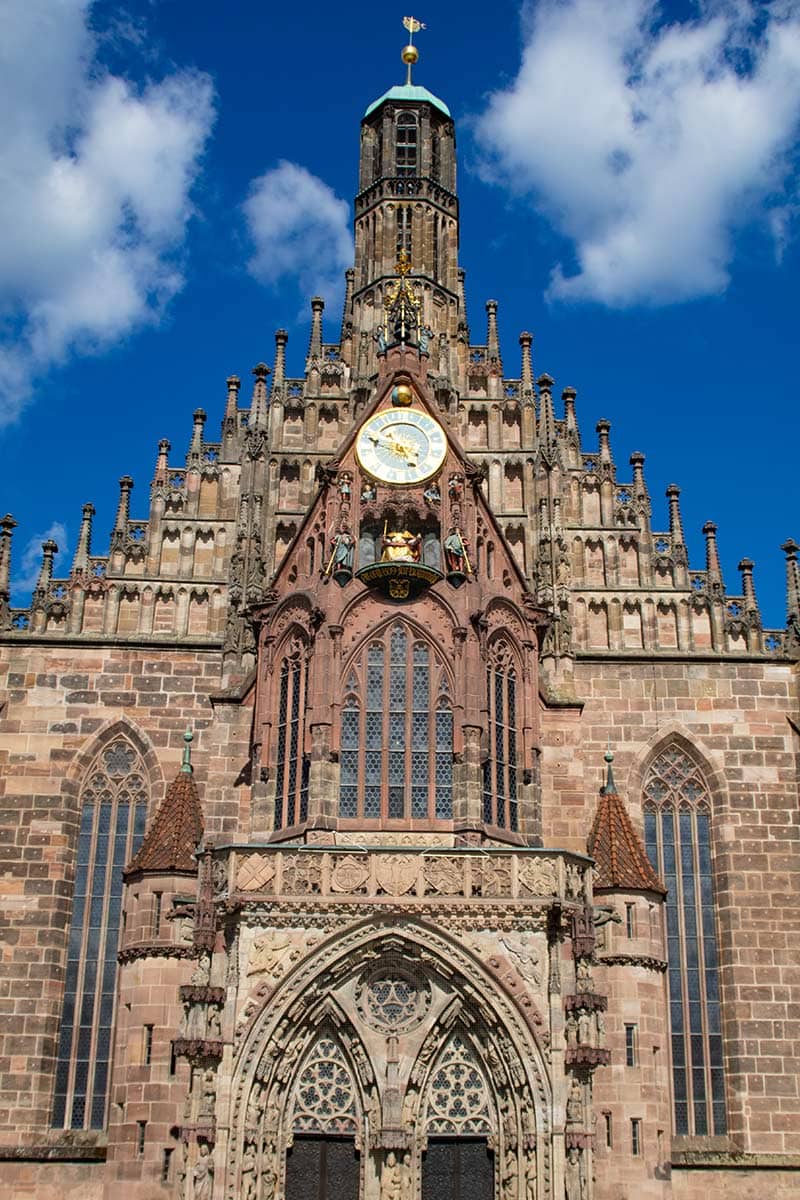
The most recognizable of the churches in Nuremberg, the backdrop for the city’s famous Christmas Market
The Frauenkirche, or Church of Our Lady, will probably be the most familiar church in Nuremberg to readers, as if you’ve ever read an article about the Nuremberg Christmas Markets, you will almost certainly have seen a picture of it.
Nuremberg Frauenkirche dominates the Hauptmarkt, the main square in the Altstadt, and its pinnacled brick Gothic façade reminiscent of churches further to the north in Germany, around the Baltic coast, and to the east in northern Poland.


The church was founded 1355 by Holy Roman Emperor Charles IV, who readers may recognize as builder of the wondrous Charles Bridge and St Vitus Cathedral in Prague and nearby Karlstejn Castle).
It has also been suggested that Charles IV’s favoured architect and stonemason, Peter Parler, may have built the church.

A Star of David in the church serves as a reminder that it is built on the site of a synagogue that was burned down during a pogrom in 1349.
The Frauenkirche is home to artistic treasures including a Tucher altar painting believed to date from 1450, pre-dating the city’s most famous artist, Albrecht Dürer, by several decades. Balcony where Xmas market opened
You’ll also see a balcony on the west front of the church – it is from there that the annual Christkindlesmarkt (Christmas Market) is opened each November.
A great way to see the Frauenkirche and other Nuremberg churches is on a guided walking tour of the Old Town, which covers the central area with the three churches and the Kaiserburg.


Finally, if you’re in the Hauptmarkt square around noon, be sure to watch the clock strike noon, when a parade of figures – Charles IV and the seven electors (Männleinlaufen) accompany the carillon.
Getting there: Buses 36 and 37 pass close by, and the Lorenzkirche U-Bahn (Line U1) is a little over five minutes’ walk away.
See Also: Prague To Nuremberg – 3 Ways To Travel Between These Great European Cities
2. Sebalduskirche – St Sebaldus Church Nuremberg


Soaring Gothic masterpiece and burial place of Nuremberg’s patron saint
For me, the Church of St Sebaldus is the most impressive of the churches in Nuremberg Altstadt. It’s a very short walk away from the Frauenkirche and Hauptmarkt, its twin spires dominant landmarks in Nuremberg.
This superb Gothic church was begun in the 13th century, most likely between 1225 and 1240, and possibly on the site of an earlier church.

It is dedicated to a local saint, Sebaldus or Sebald, who lived in Nuremberg or the surrounding area in the 11th century.
Little is known for certain about him, though miracles have been attributed to him, including walking across the Danube on his cloak and healing the sick.


His shrine, by sculptor Peter Vischer, is located in the chancel of the church, behind the high altar. It took over 30 years to complete, and houses the relics of the saint.
In 1525 the Sebalduskirche authorities and congregation adopted the Lutheran Protestant rite, as did their neighbours in the Lorenzkirche (see below).
Interestingly, the recently-completed shrine was left intact – whereas elsewhere in Europe reformers’ zeal saw to it that many similar monuments were destroyed.
Getting there: Bus 36 runs very close by, otherwise it’s a 10-minute walk from either the Lorenzkirche U1 stop or Wohrder Wiese U2 and U3 stop.
See Also: Trier Cathedral – The Oldest, And One Of The finest, Cathedrals In Germany
3. Lorenzkirche – St Lawrence Church Nuremberg

Grand Gothic Basilica with remarkable art treasures and one of the largest church organs in the world
St Lorenz Nuremberg Basilica is another great almost-twin-spired Nuremberg Gothic church, and it’s to the south of the river Pegnitz on the east side of the Altstadt.
As with many large medieval churches, construction took place in phases over more than 200 years. It is believed to have been started by 1250, though it wasn’t finished until 1477.
Like the nearby Sebalduskirche it adopted Protestant reforms and rites by 1525, but kept much of its pre-reformation artworks and furnishings.
These include the ‘Angel’s Salute’ carving by Nuremberg-based sculptor Veit Stoss, whose work was renowned across Central Europe in the late Middle Ages.


The organ of the Lorenzkirche is one of the largest in the world, with over 12000 pipes. I was fortunate to visit the church when it was being played – the church’s acoustics are amazing.
The church briefly appeared in Leni Riefenstahl’s propaganda opus Triumph of the Will, draped in swastikas. It was severely damaged in the Second World War, and subsequently restored.
Getting there: U1 Lorenzkirche station is across the street from the church.
See Also: Nuremberg Nazi Sites – 7 Fascinating Sites To Explore
4. Elisabethkirche – St Elizabeth Church Nuremberg

The Roman Catholic Elisabethkirche is one of the most prominent churches in Nuremberg, its dome one of the main landmarks of the Altstadt skyline.
This Neoclassical church is much more recent than the other Nuremberg churches we describe. It was built on site of a Gothic chapel linked to hospital of the Deutscher Orden (Teutonic Knights) whose congregation had long since outgrown it.
Work began on the church in the late 18th century, but decades of legal disputes meant that it wasn’t completed until 1905.
The dome is the most impressive feature of the church, and its interior is lined with the figures of the Twelve Apostles. While visiting, it’s also worth checking if the Jakobskirche – St James’ Church – is open on the other side of the square.
Getting there: Weisser Turm U1
5. Imperial Chapel Kaiserburg

Exclusive ancient chapel reserved for the Holy Roman Emperor to worship
The Imperial Chapel was the one part of the Kaiserburg (Imperial Castle) of Nuremberg to survive the Second World War intact.
It is part of a double chapel, and the only part accessible to visitors. Unusually for a Romanesque (most likely 12th or early 13th century) church, where you would normally encounter heavy, thick-set pillars, the overall impression is one of light and spaciousness.
The vault is supported by just four columns, and some of the main features of the Chapel, the altar shrines, have long since been lost.
The wooden figure of Christ on the Cross is believed to be the work of Veit Stoss, the renowned Nuremberg sculptor responsible for the famous altarpiece in the Mariacki church in Krakow, Poland.
The Imperial Chapel can only be visited as part of a self-guided tour of the Kaiserburg, so it’s the only one of our churches in Nuremberg where you need to pay to enter.
See Also: 2 Days In Nuremberg – 48 Hours In The Franconian Capital
Churches in Nuremberg – Final Words
These Nuremberg churches are among the best things to see in the city. Even if you only have one day in Nuremberg I suggest squeezing the three main churches into your packed itinerary and if possible the Imperial Chapel in the Kaiserburg.
Check out more of my articles on Nuremberg, including my guides to the superb Nuremberg Toy Museum and the Nuremberg Nazi Sites in the outskirts of the city.
For more churches in Germany to visit, check out some of these guides:
Frauenkirche Dresden – the rebuilt Baroque beauty in the Florence on the Elbe
Visiting Naumburg Cathedral – outstanding but little-known Cathedral, the bridge between Romanesque and Gothic in Germany
6 Best Churches in Dresden To Visit
9 Best Churches in Berlin To Visit – rare glimpses into the medieval history of the German capital
Visiting Nikolaikirche Leipzig – the church that helped spark a Revolution
Churches in Quedlinburg – World Heritage Romanesque treasures in the town with the most half-timbered houses in Europe

David Angel is a British photographer, writer and historian. He is a European travel expert with over 30 years’ experience exploring Europe. He has a degree in History from Manchester University, and his work is regularly featured in global media including the BBC, Condé Nast Traveler, The Guardian, The Times, and The Sunday Times. David is fluent in French and Welsh, and can also converse in Italian, German, Portuguese, Spanish, Czech and Polish.
Explore more of my articles on Germany here:
- Frauenkirche Dresden – the Baroque jewel of Saxony
- Churches in Dresden – 5 of the most beautiful churches on the Florence of the Elbe
- Churches in Quedlinburg – Romanesque treasures in World Heritage wonderland
- Rhine River Castles – 15 Of The Best Castles In The Rhine Gorge
- Marksburg Castle – one of the most complete medieval castles in Europe
- Burg Katz – picturesque Rhine Castle near the famous Loreley Rock
- Rheinfels Castle – great medieval ruin, the largest of the historic castles along the Rhine
- Rheinstein Castle – the original Romantic Rhine Castle
- Braubach – Stunning Medieval Village below the mighty Marksburg Castle
- Beilstein, Mosel Valley – discover this gorgeous Moselle wine village
- Porta Nigra Trier – amazing ancient Roman gateway that survived thanks to becoming a church
- Roscheider Hof Museum Trier – one of the best folk museums in Europe
- Things To Do In Trier – 26 Things To Do In The Oldest City In Germany
- Völklingen Ironworks – astounding industrial World Heritage Site near the French border
- Things To Do In Saarbrücken – discover the little-known capital of Saarland
- Photographing Berlin – how to capture Germany’s fascinating capital on camera
- Berlin Landmarks – 21 Top Sights To See In Berlin
Interested in churches in Europe? Check out more of my articles on churches here:
- 25 Famous & Beautiful Churches In London
- 22 Famous Churches In Paris – Notre Dame, Sainte Chapelle and many more
- 20 Most Beautiful Churches In Prague – from Romanesque to Modernist and more
- Týn Church Prague – one of the most beautiful Gothic churches in Europe
- Churches in Budapest – Gothic, Baroque and Art Nouveau stunners in the Hungarian capital
- Churches in Vienna – from gigantic Gothic to a suburban Brutalist beauty
- 15 Of The Most Beautiful Churches In Santorini – from caldera sunset spots to countryside chapels
- 14 Most Beautiful Cathedrals and Churches In Venice – from San Marco to hidden backstreet wonders
- Kutná Hora Bone Church – astonishing ossuary with extraordinary decorations fashioned from skulls and bones
- Cathedral of St Barbara Kutná Hora – French High Gothic in eastern Bohemia