


This is my guide to České Budějovice best known for its excellent beer, but it’s also one of the loveliest hidden gems in Central Europe.
České Budějovice is the largest city in South Bohemia, yet it has always managed to slip under the radar. We decided to stay there for a few days, using it as a base to explore the surrounding area, but got much more than we were expecting – one of the most underrated cities in Europe.
The city has always been rather overshadowed by nearby Český Krumlov, where time-poor travellers head, perhaps looking in on the famous Budvar brewery, but little else.
I had once done this myself, back in the early 1990s, so I got a wonderful surprise as I ventured out from our hotel.
České Budějovice is somewhere you could easily spend a day or more, exploring one of the loveliest squares in Europe and the porticoed medieval side streets and pockets of gorgeous old architecture.
It also has several excellent restaurants, and we ate better there than in Český Krumlov.
České Budějovice also makes a more convenient base for exploring the region, as nearly all bus and train routes pass through it.
We’d never suggest missing out on Český Krumlov, but if you’re heading that way, try to make at least a few hours in České Budějovice as well.
České Budějovice – An Introduction


The city was founded in 1265 by Bohemian King Přemysl Otakar II.
České Budějovice is the capital of the South Bohemia region of the Czech Republic.
Its German name is Budweis – and the adjective Budweiser, which will be familiar to many of you, means – of Budweis.
České Budějovice is perhaps best known for its beer, Budweiser Budvar, which is among the most famous and best Czech beers.


Since 1848 it has been the base of the Koh-i-Noor Hardtmuth company which gave the world the first mass-produced pencil made from artificial graphite – this was invented by Josef Hardtmuth in Vienna in 1792.
The city features in one of the most famous Czech novels – The Good Soldier Švejk by Jaroslav Hašek. Švejk always somehow contrives to miss trains to České Budějovice, where he is supposed to meet with his regiment.
Where To Stay In České Budějovice


We recommend the 5-star Grandhotel Zvon, which overlooks the main square. We stayed for 5 nights in the October shoulder season, in a fantastic room with a great view over the square. Check out my Grandhotel Zvon Review for more information.
The 4-star Hotel Budweis is another excellent option, a 5-minute walk away from the main square next to the Malše river. It’s a beautiful old building, which I believe to be an old mill.
Boutique Hotel U Solné brány also has a great location, less than a minute’s walk from the main square and a few metres from the Malše river and Dominican Monastery. They also have one of the best restaurants in the city.
If you prefer to stay in an apartment, Residence U Černé Věže is a great choice. It’s within a couple of minutes of the main square, on the same street as the iconic Black Tower. It’s also on one of the most beautiful streets in the Old Town.
And if you’d prefer somewhere a little closer to the train and bus stations, Hotel Metropol CB is a great 3-star option halfway between the Old Town and the stations.
České Budějovice Tours

This České Budějovice Walking Tour is the best introduction to this fascinating small city.
There is far more emphasis on tours to Český Krumlov than to České Budějovice. Some tours combine the destinations, such as this Český Krumlov tour from Prague, which only gives you half an hour or so in České Budějovice.
Things To Do In České Budějovice
Náměstí Přemysl Otakar II


The best place to begin your České Budějovice visit is the main square, named after the 13th-century Bohemian king who founded the city in 1265.
It’s a splendid, grand square, surrounded by fine townhouses and arcades lined with shops and cafes, and some of the main České Budějovice landmarks.
The best-known České Budějovice hotel,Grandhotel Zvon, dates back to 1533, and occupies several buildings on the east side of the square.

The iconic Samson Fountain dominates the centre of the Square, and it’s especially impressive at dusk as it and the surrounding buildings are lit up.
In November and December the square plays host to the České Budějovice Christmas Market, when an ice rink is laid out around the fountain.
České Budějovice Town Hall

The Radnice – Town Hall – of České Budějovice is a fine Baroque building on the corner of the Square, dating from 1727 to 1730 when it was rebuilt by Italian architect Antonio Edhard Martinelli. The exterior is very striking, with its three spires, coats of arms and superb dragon gargoyles.
It’s also worth going on a guided tour of the interior, especially to see the ceiling frescoes in the opulent ceremonial hall.
The České Budějovice tourist information office is located on the ground floor of the building, and they also have a good selection of brochures and leaflets on the surrounding region.
St Nicholas Cathedral


České Budějovice Cathedral, on the north-east corner of the main square, was initially built soon after city status was granted, but little of the original now survives.
What we see today is the 18th century Baroque reconstruction. Unfortunately it was closed the several days we were in town, but we did gain access to the small domed Baroque chapel pictured at the east end of the Cathedral which hints at what you might expect inside the Cathedral.
Černa Věz – Black Tower


The Black Tower is another prominent České Budějovice sight, rising 72 metres above the corner of the main square.
It’s the place to go for an overview of the square, the rooftops of the old town and the rest of the city, with a great view west over the South Bohemian countryside. It’s also the belltower of the Cathedral across the street.


Getting up there is quite an adventure. My son and I are veterans of many a tower climb, and this had it all, with steep 16th century staircases to scramble up and down. The view from the top is outstanding.
Dominican Church and Monastery


The Dominican Church of the Presentation of the Virgin Mary is one the most picturesque sights in České Budějovice, with the monastery complex backing onto the river Malse.
It’s more imposing from Piaristicke náměstí, its tall, clear Gothic windows dominating the square. Inside, the church is quite austere, save for the medieval wall paintings, the best of which is in the cloister.
The Dominicans remained in the monastery until 1785, after which the Piarists took over some of the buildings. After the Communists took over in the late 1940s, it was used as an Artistic School for children.
Old Town Streets and Arcades

Along with the main square, this is the most impressive aspect of České Budějovice. Several of the streets to the north and west of the main square are delightful, with porticoes between the shops and the roads providing shelter.
There are also some beautifully preserved old houses, some with intricate sgraffito decoration, others with freshened -up facades turned into shops and galleries.
We loved the walk up Panská to the Rabenštejn tower, which houses one of these galleries.
Boat Trips Along The River


The historic core of České Budějovice is situated on what the people of Lyon in France call a presqu’ile, an ‘almost-island’ at the confluence of two rivers, the Malse and Vltava.
There is a gorgeous walk along the shore of Sokolovsky Island, looking across to the Dominican Church, and you can join short boat trips along the Malse, departing from Café Vlnna, or rent boats or paddleboards there.
Iron Maiden Tower and Museum


The riverside Iron Maiden tower is named after an instrument of torture purportedly used there, a cabinet full of iron spikes that would be closed on the victim, causing them to slowly bleed to death.
This medieval tower now houses a small museum dedicated to the founder of the city, King Přemysl Otakar II.
Piaristicke náměstí

This is a wonderful small square close to the river, with the striking Solnice Restaurant, built in a medieval saltworks, on one side and the imposing nave and chancel windows of the Church of the Sacrifice of the Virgin Mary on another.
There are also a couple of cafes (intermittently open when we visited) which would make a wonderful place to pause over a shot of fine coffee for a while.
Masné Krámy Restaurant

The pick of the České Budějovice restaurants is Masné Krámy, in a building used as far back as the 16th century to house the city’s butcher shops.
It’s one of the best places I’ve seen for an introduction to Czech food, with all the classics – svickova, gulas, roast duck with red cabbage – and many fresh takes on Central European cuisine.

Masné Krámy restaurant opened in the 1950s, and is hugely popular – you normally need to reserve a table a day in advance.
Other Budvar restaurants worth seeking out around the city include Maly Pivovar and Budvarka.
Budvar Brewery České Budějovice
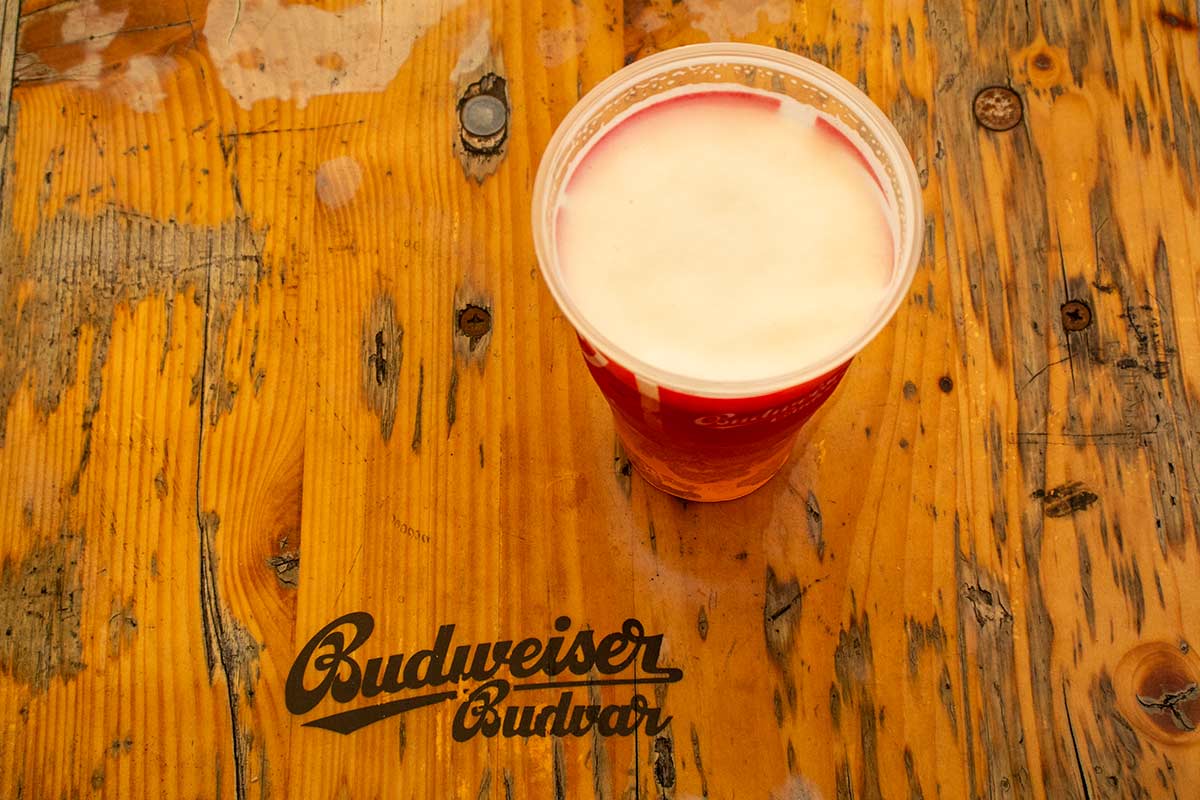

The famous České Budějovice beer, Budvar,is brewed a mile or so north of the city centre, and the Budweiser Budvar brewery tour is one of the most popular things to do in České Budějovice.
The company has been in a legal wrangle with Anheuser Busch, the American brewing giant that also produces a brew called Budweiser, over the rights to use the Budweiser name in various territories around the globe.
Cutting an extremely long story short, the Czech brewery currently uses the Budweiser name in Europe, while the US brew is called Bud there. In the US, the American beer is called Budweiser, while the Czech beer is (somewhat absurdly) called Czechvar.
My take on the whole matter hasn’t changed since I visited the Budvar České Budějovice brewery in the early 1990s – the Czech beer is far and away the superior beer.
South Bohemian Museum

The Museum of South Bohemia is well worth an hour or two of your time if you want to delve deeper into the history of České Budějovice.
The permanent exhibition on the city is complemented by a series of temporary exhibitions, with current examples at the time of writing focusing on seasonal life in the region.
When I visited I was amazed to find a dedicated advice centre for mushroom pickers in the museum building. I had never encountered anything like this before – they can usually tell you if the fungi you have picked is safe for consumption or otherwise.
Where Is České Budějovice


České Budějovice is located in South Bohemia, in the south-west of the Czech Republic.
It is 125 km (77 miles) south of Prague, and 145 km if you drive there along the main motorway routes.
České Budějovice is also situated 25 km (18 miles) north-east of the beautiful medieval World Heritage town of Český Krumlov, which has tended to attract far more visitors than its larger neighbour since tourism opened up in the early 1990s.
Getting to České Budějovice

It’s easy to get to České Budějovice, especially from Prague, with regular trains and buses making the 2 hours 15 minute journey south.
Whichever way you travel from Prague to České Budějovice, costs tend to be similar, around 6 euros per adult one way.
The Prague to České Budějovice train departs frequently from Prague main train station – Praha hlavní nádraží – during some periods as often as every 30 minutes. Check the Czech Railways website for current departure times using Praha hl.n. as your departure point.
The České Budějovice bus service from Prague is operated by RegioJet. these depart from Na Knížeci bus station in Smichov, on the west side of the Vltava River.
Services aren’t quite as frequent as the trains, but they still run almost hourly through the daytime. The final destination for these buses is usually Český Krumlov, the stop after České Budějovice.
Getting Around České Budějovice
The historic town centre, where most České Budějovice hotels are located, is over 1 km west of the railway and bus stations.
It’s around a 15-minute walk to the main square from there, otherwise the small red minibuses 21 and 22 run from outside the bus station to the main square, where they stop twice.
Trolleybuses cover other main routes around the town – the most useful for visitors are 2 and 8, which stop outside the Budvar brewery.
Trips From České Budějovice


We decided on a short break in České Budějovice to use it as a base to explore the South Bohemia region. It’s ideal for this, and as the regional transport hub, makes a better base than Český Krumlov if you’re looking to travel around the area using public transport.
The bottom line is that if you’re heading anywhere from Český Krumlov, you normally have to go back into České Budějovice and change there.
With the exception of Český Krumlov, most places in the region are a fair way off the beaten path.
Take a look at the following section for places to visit near České Budějovice.
České Budějovice – Final Thoughts
České Budějovice was a wonderful surprise for us. I had briefly visited on a day trip from Prague over thirty years before, and only saw the Budvar brewery and glimpsed the main square. I knew there was more to it than this, but just how much was a wonderful surprise.
It has a beautiful historic centre bursting with architectural gems, lovely riverside walks and some of the best beer and food in the Czech Republic. It tends to get overlooked as an option for day trips from Prague, generally getting bypassed in favour of Český Krumlov.
We stayed there for five glorious sunny autumn days, using České Budějovice as a base to explore the region. I heartily recommend doing the same sometime. Check out my Grandhotel Zvon Review if you’re looking for somewhere to stay.
If you’re planning to explore further, check out my guide to the best places to visit in South Bohemia.
Beyond the city, I strongly suggest a visit to Český Krumlov. For an overview of the town, take a look at my guide to the best things to do in Český Krumlov, and the accompanying Český Krumlov Old Town photo guide.
Also check out my Museum Fotoatelier Seidel guide. This extraordinary Museum, in a photographer’s studio in Cesky Krumlov, takes you back to small-town Bohemia in the 1930s, and also into the analogue photographic world of glass plates and film.
We have visited Český Krumlov a few times. Take a look at my article on our most recent visit, to Český Krumlov in Winter. Český Krumlov is magical year-round, but my son and I were blown away by the beauty of Český Krumlov Old Town covered in snow.
České Budějovice is a short bus ride from Hluboka Castle, a fairytale white wedding-cake-style Castle that’s one of the most famous in the Czech Republic.

Also don’t miss Holašovice, an amazing village mainly built in the 18th century. It’s the only one of its kind to have survived intact, 23 farmsteads around a central green. It’s a rare example of the ‘folk Baroque’ style, and is designated as a UNESCO World Heritage Site.
Further afield, check out my guide to Blatna Castle, a stunning water castle with a beautiful Deer Park just across the lake.
And next to the Austrian border, and the former Iron Curtain, take a look at my guide to the breathtaking Renaissance houses of Slavonice. Many houses in this sleepy border town are decorated with stunning detailed sgraffito style. It’s the best collection of such houses anywhere in Europe, and blissfully way off the beaten path.
Please feel free to browse more of these articles for further Czech Republic inspiration:
Top Sights In Prague
55 Amazing Things To Do In Prague – By A Former Local
Charles Bridge Prague – one of the most beautiful bridges in the world
Old Town Square Prague – one of the most beautiful squares in the world
Týn Church Prague – stunning Gothic church with fairytale spires
Landmarks of Prague – 22 unmissable sights in the city
Jewish Prague – all Jewish sites in Prague, including those beyond the Josefov district
Hidden Gems in Prague -27 off the beaten track sights to seek out
How To Visit Prague Zoo – one of the best in Europe
National Museum Prague – the biggest, best Museum in the Czech Republic
- Telč Czech Republic – A Gorgeous UNESCO World Heritage Town
- Kutná Hora Bone Church – the stunning art of the Sedlec Ossuary
- Things To Do In Kutná Hora – World Heritage town that grew rich on silver mining in the Middle Ages
- Czech Republic in Winter – avoid the crowds
- Things To Do In Litoměřice – gorgeous Renaissance and Baroque town on the River Elbe
- Visiting Terezin Concentration Camp – the infamous Theresienstadt Ghetto, the Nazis’ ‘model camp’ for Jews they then murdered in the gas chambers
- Mikulov – A Beautiful Moravian Wine Town Near The Austrian Border
- Mělník – wonderful wine town with castle just north of Prague
- Things To Do In Mariánské Lázně – also known as Marienbad, a splendid Bohemian Spa town